Sunday, February 28, 2010
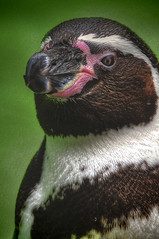
Lincoln zoo to build habitat
Lincoln zoo to build habitat
Lincoln's zoo is one of 16 zoos across the country selected for the penguin program.
The zoo's record of successfully breeding such endangered animals as the tree kangaroo and red panda led to the selection by leaders of the Humboldt Penguin Species Survival Plan, said John Chapo, president and CEO of the Lincoln zoo.
There are only about 25,000 Humboldt penguins, which live on the coasts of Chile and Peru, remaining in the wild. A total of 292 live in U.S. zoos, but last year, only 20 chicks were born at those zoos.
The Lincoln zoo plans to create penguin habitat at the former harbor seal pool. That will reduce the cost of building the habitat by about $1.5 million, Chapo said, adding that $50,000 already has been raised.
The habitat will include expanded viewing areas, an extended rocky beach, a large mural of an ocean view from the coast of Chile, an off-exhibit facility for the penguins and educational space.
For more information, visit www.lincolnzoo.org.
Contact the writer:
444-1067, carol.bicak@owh.com
Source
Saturday, February 27, 2010
Rare Melanistic Penguin

Massive Ice Collision Threatens Penguins
Massive Ice Collision Poses Problems for Penguins
Updated: 1 day 3 hours ago
(Feb. 26) -- An ice shelf twice the size of Greater Los Angeles was sheared off the coast of Antarctica after a 60-mile-long iceberg plowed into it earlier this month, endangering a key breeding area for a famous colony of emperor penguins.
A 965-square-mile tongue of the Mertz Glacier in Australia's Antarctic territory was struck by the berg known as B-9B on Feb. 12 or Feb. 13, breaking off a floating ice island that's more than 1,300 feet thick, according to an Australian-French team of scientists. They have been studying the coastal basin area with satellite photos and a sensor array strung across the sea, and announced the collision today.

That section of the glacier was already considered a "loose tooth" after rifts appeared amid a warming climate in the 1990s, according to the Antarctic Climate and Ecosystems Cooperative Research Center inHobart , Australia.
But it was still protecting the Mertz Glacier polynya, abody of water with a high food concentration for a diverse assortment of birds and marine mammals -- in particular, the emperor penguins that breed there and gained fame as the subjects of the Luc Jacquet film "March of the Penguins."
With most of the glacier moving away, that water will be exposed to strong offshore winds that promote the formation of sea ice, affecting the amount of salt in the water. The "drastic oceanographic changes" expected to take place could have "large consequences" for the penguins, the scientists reported.
Thefuture movement of what are now two giant icebergs could also affect local ocean circulation and alter oxygen levels in a much broader area of water.
A 965-square-mile tongue of the Mertz Glacier in Australia's Antarctic territory was struck by the berg known as B-9B on Feb. 12 or Feb. 13, breaking off a floating ice island that's more than 1,300 feet thick, according to an Australian-French team of scientists. They have been studying the coastal basin area with satellite photos and a sensor array strung across the sea, and announced the collision today.
Getty
Scientists say a huge ice shelf that broke off Antarctica earlier this month could have serious consequences for the area's colony of emperor penguins.
That section of the glacier was already considered a "loose tooth" after rifts appeared amid a warming climate in the 1990s, according to the Antarctic Climate and Ecosystems Cooperative Research Center in
But it was still protecting the Mertz Glacier polynya, a
With most of the glacier moving away, that water will be exposed to strong offshore winds that promote the formation of sea ice, affecting the amount of salt in the water. The "drastic oceanographic changes" expected to take place could have "large consequences" for the penguins, the scientists reported.
The


Friday, February 26, 2010
Thursday, February 25, 2010
Zoo launches fund drive for new exhibit: Humboldt penguins
Zoo launches fund drive for new exhibit: Humboldt penguins
If everything goes right, Lincoln Children's Zoo visitors will get to watch rare Humboldt penguins march or waddle around the old harbor seal area by this summer.


Executive director John Chapo said Thursday the zoo has been approved to get four to six breeding pairs of Humboldt penguins.
First, it needs to raise enough money to remodel the 45,000-gallon freshwater seal pool into penguin habitat.
"Because of our exemplary record of successfully breeding endangered animals ... the leaders of the Humboldt Penguin Species Survival Plan not only approved us to acquire penguins, but instilled an enormous amount of trust in allowing us to acquire the rarest penguin species on Earth," Chapo said in a news release.
The Lincoln zoo is one of 16 in the U.S. chosen to care for the penguins.
Fewer than 25,000 Humboldt penguins live in the wild. Found along the western coast of
Two hundred ninety-two Humboldt penguins live in U.S. zoos, the closest in Wichita, Kan., Chapo said.
Chapo and Jennifer Strand, chairwoman of the zoo's board of directors, say hope the penguins will fill the place in zoo-gers' hearts left by the departure of the harbor seals, the zoo's marquee attraction for the past 20 years.
Toney, the last harbor seal at the zoo, is headed to the
"We have to fill that void," Chapo told the Lancaster County Board at its staff meeting Thursday. "The seals played a very vital role in connecting kids to the zoo."
Chapo and Strand asked county commissioners to approve a $150,000 grant from the Visitors Promotion Fund to help pay for remodeling the seal pool area in the center of the zoo. So far, the zoo has raised $50,000 in private donations.
The total cost of the projct is estimated at $300,000, but the zoo would like to raise more to fund an endowment.
"Building a completely new exhibit and pool from the ground up would cost nearly $2 million," Chapo said. "We felt it was more prudent to utilize the current infrastructure of the seal pool in order to reduce exhibit expenses and make this dream of bringing penguins to Lincoln a reality."
The project would include expanding the public viewing area, building an enclosure for the penguins with a large room for educational opportunities, creating a rocky beach for the penguins and painting a large mural with an image of the ocean off the coast of Chile.
Chapo said the project is on a fast track because, to get the penguins for this summer, they need to start construction by April 1.
Without the penguins, zoo officials fear a lackluster membership and attendance season. Last year, the zoo attracted 170,000 visitors, Chapo said.
The Lancaster County Board voted to refer the grant fund to the committee that oversees the Visitors Promotion Fund, with a recommendation it hold an emergency meeting.
The project received enthusiastic support from the three commissioners at the staff meeting.
"We need to find a way to do this," said Commissioner Larry Hudkins.
The zoo won't have to provide saltwater habitat for the Humboldt penguins, Chapo said, because, unlike harbor seals, they spend about 90 percent of their life on land. The lack of salt water was a key reason for Toney's departure.
County Commissioner Deb Schorr asked if the zoo plans to name the penguins.
Chapo said each will have a color-coded band, and, he said, a name-the-penguins contest is a strong possibility.
He told commissioners the Humboldt penguins already have a nickname -- laughing jackasses.
"For a little bird, they got a big voice," Chapo said.
Source
Penguin 'Tica' dies at aquarium
Penguin 'Tica' dies at aquarium
Wednesday, February 24, 2010
Tuesday, February 23, 2010

Monday, February 22, 2010

Sunday, February 21, 2010
Saturday, February 20, 2010
Image of the Day
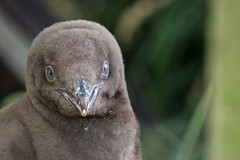
This fluff-ball is a baby Yellow-eyed penguin, endemic to NZ and fairly uncommon. This was taken on the Otago Peninsula.
Latin: Megadyptes antipodes
Maori: Hoiho
Latin: Megadyptes antipodes
Maori: Hoiho
One Traveler's Perspective on Antarctica
Feat in the freezer
February 20, 2010
 Kind of blue ... a king penguin colony on
 My long-time fascination with the exploits of polar explorer Ernest Shackleton led me aboard the MV Plancius on a three-week journey to the
Among the Antarctic hero's greatest achievements on that ill-fated 1915 expedition was an incredible 15-day dash across the Southern Ocean in an open boat with five crew hammered by a hurricane, in constant danger of capsizing. I was keen to see a little of what he saw, not follow in his footsteps. Yet only eight days into my voyage, I, too, find myself tossed around in those same seas off South Georgia in a small open boat in a force-10 gale and a three-metre swell with nine terrified companions.
We land at Cooper Bay after breakfast, in overcast conditions but little wind, to see nesting macaroni penguins and the rare South Georgia pipit, Antarctica's only song bird. We're back on board our Zodiac (an XL-sized rubber ducky) and on our way to another beach to see elephant seals when the sky darkens suddenly and a strong wind blows up. Our driver turns us around quickly and heads back to the ship, anchored a few kilometres offshore, as the storm gathers with frightening and unpredictable speed.
We watch with a mixture of anxiety and admiration as the driver of a Zodiac ahead of us unloads his nervous passengers and - in a desperate acrobatic feat - shoves an aged and rotund passenger on to the ship's landing platform while executing his own reverse flip back into the Zodiac.
By the time we get close to the mothership, the wind has reached 90km/h and we're pitching and rolling too violently to tie up. Two ropes - forward and aft - must secure the Zodiac and the driver can't leave the rudder, which means the forward-most passenger must catch a rope flung seawards by a sailor on the ship. For 90 minutes, 10 of us huddle on the floor of the Zodiac, swamped by waves and lashed by sleet, shakily singing songs as our heroic driver and his fellow Russian sailors on the Plancius attempt to tie us alongside.
The ship changes position three times before we can edge alongside, riding the swell. A young Swiss banker on our boat secures the forward rope. Our driver points to me - at that moment I'm the closest one to the landing platform on the Plancius - and he urges me to leap across as the next wave crests. I clear the one-metre gap the instant before it becomes three metres and climb the ladder shakily.
I turn to see no one has followed. Part of the landing platform broke away as I leapt on to it, forcing the Zodiac back for another circuit in the mixmaster seas, my wife and friends on board. "I remember thinking: 'Thank God, one of us had got off to tell people at home,'" my wife tells me later but at the time I feel incredibly guilty that I'm safe and they're still at sea.
Just as Shackleton had left his main party behind when he set out in the lifeboat James Caird to South Georgia, the storm leaves most of the Plancius's passengers stranded on the beach. Another Zodiac behind us on approach to the Plancius is swamped when it's ordered back to the beach. Several of its passengers are treated for hypothermia, crew members climbing into emergency sleeping bags to share precious
The Plancius weighs anchor and sails to the lee side of an island, positioning itself between the shelter of the winds and the beach where the main party is stranded. All 10 Zodiacs are employed for three hours to ferry about 80 people in calmer waters back to the ship. The tour company's motto has worked: "Hope for the best, prepare for the worst."
We had already missed one highly anticipated landing at Prion Island, where the wandering albatross nests, when the two-day journey from the
Then a pre-breakfast excursion to Stromness, the abandoned whaling station on South Georgia to which Shackleton walked at the end of his historic journey, was cancelled because of force-seven winds.
Some of the "birders", as the loose collection of South African, American and German bird enthusiasts are called, had been agitating for more landings.
We'd had only two landings on South Georgia, the expected highlight of the voyage. Our first landing is at Grytviken, an abandoned whaling station that now serves as the administrative headquarters of South Georgia with a permanent staff of six. This is where Shackleton is buried and it appeals to the histories and the birders. We stand around "the boss's" final resting place with a plastic cup of rum each to pour on his grave.
This cemetery must be one of the few in the world with a white picket fence and gate to keep out the fur seals, creatures that are surprisingly aggressive and unlovable in the wild. Fur seals and mean-looking leopard seals are the only Antarctic creatures that seem to be wary of humans. Giant elephant seals lie about in slothful piles and all breeds of penguins waddle about quite oblivious to delighted human onlookers with their huge lens appendages. Bird and seal co-exist peacefully on land; it's only in the water the penguin is prey.
Our second landing, at
We round Cape Disappointment, so named by Captain Cook when he discovered South Georgia was an island and not the vast southland he sought. And as we near Cooper Bay at the southern tip of South Georgia, the birders are anxious to see the pipit, a small brown bird found nowhere else. Though the forecast had warned of gale-force winds from the east late in the day, the sea is calm when the Plancius anchors. But in the Antarctic, you get what the weather gives. The gale comes in the morning and from the opposite direction.
Two days after the storm, when we sail past the South Orkneys and the cruise director indicates the weather is unsuitable for a landing, there are no dissenters.
A Falkland-South Georgia-Antarctic Peninsula voyage covers a huge distance, a 4000-nautical-mile (7400km) loop from the Argentine port of Ushuaia. In between a dozen scheduled landings, there are many hours on board: playing cards, listening to lectures from experts on wildlife and history, watching for whales, studying birds and icebergs with binoculars.
As we approach 60 degrees south we pass tabular, or table-top, icebergs as big as aircraft carriers, dwarfing the orca and minke whales that occasionally follow the ship. Sunset at 11pm has everyone reaching for their cameras to capture the
We spend a perfect afternoon in a Zodiac cruising through scattered ice floes in Cierva Bay, on the western side of the
Here we find small but unmistakable evidence of glacial retreat. Our driver scoops up an unusual chunk of ice from the sea - crystal-clear with all oxygen crushed from it, like an enormous raw diamond. It's a block of metamorphic ice that for 100,000 years or more had been locked in the vast Antarctic ice shelf, now broken free, gathered up, taken aboard ship, chiselled into bite-size pieces and splashed respectfully with gin and tonic.
In the glistening white and impossibly turquoise landscape of the Antarctic waters, the overwhelming feeling is a sense of intrusion into a vast, still land of monumental physical forces.
Some of the beauty, however, is on a human scale. It is impossible to look at penguins without smiling or ascribing human qualities to them. They have not learnt to fear humans and are endearingly trusting. Visitors to colonies are asked to respect this by maintaining a distance of at least five metres. I add six more species to my penguin repertoire: the impossibly elegant king penguin, the pot-gutted gentoo, the comically angry-looking rockhopper, the little adelie, the flamboyant macaroni and the try-hard chinstrap. Whatever the species, the smell of a penguin colony is uniform - dead possum - and the racket is like thousands of kids blowing through comb and paper.
Source
Friday, February 19, 2010
Thursday, February 18, 2010
Image of the Day
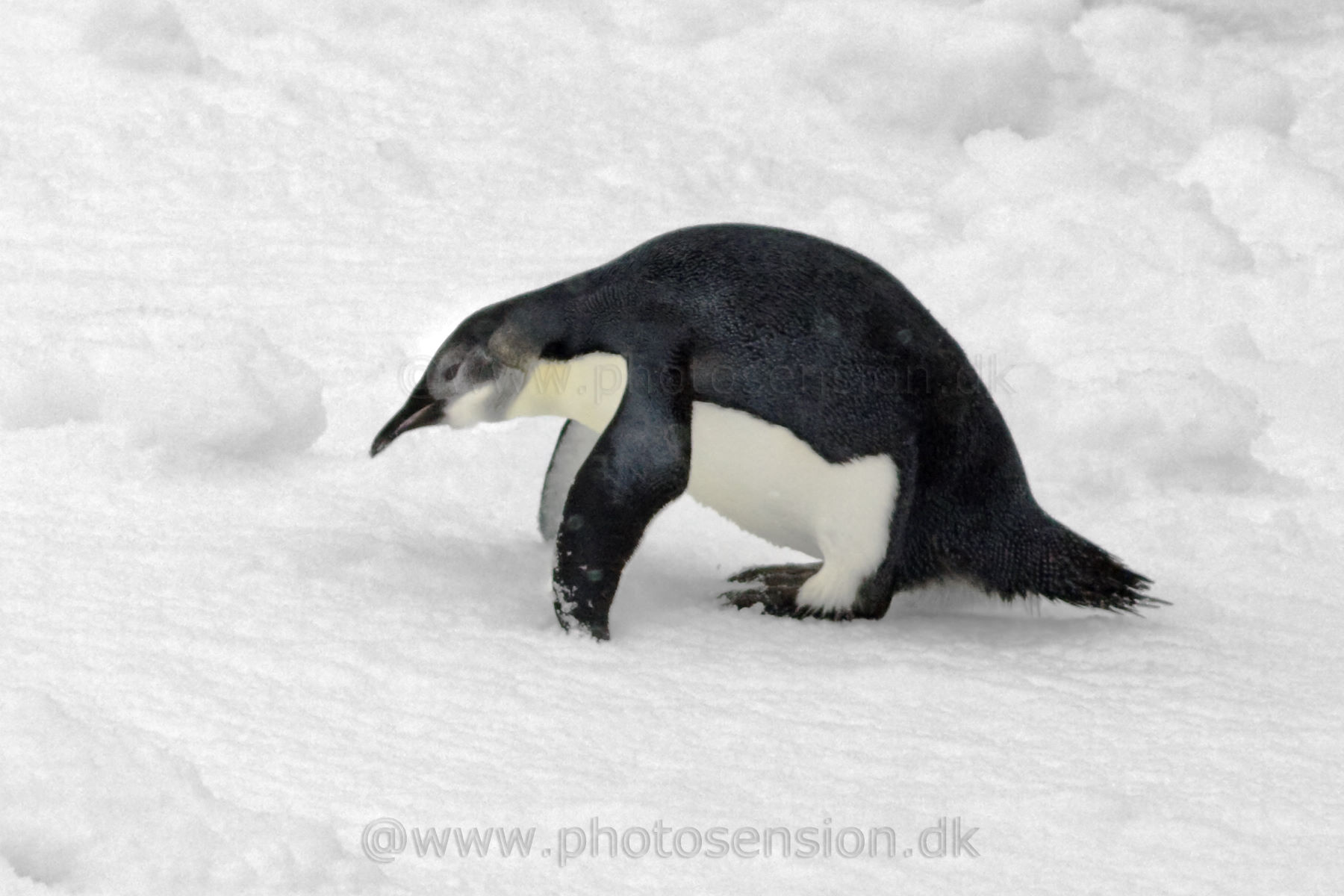
Many thanks goes to the photographer and friend, Allen, for permission to use this picture. Please click on the above link for more demonstrations of his remarkable talent.
~~wiinterrr~~
PS---How I love to see juvenile Emperor penguins. Nothing quite like them at this age. :)
Wednesday, February 17, 2010
4 New King Penguins Debut at Central Park Zoo
Central Park Zoo debuts 4 new King penguins and revamped polar habitat
Originally Published:Wednesday, February 17th 2010, 4:48 PM

Finkelstein for News
The Central Park Zoo's four newest stars, King Penguins, introduce themselves to a neighbor. 
Finkelstein for News
At 30 inches, the Kings tower over the other penguins. Slappy is the largest at 36 pounds. He eats more than 100 capelins a day. "He is definitely the leader," Sailer said. "The other day they were walking, he stopped short and they all ran into him." If all goes well, the Wildlife Conservation Society will start hunting for some lady penguins to join them. "First, let's see how they do," Sailer said. "They are a little young."
Meanwhile, the rest of the penguin crowd is gearing up for an active - and noisy - breeding season. "They are checking each other out and pairing up," Sailer said, as he watched the penguins eyeball each other and squawk. "It gets so loud in here, it's almost unbearable," he said with a laugh.
Source

Tuesday, February 16, 2010
Monday, February 15, 2010

Saturday, February 13, 2010
Images of the Day and South Georgia News

A mystery penguin seen at Hercules Bay is confounding even the experts.
The bird was spotted amongst the macaroni penguin colony by naturalists working as staff on cruise ship “Polar Star”. There was hot debate on board as to what the bird was, some claiming it to be a royal penguin, whilst other said it was surely just an aberrant macaroni.
The bird was said to be slightly larger than the surrounding macaroni penguins with a more massive bill and a white chin and throat, it also has a different pattern to the yellow feathers above the eye. The opinions of two bird experts were sought. One agreed that though the penguin obviously suggested a Royal Penguin, which only breeds at Maquarie Island near New Zealand, and despite the white chin and heavy bill, it was actually not a royal, which have a very distinctive "look and feel" about them; it was a 'white-faced' macaroni, almost certainly a male.
But the other expert begged to differ. He said the bird in the photo was indeed a royal, and reminded us that macaroni and royal penguins were once thought to be the same species. He also said the only way to be sure would be to get a feather sample and have it DNA analysed!
Do you know what the bird is? If you want to join the debate leave a comment on this website and we will pass it on.
Many king penguins are up to moult, and locals are delighted that maybe as many as seven kings are incubating eggs at the newly forming colony at Penguin River. Only three or four pairs have laid here together before.

Source

Vets work to heal penguin
Vets work to heal penguin
Massey University wildlife veterinarians are working hard to heal anThe penguin was observed coming ashore at the end of last month by staff at Penguin Place on Otago Peninsula, who called Dunedin wildlife vet Tony Malthus.
He assessed the penguin and called on Massey's wildlife centre for help when he discovered it had possible severe nerve and tendon damage to its foot. The Department of Conservation (Doc) flew the bird to the centre in Palmerston North last week. Dr Gartrell said the penguin was in danger of contracting a severe infection from the bacteria, sand and grit in its wounds, so staff were flushing them out twice a day and applying antibiotics.
The leg injury appeared to be improving, but it would not return to full function. The penguin was being kept in an air-conditioned room and was regularly sprayed with fresh water. It was being force-fed king salmon and was receiving fluids intravenously.
Doc coastal Otago biodiversity assets programme manager David Agnew said surgery to close the main wound on the penguin's leg, which sustained nerve damage, would be carried out once its condition was stabilised. The penguin's life was no longer in danger, but it was unclear whether it would be able to return to the wild.
Dr Gartrell said while it could be argued the incident was a natural event and humans should not intervene, many penguins also died because of the actions of humans. "This is giving a little bit back. If we had left it alone it would have died a long, slow, agonising death by infection."
The penguins were a relatively endangered species so helping one additional female back into the wild would benefit the population. While Massey had an oil wildlife response unit, the rescue gave staff a chance to learn ways to help penguins injured in an attack, Dr Gartrell said. "We'll need to see it stand and walk before we send it back. If it can't go back to the wild, it'll have to be put to sleep."
Penguin Place owner Howard McGrouther said shark, sea lion or barracuda attacks on yellow-eyed penguins were common at this time of year. "It was very lucky to get away. Not many do." Ninety penguins were treated at Penguin Place's hospital last year.
Source
Penguin recovering
Penguin recovering
Click photo to enlarge

Department of Conservation biodiversity assets programme manager (coastal Otago) David Agnew holds the injured crested penguin before it was transferred to Penguin Place yesterday. Photo by Gregor Richardson .
It was treated in Wanaka on Saturday, and transferred to Dunedin's Doc office yesterday morning for a quick stop, before heading to Penguin Place hospital on the Otago Peninsula to recuperate. Doc South Westland biodiversity ranger
Miss Wilson said Doc usually "let nature take its course", but crested penguins were an important species in decline. She kept the penguin, whose sex and age is unknown, in a bath overnight before it went to Wanaka. The penguin's wound was cleaned at the Wanaka Veterinary Centre, and it was put on a course of antibiotics. She expected it would take about a fortnight to recover.
Miss Wilson said the community's involvement in the penguin rescue was invaluable. The exercise helped raise awareness of a threatened species which breeds in South Westland.
Source
Widowed penguin wooed by two suitors
Widowed penguin wooed by two suitors
 |
| The Sealife Centre penguins |
08 February 2010
AS The newest arrival in the centre's penguin colony is nine-year-old Rosie, a widow of nine months who is looking for new love…and has two handsome young penguin studs to choose from.
Perhaps still mourning the loss of her long-term partner Dougal at her former home the
“We're sure a longing for close companionship will override her sadness very soon now,” said Displays Supervisor Christine Pitcher. “She may also have shown little interest in Ringo and Boomer because at just four-years-old they are only barely sexually mature.”
If one of them does manage to turn Rosie's head, he could very soon find himself fulfilling parental duties.
Rosie has already produced two healthy offspring Kev and Barney, who are still flourishing in Scarborough.
Sadly, the Great Yarmouth colony of Humboldts - one of the world's most endangered penguin species - currently numbers seven, and one of the two brothers is destined to be a gooseberry.
“We're scouring the continent in search of another female to even things up, so whoever loses out shouldn't be disappointed for too long,” said Christine.
SAVE! See this week's Great Yarmouth Mercury for an exclusive half price entry voucher for up to 4 people!
Source
New concern for penguins
New concern for penguins
05 Feb 10 @ 03:49pm by JOHN MORCOMBE
THE Bathers Pavilion at Manly is due to open later this month but the chairman of the Fairlight precinct committee says he can’t get access to the plan of management which outlines how the new restaurant will operate.
Richard Hewitt is also concerned smokers will use the promenade overlooking the harbour - which is a public thoroughfare - and that the little penguins nesting sites nearby will be affected by cigarette butts thrown into the harbour or flicked behind the pavilion. “The plan of management incorporates all the issues that were raised when the development application was approved,” he said. “It’s a key document for policing and liquor licensing. I’m concerned the plan of management has not been thoroughly checked by by council staff and that it has major errors.”
Mr Hewitt said he has been trying for several weeks to view the document “but I’ve got zero response so far”. “It should be a public document and we’d like to see it,” he said. Manly Council general manager Henry Wong said the plan of management was available to anyone who wants to view it.
Mr Hewitt said council staff had thoroughly examined the document and “there some clarifications we need to seek from the applicant before it can be formalised”.
“It’s assessed by us and by the private certifier. If it’s not consistent with the approval, that’s a risk the applicant runs if he doesn’t get it right. It’s not just a council staff issue, the private certifier also has a responsibility.”
Mr Hewitt said the vagueness about where smoking will be allowed leaves the little penguins at risk. “The Manly Independent Assessment Panel (MIAP) required designated smoking areas on the eastern side of the building to stop smokers using the boardwalk or the carpark, but the new plans show a solitary ashtray on the colonnade,” he said. “It’s part of the scenic walkway, so every passerby will share passive smoke. And there’s no barrier to stop butts being thrown into the harbour or smokers sharing their habit with the penguins.”
Source
Supermom and Her 180,000 Charges
 Source: ONE News
 For one
Kerry Barton has been researching in Antarctica for 20 years, playing super mum to the Adelie Penguins who wobble around the remote colony.
"I think you'd have to be dead not to find a penguin colony fascinating," she says.
The research is one of New
Source
KI penguins die after "rescue"

A DEH officer removes the fledglings from the Kangaroo Island Penguin Centre.
KI penguins die after "rescue"
05 Feb, 2010 10:32 AM
Two penguin chicks have died after they were seized by a government officer from the Kangaroo Island Penguin Centre. “It is unforgivable,” said the centre’s owners. The birds were among five penguins removed by the A DEH spokesperson said this week the penguins were in poor health when they were taken from the centre, but this is disputed by Mr Ayliffe, who said the officer who removed them commented on their good condition. Mr Ayliffe believes stress contributed to the penguins’ death. He said after being seized by DEH, they were transported in cat cages from Kangaroo Island to Adelaide Zoo “on a stinking hot day”.
The remaining penguins are still being cared for at the zoo, and DEH said it was not yet known if or when they would be released back into the wild.
Mr Ayliffe and Ms Clapson have been fined $240 for breaching the permit conditions for the birds. DEH now considers the matter closed – but the couple doesn’t agree.
The pair is concerned about what will happen to the remaining birds, and want to meet the DEH to discuss future management of the colony. Meanwhile, the pair is not prepared to risk further fines by rescuing more penguins. “We got a call last week from someone who saw two sick penguins and a dead one in the colony,” Mr Ayliffe. “She was very disturbed, but we couldn’t do anything. If we go and rescue any more the second fine would be massive.”
Source
Fledgling penguin rescued
Fledgling penguin rescued
The Nelson Mail
Last updated 13:00 29/01/2010

MARION VAN DIJK/Nelson Mail
CATCH AND RELEASE: Natureland Zoo's vet nurse, Lynn Cameron with one of the little blue penguins they have cared for in Nelson.
Beach visitors who found the fledgling brought him to nearby Natureland Zoo, where staff took him in under its rescue and release programme for native and seabirds. They fed him on fish, courtesy of NZ King Salmon and Sealord, and on Monday released him back to where he was found. "He looked at us, gave us a wave and headed out to sea," said Natureland operations manager
Another fluffy baby penguin, which had come out of its nest too soon to be able to fish, was found among the flotsam against the seawall by Rocks Rd. He, too, is being looked after until he can survive on his own and will be released by the Sealord Rescue Centre. Three other guests at Natureland are fairy prions, which usually live in the outer islands, especially
Because the seabirds need to go back there, on Wednesday they were booked on an Amaltal fishing boat trip to be released near French Pass.
A shining cuckoo, also nursed back to health after flying into a window at Atawhai, has just been returned to the residents who found it, so it can be released there.
Source
News about Little Penguins (and lots of it)
Penguins rally for comeback
23 Jan, 2010 04:00 AM
AN encouraging number of fairy penguins was recorded at Warrnambool's Middle Island this week, despite a cruel attack on the small colony 10 days ago. Last week environmental workers found three penguin chicks dead and dozens of nests crushed after vandals went on a violent rampage across the island. Warrnambool City Council environmental officer In the world-first initiative, two sisters of the Italian canine breed have been working to keep predatory foxes away from the vulnerable birds. The Maremma s are regularly let loose on the island to mark their scent over the special territory. Mr Williams told The Standard the pair would eventually live on the island for extended periods of time to ensure the penguin's breeding season went uninterrupted. "The dogs are nearing maturity and will spend the majority of their time on the island next breeding season," Mr Williams said.
However, the population of the penguin colony has been put at constant risk as vandals and trespassers ignore the island's restrictive laws. A council bylaw prohibits any access to the island but it seems the message is not getting through. Mr Williams said humans were turning out to be bigger problems than foxes and wild dogs, prompting security cameras to be installed to catch trespassers. "There are CCTV cameras installed in various locations across the island and people face a hefty fine if caught trespassing," he said.
More than 300 law-abiding participants attended the Meet-the-Maremmas summer program earlier this month.
The daily tours gave participants an insight into the life of a Maremma and the importance of the little penguin colony.Mr Williams hoped the tours had educated the public enough to help protect the precious rookery.
Anyone who witnesses suspicious activity on the island should call the council on 5559 4800 or 0417 145 781.
Source
----------------------------------------------------------------------------------------------------------

The plight of the Little Penguins off Narooma
27 Jan, 2010 11:34 AM
IN the last few weeks numerous little (fairy) penguins have been washed up on the beaches around Tuross and Narooma. These are mostly chicks that have left the nest too early. Most of them weigh between 400 and 500 grams and are far too small, weak and exhausted to survive on their own. Peter West a spokesperson for 'Australian Seabird Rescue' said that ASR has been swamped with calls to rescue these little penguins. He said that it is possible that they were forced to leave their burrows before they were ready because their parents were no longer feeding them.However, this is only an educated guess. No one seems to know why this is happening again this year on the far south coast. Trained carers from ASR (www.seabirdrescue.org) are looking after these birds and feed them until they reach a weight, which is more realistic for them to survive. A penguin sitting on the beach during the day is a sick, weak or moulting penguin and should be picked up gently with a towel and placed in a dark box. "Keep it warm and transport it as soon as possible to the local vet or contact the above organization," Mr West said.
If it is a moulting penguin it is quite heavy and fat as it has to live on its stored fat until the moult is over.
This takes generally around 17 days. These penguins cannot go in to water because their old feathers are not watertight. "These birds commonly sit on a beach or under a rock somewhere and they are easy prey for foxes and dogs," Mr West said.
If you come across a penguin or other injured sea or shore bird please ring ASR on 0431 282 238. You may also consider supporting their volunteer work with a donation.
Source
-----------------------------------------------------------------------------------------------------------

BAYWATCH: Maremma man says dogs need human help
27 Jan, 2010 04:00 AM
A CALL to arms to protect Middle Island’s penguin colony has been issued.The godfather of the Maremma project, Allan “Swampy” Marsh, wants to develop a daily surveillance roster of residents to patrol the Stingray Bay precinct. The Dennington egg farmer’s ambitious proposal comes after a string of trespassers and vandals breached the ban on entering the island. “We have an untapped resource here of people who walk along the foreshore,” Mr Marsh said. “We would need a minimum of 10 people a day who could keep an eye on the island for about an hour a time.”
Two weeks ago four penguin chicks were found dead after trespassers trampled nests and smashed security cameras. It was the fourth known attack on the island since the start of the season. Mr Marsh said while foxes and wild dogs were once regarded as the penguins’ primary predator, it seemed “the two-legged foxes” were now the biggest threat.
Source
King Penguins and Fur Seals
King penguins become fast food for Antarctic fur seals
| By Editor, Earth News |

Antarctic fur seals have been filmed catching and eating king penguins in the open ocean, behaviour not seen before.
Catching a king penguin at sea is not easy.
 | KING PENGUINS: FIND OUT MORE   |
Fur seals are also known to prey on king penguins on the shore, a behaviour filmed by the BBC
She and her colleagues Dr Yohan Charbonnier and Dr Jean-Baptiste Thiebot were studying the conservation of penguins, sooty albatrosses and giant petrels around Possession Island, one of five small islands that make up the Crozet archipelago in the southern Indian Ocean.
While located high up on top of a nearby cliff, they witnessed fur seals predating on king penguins below them in the sea on 17 occasions during five days.
Sometimes the penguins escape injured, sometimes they do not
Though all were injured, each made it to the shore. Later the researchers witnessed a fur seal killing and eating a king penguin at sea. "We found that predation on king penguins by Antarctic fur seals is more common and widespread than previously reported," says Dr Delord. "It is too early to assess the impact of such behaviour because our observations need to be quantified on a longer period of time and other colonies of king penguins."
However, as seal numbers increase in the area, they could start to have a greater impact on small populations of king penguins.
| FUR SEALS: FIND OUT MORE  |
Currently, 30,000 pairs of king penguins reside at the largest colony on Possession Island, while less than 500 seals live in the same area.
The fur seals are still recovering, after both species were nearly driven extinct by human hunters at Crozet during the
At nearby Marion Island, where most documented attacks by Antarctic fur seals on shore-bound penguins occur, males, and particularly sub-adults males, are responsible.
Source