Wednesday, October 31, 2012
Tuesday, October 30, 2012
Monday, October 29, 2012
Happy feet make for a happy penguin
ALISON Edmunds isn't your average masseuse. Instead of applying her fingers to tense human necks, her massage therapy is geared to penguins.
''When I tell people that I massage penguins, the response is shock,'' she says.
But, according to Ms Edmunds, the positive effect that massage can have on an animal, just like on a person, is often immediate.

Massaging penguins is a virtually unheard-of practice, but Ms Edmunds - an animal husbandrist at Melbourne Aquarium and qualified remedial masseuse - says physical therapy takes a ''holistic approach'' to healing and is a genuine treatment option.
''These days, we often pop a pill, and we've put that onto our animals,'' she says. ''Massage therapy will care for not only the injured leg, but also the leg that's taking more of the load while the injury is healing,'' she says.
And massages aren't strictly reserved for the penguins at Melbourne Aquarium.
An injured shark was the first to be treated to one of Ms Edmunds' rubs, and the team at the aquarium firmly believe that massage saved the creature's life.
After working with several sharks, and even fish, the aquarium vet suggested Ms Edmunds have a go with a penguin that hadn't responded to pain medication, and whose X-ray came back clear.
''The results spoke for themselves. Not only was the walking behaviour improved, but the social behaviour of the bird improved as well.''
While penguins have evolved to be resilient to ice-related injuries, Ms Edmunds says there is that occasional time a penguin leaps from the water and gets hurt. And that's when it pays to be living at Melbourne Aquarium.
''These penguins have got to be the luckiest birds in captivity!''
source

Sunday, October 28, 2012
Akron zookeeper marches with penguins
By Kathy Antoniotti
Beacon Journal staff writer
Published: October 28, 2012

Vicky Croisant, senior wild animal
keeper, took part in a Humboldt penguin species survival plan management
program in Peru recently. (Mike Cardew/Akron Beacon Journal)
(More Images at bottom of post)
The inquisitive, friendly penguin resides in the most popular exhibit at the zoo and appears to be as curious about visitors as they are about him.
If there were such a thing as a lap penguin, 3-month-old Pedro would be it, said senior wild animal keeper Vicky Croisant, of Akron.
Generally, the birds get excited when she enters the exhibit with a bowlful of capelin, a member of the smelt family of fish. She has tiny scars up and down her arms to prove it.
“When you feed them, its like feeding a kindergarten class,” as the birds vie for her attention, said Croisant, who has been keeper of the endangered South American birds for eight years.
Each penguin has a name and a distinct personality.
In September, Croisant spent two weeks studying the birds in their nesting habitat along the rugged coast of the Pacific Ocean on the 130-acre protected Punta San Juan Reserve in Southern Peru. She and other volunteers monitored local guano miners, called guaneros, as they harvested bird droppings that the native Humboldts use for nesting sites.
It is a symbiotic relationship, Croisant said, as the penguins build their nests by burrowing holes in guano dropped from thousands of cormorants, called guanay, Peruvian pelicans and Peruvian boobies that live near the nutrient-rich ocean shores. The reserve is home to 200,000 to 250,000 cormorants, she said.
As many as 4,000 Humboldt penguins, 5,000 fur seals and 8,000 sea lions live in the walled-off reserve.
Highland farmers have hand harvested the birds’ guano for commercial fertilizer for more than 200 years, said David Barnhardt, director of marketing and guest services at the zoo.
“They would grab the guano from the site with no regard for the penguins, stepping on eggs and destroying the nests,” said Barnhardt.
Today, the product is sustainable inside the reserve by only allowing the guaneros to harvest it every four or five years in order to protect the penguins that nest twice a year.
The Akron Zoo is part of the Humboldt penguin Species Survival Plan through the Association of Zoos and Aquariums. Pedro and the other 18 penguins that currently call the zoo home are why Croisant was afforded the opportunity to participate in a research study of the birds.
Croisant, a zoologist trained at Michigan State University, traveled 4,000 miles by air and bus to spend two weeks living in primitive conditions at the reserve. There was no electricity except when it was produced by a generator from 6 to 9 p.m. each day. With no running water, showers were limited to every other day. Toilets are flushed one bucket of water at a time.
“It was not a vacation by any means,” but still an experience of a lifetime, she said.
The trip was made possible by a $2,500 donation by Pepper Pike residents Kathy and Tom Leiden, owner of Leiden Cabinet Co. in Twinsburg, which manufactures wood fixtures.
The Leidens, who recently returned from an Earthwatch Expedition at the University of Cape Town, South Africa, where they participated in a variety of research activities to monitor the health of the environment of the African penguin, said the birds have long fascinated them.
The couple financially supports a half-dozen projects to benefit the African penguin in Cape Town, said Tom Leiden.
“The penguin is a species that lives in the ocean and on the land. They are a sentinel species,” he said.
“If they are doing poorly, it sends a message of ‘hey, what’s going on with the ocean?’ ”
The couple also supports people they believe will be ambassadors for conservation efforts, such as Croisant.
“My wife and I have always believed in conservation efforts in the wild and education at the adult level,” he said.
To make Croisant’s trip possible, the zoo also provided $6,000 collected from the Wishing Well change in the Komodo Kingdom, and a portion of one percent of admission receipts set aside in a Conservation Fund, said Barnhardt.
During her stay in Peru, Croisant did twice-daily census counts of the Humboldts, sea lions and fur seals that share the beach at the reserve. Daily, she and fellow volunteers noted feeding behaviors and kept track of obvious culprits that may cause the animals to abandon the site.
Her job, and the job of all the employees at the zoo, is to help visitors to understand conservation efforts to help animals survive in the wild.
“It’s why we do tours and penguin feeding, to make that connection,” Barnhardt said.
“If you make that connection with just one person and they want to change the world, then we have done our job,” said Croisant.
The public is invited to feed the zoo’s Humboldt penguins from 11 a.m. to 3 p.m. starting Dec. 1 through Feb. 29 when temperatures are 55 degrees or below. Tickets are $3 and can be purchased at the penguin exhibit.
source

Akron zoo visitor watch as Vicky
Croisant, senior wild animal keeper, feeds the Humboldt penguins in the
enclosure at the Akron Zoo.Croisant, took part in a Humboldt penguin
species survival plan management program in Peru and talked about her
experiences. (Mike Cardew/Akron Beacon Journal)

Vicky Croisant, senior wild animal
keeper, took part in a Humboldt penguin species survival plan management
program in Peru recently. (Mike Cardew/Akron Beacon Journal

A juvenile (left) and an aduit Humboldt
penguin look out of a window of their enclosure at the Akron Zoo. Vicky
Croisant, senior wild animal keeper at the zoo, took part in a Humboldt
penguin species survival plan management program in Peru. (Mike
Cardew/Akron Beacon Journal)

Vicky Croisant, senior wild animal
keeper, plays with a Humboldt penguin as it swims by in its enclosure at
the Akron Zoo. Croisant, took part in a Humboldt penguin species
survival plan management program in Peru and talked about her
experiences. (Mike Cardew/Akron Beacon Journal)

Vicky Croisant, senior wild animal
keeper, sits among the the Humboldt penguin in their enclosure at the
Akron Zoo . Croisant, took part in a Humboldt penguin species survival
plan management program in Peru. (Mike Cardew/Akron Beacon Journal)
Seal Sanctuary p-p-p-picks up a penguin
Falmouth/Penryn
Saturday 27th October 2012
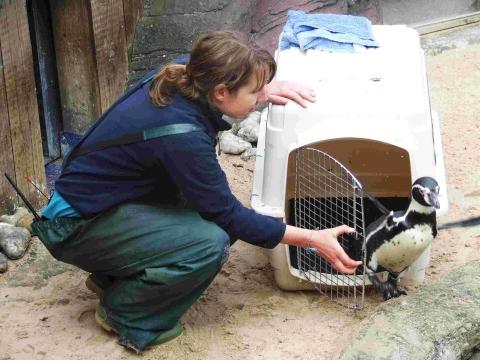
Pine is the newest member of the Humboldt penguin colony
Pine is the newest member of the Humboldt penguin colony and joins the four other comical characters in the Humboldt penguin enclosure.
Pine was born at the Weymouth Sealife Centre, just like all of our penguins, and he was re-homed by the sanctuary last month.
There was much anticipation surrounding Pine’s arrival, with all staff |gathering to see how he would settle in and how Piran, Ivy, Gilbert and Lola would react.
Pine was anxious to escape from his carrier and greet his new family, diving straight into the pool. He hasn’t stopped swimming since.
The other penguins swam straight over to greet him and have accepted Pine well into the group, once Piran let him know who was boss.
Piran and Gilbert are half-brothers to Pine, so it seems only right he should get bossed about by his older brothers.
The Animal Care Team are hoping Pine will take a shine to our cheeky female penguin Lola.
Animal care assistant Jenny said: “Penguins are monogamous, so mate for life, sharing a very strong pair bond.
“Lola has had a tough time of it with a serious operation last year and no attention from other males, so the team are hoping she’ll finally settle down with Pine.”
source
Saturday, October 27, 2012



Friday, October 26, 2012
Antarctic Ocean Petition-Sign to Help Save It!
Help us protect Antarctica’s ocean.

Sign the petition & JOIN THE WATCH
Tell me moreSee Who's Watching!- Find ME on the Map!
Thursday, October 25, 2012
Wednesday, October 24, 2012
Penguin egg at Calgary Zoo a dud
Officials still hopeful for new addition to exhibit
Asa laid the Calgary Zoo’s first penguin egg last month, but on Tuesday zoo officials said it wasn’t successful.
CALGARY
— While the first penguin egg wasn’t successful, the Calgary Zoo says
it’s still holding out hope it will have a new addition to Penguin
Plunge soon.
The egg that king penguin Asa laid Sept. 20 was “ultimately unsuccessful,” zoo officials said Tuesday.
On Saturday, Asa began moving out of the area she’d been staying in since first laying the egg. That’s when the egg fell off her feet and cracked.
“Asa retrieved the egg and again tucked it under her brooding patch but still continued to move toward the pool,” zoo officials said in a statement.
“Moments later she decided to jump into the water, at which point the egg came to rest at the bottom of the pool.”
Zoo staff retrieved the egg, and after examining it, found no sign of development.
“After 30-days incubation it is impossible to say whether or not the egg was ever fertilized, but since there was no development after a month of Asa’s hard work, we know the egg was not viable, possibly because of the male Tut being so young,” said area curator Dr. Malu Celli, in a news release.
Celli said the experience was still a good step toward successful breeding behaviour.
“Asa exhibited all the right behaviours even though her mate was young and inexperienced. We can anticipate that this will be just the first of many penguin eggs at the Calgary Zoo,” Celli said.
source
The egg that king penguin Asa laid Sept. 20 was “ultimately unsuccessful,” zoo officials said Tuesday.
On Saturday, Asa began moving out of the area she’d been staying in since first laying the egg. That’s when the egg fell off her feet and cracked.
“Asa retrieved the egg and again tucked it under her brooding patch but still continued to move toward the pool,” zoo officials said in a statement.
“Moments later she decided to jump into the water, at which point the egg came to rest at the bottom of the pool.”
Zoo staff retrieved the egg, and after examining it, found no sign of development.
“After 30-days incubation it is impossible to say whether or not the egg was ever fertilized, but since there was no development after a month of Asa’s hard work, we know the egg was not viable, possibly because of the male Tut being so young,” said area curator Dr. Malu Celli, in a news release.
Celli said the experience was still a good step toward successful breeding behaviour.
“Asa exhibited all the right behaviours even though her mate was young and inexperienced. We can anticipate that this will be just the first of many penguin eggs at the Calgary Zoo,” Celli said.
source

Tuesday, October 23, 2012
Monday, October 22, 2012
Emperor Penguins
Published: November 2012

Escape Velocity
Awkward on land, emperor penguins soar through the sea. Now scientists have discovered the secret of their speed.
Photograph by Paul Nicklen
Roger Hughes has never seen emperor penguins in the wild.
But when he saw them in a BBC documentary, rocketing through the sea
with trails of bubbles in their wakes, he had an insight that would lead
to a surprising discovery. A marine biologist at Bangor University in
north Wales, Hughes had recently been talking with his wife about the
lubricating properties of new competitive swimsuits. He wondered: Maybe
those bubbles help penguins swim faster.
Over beer in a pub, Hughes bounced his hypothesis off his friend John Davenport, a marine biologist at University College Cork in Ireland. “Roger thought I’d have the answer straightaway,” says Davenport, who studies the relationship between animals’ body structures and their movements. But he didn’t know what the bubbles did for the penguins. It turns out no one else knew either. The two men combed the scientific literature and found that the phenomenon had never even been studied. So they decided to do it themselves.
With the help of Poul Larsen, a mechanical engineer at the Technical University of Denmark, they analyzed hours of underwater footage and discovered that the penguins were doing something that engineers had long tried to do with boats and torpedoes: They were using air as a lubricant to cut drag and increase speed.
When an emperor penguin swims through the water, it is slowed by the friction between its body and the water, keeping its maximum speed somewhere between four and nine feet a second. But in short bursts the penguin can double or even triple its speed by releasing air from its feathers in the form of tiny bubbles. These reduce the density and viscosity of the water around the penguin’s body, cutting drag and enabling the bird to reach speeds that would otherwise be impossible. (As an added benefit, the extra speed helps the penguins avoid predators such as leopard seals.)
The key to this talent is in the penguin’s feathers. Like other birds, emperors have the capacity to fluff their feathers and insulate their bodies with a layer of air. But whereas most birds have rows of feathers with bare skin between them, emperor penguins have a dense, uniform coat of feathers. And because the bases of their feathers include tiny filaments—just 20 microns in diameter, less than half the width of a thin human hair—air is trapped in a fine, downy mesh and released as microbubbles so tiny that they form a lubricating coat on the feather surface.
Though feathers are not an option for ships, technology may finally be catching up with biology. In 2010 a Dutch company started selling systems that lubricate the hulls of container ships with bubbles. Last year Mitsubishi announced that it had designed an air-lubrication system for supertankers. But so far no one has designed anything that can gun past a leopard seal and launch over a wall of sea ice. That’s still proprietary technology.
source
~~~~~~~~~~~~~~~~~~~~~~~~~~~~~~~~~~~~~~~~~~~~~~~~~~~~~~~~~~~~~~~~~~~~~~

Behind the Lens
 Penguins are pretty big. Did you worry one might hit you?
 I
was hit once, quite hard in the head. I was in a safe place—out of
their way—but a penguin went way off course, flew through the air, and
landed on my head. He just casually stood up and walked away. A 70-pound
bird to the head hurts a lot, but I’m lucky I’ve never been injured. I
was also hit by a leopard seal. Its strategy is to fly out of the water
and knock over penguins like bowling pins.
I
was hit once, quite hard in the head. I was in a safe place—out of
their way—but a penguin went way off course, flew through the air, and
landed on my head. He just casually stood up and walked away. A 70-pound
bird to the head hurts a lot, but I’m lucky I’ve never been injured. I
was also hit by a leopard seal. Its strategy is to fly out of the water
and knock over penguins like bowling pins.
How close were you to the penguins in this shot?
I
was about three feet away. My camera was in a [protective] Seacam
housing; they were sending up so much spray and ice it would’ve
destroyed my camera. The noises and thuds when they landed on the ice
were incredible. They knocked the air out of themselves and made a
squeak. We were lucky in that there was really only one opening where
the penguins entered and exited the ocean.
Did you enjoy living with them?
The
first night in camp, the penguins followed me home. They stood outside
and bugled all night. By the third night, I had a hard time sleeping,
and the romanticism began to wane.
source
Over beer in a pub, Hughes bounced his hypothesis off his friend John Davenport, a marine biologist at University College Cork in Ireland. “Roger thought I’d have the answer straightaway,” says Davenport, who studies the relationship between animals’ body structures and their movements. But he didn’t know what the bubbles did for the penguins. It turns out no one else knew either. The two men combed the scientific literature and found that the phenomenon had never even been studied. So they decided to do it themselves.
With the help of Poul Larsen, a mechanical engineer at the Technical University of Denmark, they analyzed hours of underwater footage and discovered that the penguins were doing something that engineers had long tried to do with boats and torpedoes: They were using air as a lubricant to cut drag and increase speed.
When an emperor penguin swims through the water, it is slowed by the friction between its body and the water, keeping its maximum speed somewhere between four and nine feet a second. But in short bursts the penguin can double or even triple its speed by releasing air from its feathers in the form of tiny bubbles. These reduce the density and viscosity of the water around the penguin’s body, cutting drag and enabling the bird to reach speeds that would otherwise be impossible. (As an added benefit, the extra speed helps the penguins avoid predators such as leopard seals.)
The key to this talent is in the penguin’s feathers. Like other birds, emperors have the capacity to fluff their feathers and insulate their bodies with a layer of air. But whereas most birds have rows of feathers with bare skin between them, emperor penguins have a dense, uniform coat of feathers. And because the bases of their feathers include tiny filaments—just 20 microns in diameter, less than half the width of a thin human hair—air is trapped in a fine, downy mesh and released as microbubbles so tiny that they form a lubricating coat on the feather surface.
Though feathers are not an option for ships, technology may finally be catching up with biology. In 2010 a Dutch company started selling systems that lubricate the hulls of container ships with bubbles. Last year Mitsubishi announced that it had designed an air-lubrication system for supertankers. But so far no one has designed anything that can gun past a leopard seal and launch over a wall of sea ice. That’s still proprietary technology.
source
~~~~~~~~~~~~~~~~~~~~~~~~~~~~~~~~~~~~~~~~~~~~~~~~~~~~~~~~~~~~~~~~~~~~~~
Emperor Penguins
Photograph by Dean Gushee
The Moment Paul Nicklen
Shooting Stars
Capturing the flight of emperor penguins in Antarctica is no easy feat.
They rocket around underwater, then explode out of holes in the sea ice
(above). To follow them, Paul Nicklen used polar survival skills he
learned as a child living among the Inuit on Canada’s Baffin Island. He
read the ice and winds, and pressed the shutter even when he lost
feeling in his fingers. Every so often, penguins burst from the water at
this site, where Nicklen lay waiting. “They soared underwater like
fighter jets in a dogfight,” he says. “Then they’d fly out, land, push
down with their bill, and stand up, going back to that slow, waddling
bird. It was a privilege to see.” —Luna Shyr
Behind the Lens
Penguins are pretty big. Did you worry one might hit you?I
was hit once, quite hard in the head. I was in a safe place—out of
their way—but a penguin went way off course, flew through the air, and
landed on my head. He just casually stood up and walked away. A 70-pound
bird to the head hurts a lot, but I’m lucky I’ve never been injured. I
was also hit by a leopard seal. Its strategy is to fly out of the water
and knock over penguins like bowling pins.How close were you to the penguins in this shot?I
was about three feet away. My camera was in a [protective] Seacam
housing; they were sending up so much spray and ice it would’ve
destroyed my camera. The noises and thuds when they landed on the ice
were incredible. They knocked the air out of themselves and made a
squeak. We were lucky in that there was really only one opening where
the penguins entered and exited the ocean.Did you enjoy living with them?The
first night in camp, the penguins followed me home. They stood outside
and bugled all night. By the third night, I had a hard time sleeping,
and the romanticism began to wane.source
Bird Island Diary – Gentoo Breaks The Egg Record
By Jenny James, Zoological Field Assistant (albatrosses) at the BAS Research Station at Bird Island.
Well spring seems to have officially sprung here on Bird Island. We celebrated the spring equinox on September 22nd by making cider with the remnants of our apples (I use the term ‘apple’ in the loosest sense of the word as they have now been in the store room for nearly 6 months).
With spring comes the new breeding season and already Ruth has been monitoring the progress of the northern giant petrel nests in her study area, marking all those with eggs and recording the parents ring numbers. The gentoo penguins have also begun to gather and prepare for the breeding season, building nests out of rocks and any other debris they can find (bits of seal carcass seem to be a firm favourite). Ruth is also monitoring the progress of two of the island’s gentoo colonies, recording the date of the first egg laid and counting the total number of nests when laying is complete. To our great astonishment the first egg this year was seen on 22nd September – a record early start to the gentoo breeding season, six days earlier than the previous record set in 2010!

The gentoo penguins have also started nesting at Maiviken. This year
they have chosen hillocks to the east of the valley and are constructing
their nests from tussac grass instead of the moss they have used on
some of their previous sites in the area. One group is on a very steep
hillside and another smaller group even appears to be trying to nest on
the remains of a snow avalanche.

 The gentoos on the path from the landing beach to their colonies.

Crafty success: Amidst stiffer competition and more entries
than in past years, the South Georgia crafts entered into the Falkland
Island Craft Fair scored well once again. Craft Fair entries were up by
140 this year, having declined in previous years. The Craft Fair took
place in Stanley on September 8th and 9th. In all there were six South
Georgia entries, all entered in the woodwork and metalwork classes, and
between them they gathered a First, a Second, two Thirds and a Highly
Commended. The First was taken by the stunning metalwork king penguin
clock by Alastair Wilson.


Sunday, October 21, 2012
Saturday, October 20, 2012
London Zoo’s most popular penguin survives outbreak of avian malaria


Penguin Beach, the new penguin enclosure at London Zoo opened
26.05.11. Pictured, Ricky the macaroni penguin and keeper meets the
press at the opening.
Peter Apps, Reporter
Friday, October
19, 2012
Six penguins died this summer after contracting malaria from mosquito bites, but Ricky – one of the zoo’s most popular animals – was not affected.
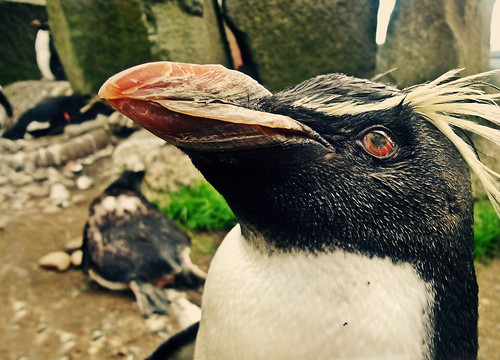
Rockhopper penguin Ricky is one of the most adopted animals at the zoo, thanks to his attention grabbing performances for visitors.
He likes to perch on the high rocks at London Zoo’s penguin beach and pose for photographs, with his distinctive yellow crest making him stand out from the crowd.
The recent avian malaria outbreak was spread by mosquitoes, and cannot be passed between birds.
A zoo spokesman confirmed the outbreak has cleared up, with all penguins given increased doses of anti-malarial medicine and lavender trees planted to ward off mosquitoes.
source
Gay penguin pair becomes parents
October 19, 2012

The
two gay penguins have successfully hatched the little fledgling and are
raising it without trouble (Photo: Ard Joungsma, Odense Zoo)
Apparently,
it’s not only human beings that have scoffed at the traditional
conception of parenting roles in Denmark. The prevailing liberal views
of the country have made a transition to the animal kingdom now as well.
A pair of homosexual emperor penguins at Odense Zoo are now the proud new adoptive parents of a little penguin fledgling following a successful hatching experiment.
The two male penguins, who were broody to the point that they sat on dead herrings due to a lack of an egg, assumed the egg-caring duties after the biological mother discarded her egg.
The female penguin in question had laid two eggs with two different fathers during the breeding period, a rare occurrence in emperor penguins.
She left the father of the first egg to sit on the egg alone, before abandoning the father of the second egg as well, leaving Odense Zoo with a unique problem.
“It’s very rare that female emperor penguins lay two eggs over one breeding season,” Nina Christensen, a zoologist at Odense Zoo, told Ekstra Bladet tabloid. “Normally, they lay two eggs over three seasons, so she is extremely productive. But she just doesn’t want to hatch the eggs or raise the chicks.”
The zookeepers let the gay penguin couple adopt the egg after first giving them a fake egg to practise with during a trial period.
The two males were up to the task because the egg hatched and they are now taking good care of the little fledgling, which appears to be growing normally.
Emperor penguins rely heavily on their partners during the egg-sitting period, during which they place the egg on top of their feet before lowering themselves on top of it to keep it warm. Meanwhile, the other parent is charged with finding food before they switch places.
The solitary male that was first abandoned by the female is raising that egg alone, but can only do so because he is fed by the zoo staff, who now know what to do with abandoned eggs in the future.
A pair of homosexual emperor penguins at Odense Zoo are now the proud new adoptive parents of a little penguin fledgling following a successful hatching experiment.
The two male penguins, who were broody to the point that they sat on dead herrings due to a lack of an egg, assumed the egg-caring duties after the biological mother discarded her egg.
The female penguin in question had laid two eggs with two different fathers during the breeding period, a rare occurrence in emperor penguins.
She left the father of the first egg to sit on the egg alone, before abandoning the father of the second egg as well, leaving Odense Zoo with a unique problem.
“It’s very rare that female emperor penguins lay two eggs over one breeding season,” Nina Christensen, a zoologist at Odense Zoo, told Ekstra Bladet tabloid. “Normally, they lay two eggs over three seasons, so she is extremely productive. But she just doesn’t want to hatch the eggs or raise the chicks.”
The zookeepers let the gay penguin couple adopt the egg after first giving them a fake egg to practise with during a trial period.
The two males were up to the task because the egg hatched and they are now taking good care of the little fledgling, which appears to be growing normally.
Emperor penguins rely heavily on their partners during the egg-sitting period, during which they place the egg on top of their feet before lowering themselves on top of it to keep it warm. Meanwhile, the other parent is charged with finding food before they switch places.
The solitary male that was first abandoned by the female is raising that egg alone, but can only do so because he is fed by the zoo staff, who now know what to do with abandoned eggs in the future.
Watch the launch of the penguins

(c) Paul Nicklen / National Geographic
Preparing to launch from the sea to Antarctic sea ice, an Emperor penguin reaches maximum speed.
You thought "The March of the Penguins" was cool? Check out the launch of the penguins — an aerodynamic phenomenon that helps these flightless birds take flight.
Emperor penguins can't fly just by flapping their wings, but they can propel themselves fast enough through Antarctic waters to turn themselves into winged rockets. They do it by releasing tiny bubbles of air from their feathers: The air acts as a lubricant, reducing drag as they swim up from the depths like tuxedoed torpedoes. In fact, engineers have used air bubbles in similar ways to speed the movement of torpedoes through the water.
Who knew that penguins have been doing the same sort of thing for eons? University College Cork's John Davenport knew: He and his colleagues studied video footage from the BBC's "Blue Planet" TV series to develop a biochemical model for the penguins' torpedo trick. They were amazed to find that the birds' speed was due to the "coat of air bubbles" streaming from their feathers.
The trick is described for scientists in the Marine Ecology Progress Series, and for the rest of us in November's issue of National Geographic magazine. The heart of the magazine story is Paul Nicklen's pictures, which have just won him top honors in the Environment Wildlife Photographer of the Year competition.
"We wanted to change people's perception of penguins as ungainly animals," said Nicklen, who has followed penguins and other polar species for years, and admits he's always had an obsession with Antarctica. "The biologist in me was trying to learn about the science."
And he did learn more about the biological background for the bubble trick: Penguins are preyed upon by leopard seals, which lie in wait beneath the ice to ambush the birds during their ascent from the depths. "The penguins know they're there, and as they're coming up ... it's like someone turns on a tap, and there are millions of microbubbles pouring over their bodies."
The supercharged speed helps the penguins elude their predators and shoot up to safety on the ice, Nicklen said. The masses of bubbles have another defensive effect: They confuse the seals as they try to swim in for the attack. Nicklen himself found out how that feels. When he got too close to the penguins underwater, they released a bubbly barrage.
"It was like I was floating through space, in a sea of bubbles," he said.
The online version of National Geographic's penguin spread will feature a video and interactive graphic showing in detail how the penguins rocket out of the water and onto the ice. Next week, the photographer will unveil an app called "Paul Nicklen: Pole to Pole," with more images. In the meantime, feast your eyes on these images from National Geographic, plus a bonus video:
The penguin images are from the November edition of National Geographic magazine. The electronic versions of the report include an exclusive video and interactive graphic that show penguins rocketing onto the ice.
source


