

Monday, September 30, 2013
Sunday, September 29, 2013
You just put one flipper in front of the other: Cute moment penguin appears to teach his friend how to walk
By
Daily Mail Reporter
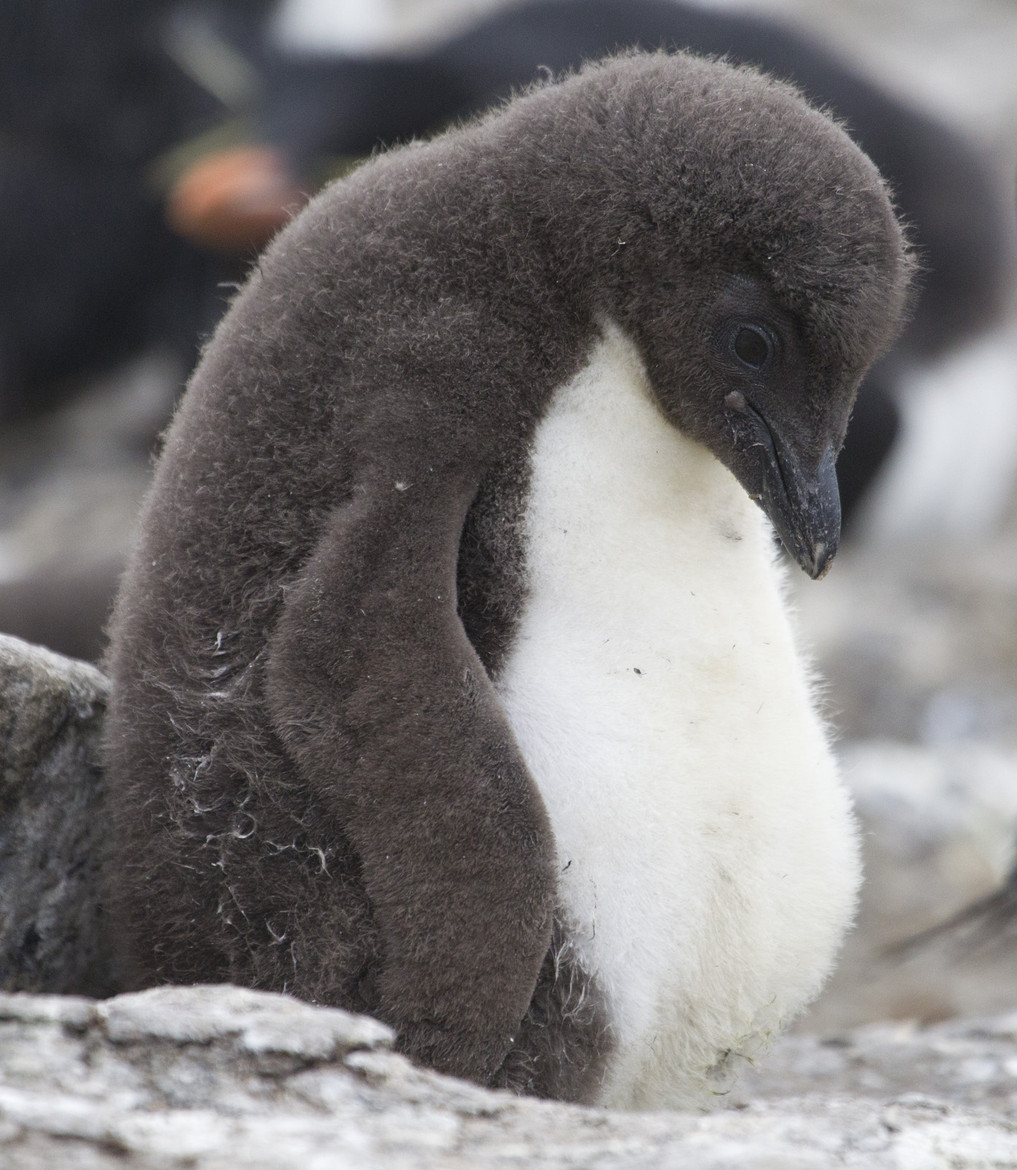
A baby emperor penguin appears to be teaching its friend how to walk in this set of adorable pictures.
Either that, or it thinks it is Usain Bolt as it strikes a pose in the image of the lightning-fast Jamaican sprinter.
Meanwhile, another young penguin argues its case with a friend, gesturing with its wing as if to make a point.


The new-born penguins are simply enjoying a tranquil day in the cold sunshine - because no predators are nearby.
However, one shot has a large crowd huddling close together, hoping to stay warm in each others' company.
Their curiosity entertained wildlife photographer Jan Vermeer, 51, who sat close by watching the action.
Mr Vermeer, from Apeldoorn in the Netherlands, travelled to Snow Hill Island in Antarctica to capture the shots.

He said: 'Fortunately the
penguins are not afraid of humans as they have never seen us before -
it's the most remote place in the world.
"They have no fear but they are curious and, if you wait long enough, they come closer to you.
'Daily life for penguin chicks is not that exciting - as long as they aren't being attacked by any predators.'
The playful penguins have very little to worry about compared to their parents.
They have to find a spot 100km from the open sea in the cold winter to hatch an egg.
Once the summer heat begins melting much of the ice, the sea comes closer so that when they hatch, their babies are ready to dive in.
Jan said: 'Females lay one egg and leave it with their partner before heading out to sea for two months.

'The male emperor penguin holds the single egg on his feet, gently cradled in its brooch pouch to keep the egg from freezing.
'He doesn't eat anything during this period and, when the female returns, they trade off brooding duties.
'Raising a healthy chick in frigid environment like Antarctica is a touch job, requiring the work of two parents.'
Antarctica is not an easy place to travel to and Mr Vermeer pointed out the difficulty he had in making it to the island.
He said: 'It's a tough place to get to because there is only one ship which offers tours here.
'When it's very cold, the ice is too thick and the boat cannot get close enough to the island.
'What they do then is park as close as they can and you travel the rest of the way by helicopeter - but this can get expensive.
'It's worth it though - I think these are the best photos I've ever taken.'
source
A baby emperor penguin appears to be teaching its friend how to walk in this set of adorable pictures.
Either that, or it thinks it is Usain Bolt as it strikes a pose in the image of the lightning-fast Jamaican sprinter.
Meanwhile, another young penguin argues its case with a friend, gesturing with its wing as if to make a point.
Poser: This young emperor penguin seems to think it is Usain Bolt as it mimics the Jamaican sprinter's trademark celebration
Care to dance? Another penguin seems to want engage in a jig with a friend
However, one shot has a large crowd huddling close together, hoping to stay warm in each others' company.
Their curiosity entertained wildlife photographer Jan Vermeer, 51, who sat close by watching the action.
Mr Vermeer, from Apeldoorn in the Netherlands, travelled to Snow Hill Island in Antarctica to capture the shots.
Help is at hand: These two seem to be helping each other cross Antarctica's freezing terrain
"They have no fear but they are curious and, if you wait long enough, they come closer to you.
'Daily life for penguin chicks is not that exciting - as long as they aren't being attacked by any predators.'
The playful penguins have very little to worry about compared to their parents.
They have to find a spot 100km from the open sea in the cold winter to hatch an egg.
Once the summer heat begins melting much of the ice, the sea comes closer so that when they hatch, their babies are ready to dive in.
Jan said: 'Females lay one egg and leave it with their partner before heading out to sea for two months.
Gathering: This large crowd huddle close together, hoping to stay warm in each others' company
'He doesn't eat anything during this period and, when the female returns, they trade off brooding duties.
'Raising a healthy chick in frigid environment like Antarctica is a touch job, requiring the work of two parents.'
Antarctica is not an easy place to travel to and Mr Vermeer pointed out the difficulty he had in making it to the island.
He said: 'It's a tough place to get to because there is only one ship which offers tours here.
'When it's very cold, the ice is too thick and the boat cannot get close enough to the island.
'What they do then is park as close as they can and you travel the rest of the way by helicopeter - but this can get expensive.
'It's worth it though - I think these are the best photos I've ever taken.'
source


Saturday, September 28, 2013
Image of the Day

Emperor penguins and chick at Snow Hill Island, a photo by Exodus Travels - Reset your compass on Flickr.
Rolling Hills Extends Penguin Viewing Hours
 |
||
At Penguin Landing, visitors will learn more about the plight of penguins in the wild and the conservation efforts currently taking place to preserve their future existence. You will also learn what they can do to help wild penguins. Penguin Landing will be on exhibit in the Earl Bane Gallery within the wildlife museum starting April 20th. This 2,000-square-foot space is an ideal location for the exhibit. Because it is indoors, it will always be a comfortable for our visitors - regardless of outdoor climate. The exhibit will also have some great hands-activities that will be fun for everyone including a touch screen computer that allow you to explore the world of penguins, rubbing stations to make your own penguin artwork, a penguin “beach” to play in and build your own penguin habitat, and numerous photo opportunities for the whole family! A docent will be present during exhibit hours to answer questions, provide insight into the life of the penguins, and help monitor and maintain the public exhibit area. A special penguin gift shop will be located right outside the exhibit, so you can be sure to get a souvenir to take home with you. Make plans now to come to Penguin Landing – the penguins will only be here until September 30th!  Historically, penguins have been hunted for their meat, feathers, fat, and eggs. Penguin droppings (guano) were highly valued as garden fertilizer. Layers of clay-like guano, hundreds of feet deep, were removed, depriving temperate penguins of nesting burrows. Penguin populations never fully recovered from these activities. Today there are new threats to penguins, and many species are in danger. While all 18 species of penguins are now legally protected from hunting and egg collecting, at least 10 of the species are still considered “at risk”. Education and awareness programs play a significant role in conservation. Penguin Landing will help the public make a direct connection with these amazing birds and learn more about the threats facing penguins, conservation efforts that are underway, and how they can make a difference. source |

UNCW professor makes studying penguins his life work

Steven Emslie, a professor of biology and marine biology at UNCW,
and former undergraduate student Chelsea McDougall, excavate
ornithogenic sediments (or bird soil) on Ardley Island in the Antarctic
Peninsula. Photo Courtesy Dr. Steve Emslie
Published: Friday, September 27, 2013
Taking care not to face-plant on glacial ice floes, digging
through debris from polar birds' nests, dodging painful smacks from
Adelie penguin flippers - all in a day's work for Steve Emslie, a
biology and marine biology professor at the University of North Carolina
Wilmington.
"They're really strongly
tied to their nest site, and even if you're a lot bigger than them, they
will still charge at you and whack you with their flippers," he said.
"It's like taking a ruler sideways and hitting it against your shin.
They pack a powerful punch for a little bird."
After
spending nearly 20 years researching the penguins, Emslie is familiar
with the unique hazards of his work. Since the early 1990s, he's
traveled throughout Antarctica excavating penguin nests and analyzing
the remains, hoping to uncover details about the breeding and feeding
habits of past and present bird colonies. Adelie penguins - much smaller
than emperor penguins, with white stomachs and black heads and flippers
- nest in the same location each year, leaving a well-preserved trove
of organic matter that dates back centuries.
"It
leads to an accumulation of sediments, pebbles, organic debris, guano,
feathers, eggshell, bone and remains of chicks that don't make it,"
Emslie said. "It's like a freezer. They stay there forever. So what you
get is a natural archive of tissues and remains that can date back
hundreds to thousands of years."
Traveling
around the continent, Emslie began by studying the distribution history
of the Adelie, the most abundant penguin in the Antarctic.
"I
looked at where they've been, where they are now and how that might
relate to climate factors," he said. "They require a lot of things -
open-water access to their nesting sites, ice-free terrain and pebbles,
nearby food sources - so they're a good indicator species for all those
factors in the marine environment."
If,
for example, Emslie finds the remains of a colony that existed 5,000
years ago, he knows definitively that those same conditions existed back
then. Emslie - working with undergraduate and graduate student
researchers - uses radiocarbon dating to confirm the age of remains,
which go back as least as far as 40,000 years.
"With that kind of record, we can ask more complex questions and put together a really nice story," he said.
For
example, researchers about five years ago analyzed tissue samples to
explore shifts in the penguins' diet as it relates changes in climate
and other factors.
"We
found that their diet didn't really change for most of that 40,000-year
record, until the last few hundred years," he said. "Then we found a
distinct drop in carbon and nitrogen, indicating their diet switched
from primarily fish to primarily krill."
That
finding fit a previous hypothesis, suggesting that krill populations
skyrocketed after whalers and sealers in the 1700s removed many
krill-eating marine mammals from the southern ocean. The switch isn't
bad for the penguins, Emslie said - krill swim in large swarms and are
simply easier to catch than individual fish - but it does show how the
birds adapt to changes in their environment.
"It
has implications in terms of what might happen next," he said. "The
krill is starting to run out, which means less for penguins overall. In
the Antarctic peninsula, Adelie penguins are declining, and I suspect in
the future they may disappear from that region. Their populations are
definitely being impacted."
Friday, September 27, 2013

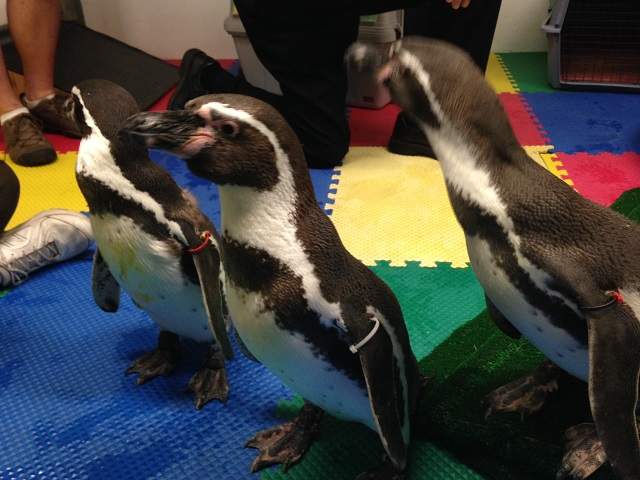
Penguins arrive at the Kansas City Zoo
Posted: 09/26/2013 By: Lindsay Shively
Kansas
City, Mo. - Three Humboldt penguins are the first of a few dozen to ham
it up for the camera, getting ready for the Kansas City Zoo's new
penguin exhibit.
Zoo Director Randy Wisthoff said attendance at the zoo has continued to break records since Nikita the polar bear came in 2010. But with the addition of the penguins, attendance could push one million visitors this year. Before Nikita, attendance hovered around 500,000.
The penguins mark the first major use of money from the zoo tax passed in 2011 by Jackson and Clay County voters.
Zoo officials picked up the penguins from the Sedgwick County Zoo on Thursday morning and let the media get an up-close look Thursday evening.
Zoo Director Randy Wisthoff said attendance at the zoo has continued to break records since Nikita the polar bear came in 2010. But with the addition of the penguins, attendance could push one million visitors this year. Before Nikita, attendance hovered around 500,000.
The penguins mark the first major use of money from the zoo tax passed in 2011 by Jackson and Clay County voters.
Zoo officials picked up the penguins from the Sedgwick County Zoo on Thursday morning and let the media get an up-close look Thursday evening.
source




5 Baby Penguins Learning How To Swim
It’s back to school for penguins too.
The five baby Humboldt penguins at Chester Zoo are off to school.

Chester Zoo
They’re learning how to swim, hunt and feed in water.

Chester Zoo
The Doctor, Dalek, Tardis and Gallifrey are all five months old. Sonic is three months old.

Chester Zoo
In case it’s not clear, they’re all named after icons from Doctor Who.
Lead keeper Anne Morris said: “The chicks, which are the penguin equivalent of toddlers, have settled into our penguin crèche really well indeed.”

Chester Zoo
Keeper Karen Neech added, “Dalek, Tardis and Gallifrey are showing a great appetite for learning but The Doctor is of course top of the class.”

Chester Zoo
“Sonic is a little further behind the others but given a few more lessons, we’re sure he’ll catch up.”
source
source
Thursday, September 26, 2013
Wednesday, September 25, 2013

Tuesday, September 24, 2013
Chester Zoo’s adorable class of 2013 starts penguin crèche

With children across the country back at school after the summer break, some of the zoo’s youngsters have also just started at its crèche.
The five Humboldt penguins, born in spring, have moved into a nursery pool where they will learn how to swim, hunt and feed in water.
‘The chicks, which are the penguin equivalent of toddlers, have settled into our penguin crèche really well indeed,’ explained lead keeper Anne Morris.

She added: ’It’s all part of their education and really helps to build up their confidence.
‘All five of the chicks are coming along nicely and it shouldn’t be too long until they all “graduate” and join the rest of the colony in our main pool.’

Chester Zoo funds conservation initiatives in the penguins’ homeland to help them in their natural habitat.
source
A dedicated follower of penguins

Internationally renowned New Zealand wildlife photographer
Tui De Roy with the book on penguins she has co-authored.
Photo by Craig Baxter.
During the production of her latest book, Penguins Their World, Their Ways, co-authored with Mark Jones and Julie Cornthwaite, she made an exception, visiting Otago Peninsula to photograph the yellow-eyed penguin.
Ms De Roy (59) and her co-authors were in Dunedin this week to talk to the Dunedin Photographic Society.
The book was a sister to an earlier one on albatrosses and together marked the end of a 15-year project for the trio.
It was during the work for the latest book that she fell in love - with emperor penguins.
She travelled to the Antarctic with the Australian Antarctic programme and was able to spend three days photographing the penguins.
''It's very much the end of the earth. I was very lucky.
''The space, the immensity, the soft light and they were such stately birds. It was very other-worldly.''
Her dream was to spend one year in Antarctic photographing the penguins' life for another book.
Such an endeavour was not that outrageous for the woman who has been photographing wildlife in remote places for many decades - including the Galapagos Islands, where she used to live - and who has produced six books in the past eight years.
Another highlight was photographing the ''outrageous'' looking northern rockhopper penguins, as their remote location meant they were not often seen by people.
In contrast, she also spent four weeks camping in the Falkland Islands among four different species of penguins.
Her work required much time and the ability to be able to immerse herself in the environment, she said.
With the book out, she planned to take some time out before planning her next project.
source

Monday, September 23, 2013


Sunday, September 22, 2013
Bloomfield Hills couple donates $10 million for penguin house at Detroit Zoo


Stephen Polk has a fascination with penguins.
“First and foremost, you can watch them for hours,” he said. “When you look at their ability to survive in the Antarctic, I just think they’re amazing creatures. But their whole world is changing … they’re vulnerable now.”
Polk and his wife, Bobbi, are donating $10 million toward the development of The Polk Family Penguin Conservation Center at the Detroit Zoo. It will replace the existing penguin house that was built in 1967.
“This project and the Polk’s generous support will be truly transformational for the zoo and for our community,” Detroit Zoo Executive Director Ron Kagan said in a statement Wednesday. “We are thrilled to be able to move forward with our plans for an amazing place for our penguins that is centered on conservation and will be an extraordinary and unique experience for our guests.”
Polk, who lives in Bloomfield Hills, is the former chairman and CEO of the R.L. Polk Company and vice chair of the Detroit Zoological Society board. He traveled with Kagan to Antarctica earlier this year.
Part of the design for the new penguin house will capture the harsh elements of Antarctica. The facility will feature 4-D effects, such as arctic blasts, rough waves and snow, and include other physical elements such as ice crevasses. The entry plaza will include a water feature that will be a splash area in the summer and skating rink in the winter.
Polk has a bachelor of science in biology and met his wife at Northern Michigan University in Marquette. He was attending graduate school and she was earning a nursing degree. They both enjoy cold weather, and they both love nature — especially when it comes to the zoo.
“Bobbi won’t go into the reptile house, but lemurs are always high on the list,” he said about their favorite attractions. “She loves the giraffes.”
The Polks have been supporters of the zoo for over three decades. Stephen Polk said he admires how Kagan looks out for the welfare of the animals — such as when he decided several years ago to move the elephants to another zoo so they would have more space to roam.
“The zoo is very conscious of animal welfare,” Polk said. “Some animals are stimulated in a positive way from interaction with people, and these exhibits are laid out with the human experience in mind. But everything is done to create a positive environment for the animals.”
The new penguin house will be a 24,000-square-foot facility and house up to 80 penguins. Visitors will have a front-row seat as the birds dive and soar through a chilled 310,000-gallon, 25-foot-deep aquatic area.
That feature will allow visitors to see penguins as they deep-water dive — something than cannot be seen anywhere else, not even in nature.
It will be built on a 2.1-acre site near the entrance and open in 2015. Kagan said he anticipates the exhibit, which will cost about $21 million, will draw an additional 100,000 visitors to the zoo and have an economic impact of more than $3 million per year. Still undetermined is how the zoo will use the existing penguin house.
Polk expects the new exhibit will entertain visitors and serve as a teaching tool in terms of how climate change is affecting the Antarctic. He anticipates it will be the finest penguin exhibit in the world.
“I think the zoo has positioned itself so well,” he said. “We’re getting support from the tri-county area and it’s one of the best attended exhibits in state. It is an enormous asset in southeast Michigan.”
source
Kansas City Zoo's penguin exhibit opening nears
Posted Sept. 19, 2013
Independence, Mo.
By Jeff Fox
The penguins are coming to the Kansas City Zoo in a matter of weeks – and maybe, maybe a baby polar bear is too.
By Jeff Fox
The penguins are coming to the Kansas City Zoo in a matter of weeks – and maybe, maybe a baby polar bear is too.
The zoo’s $15 million penguin exhibit is scheduled to open in late October. The 18,000-square-foot indoor-and-outdoor exhibit will have four kinds of penguins – warm-water and cold-water species – that can be seen on land and in the water. Among them will be the well known king penguin. Three smaller aquariums indoors will show moon jellies, schooling fish and an artificial coral reef.
“You ... will have the opportunity to see penguins both above and below water,” Laura Berger, the zoo’s development director, said at Thursday’s Blue Springs Chamber of Commerce monthly luncheon.
With the penguins on the way, the zoo has saved the last of its popular free-admission days for Dec. 30, a day when the exhibit will be open and kids will be out of school.
The penguin exhibit was among the promises made when the zoo went to the voters of Jackson and Clay counties in 2011 for a one-eighth-cent sales tax for continued improvements. It passed. The free-admission days – four a year – for residents of those counties was part of the deal, too.

Saturday, September 21, 2013

Researchers count on boosting little penguin knowledge
Posted

Land animals which prey on little penguins will also
be a focus for researchers this year's annual penguin census on Kangaroo
Island.
Last year, about 960 breeding adult penguins were counted, compared with more than 1,300 the year before.
There is no definite conclusion as to why numbers are dropping but Martine Kinloch from Natural Resources Kangaroo Island says a count alone would be unable to answer that.
"But the work that Flinders University is doing ... as well as the large research program that SARDI [the South Australian Research and Development Institute] Aquatic Sciences has got running at the moment, that's going to be able to assist a lot more in determining causes," she said.
She says for the first time, staff will also be doing multiple counts at the same colony.
"So that's going to allow us to investigate whether or not there are any shifts in the peak of the breeding season and whether or not doing the census at slightly different times makes any big difference to the estimate that you get," she said.
"So that will give us some idea of how confident we can be in the estimates we've gathered so far."
source
Penguin Point population at Akron Zoo expands by two
Beacon Journal staff report

Bisnieto (bottom) and Regalo, the two
Humboldt penguins that were recently born at the Akron Zoo, enjoy the
warm weather in the Penguin Point exhibit. They are two of the 13 chicks
born at the zoo since the exhibit opened in 2003 and their names, which
are Spanish, respectively mean great-grandson and gift. (Ed Suba
Jr./Akron Beacon Journal)
The Akron Zoo’s endangered Humboldt penguins have
welcomed two chicks into their Penguin Point exhibit, increasing the
penguin population at the zoo to 23 birds.
Bisnieto and Regalo, born June 8 and June 11, respectively, are the chicks of first-time penguin parents, Zulimar, 4, and Nina, 2.
Thirteen chicks have been born at the Akron Zoo since Penguin Point opened in 2003.
The endangered chicks have been reared by their great-grandparents, Tweedle and Una, who are more experienced in chick rearing than their young and inexperienced parents to ensure successful hatching of the eggs.
The newborns, who have stayed inside their burrow since they were born, are now on exhibit at Penguin Point.
Bisnieto, which means “great-grandson” and Regalo, which means “gift” in Spanish weigh about 7 pounds and are about 16 inches tall. When fully grown, they will weigh about 8 to 12 pounds and stand 17 to 22 inches.
Unlike their Antarctic relatives, Humboldt penguins are a warm-climate species found in coastal areas of Peru and Chile. They are endangered, primarily because of commercial harvesting of guano for agricultural fertilizer.
Without nesting locations, Humboldt penguins are is serious danger of extinction. Some estimates indicate the possibility of extinction in the wild in the next 10 years.


source
Bisnieto and Regalo, born June 8 and June 11, respectively, are the chicks of first-time penguin parents, Zulimar, 4, and Nina, 2.
Thirteen chicks have been born at the Akron Zoo since Penguin Point opened in 2003.
The endangered chicks have been reared by their great-grandparents, Tweedle and Una, who are more experienced in chick rearing than their young and inexperienced parents to ensure successful hatching of the eggs.
The newborns, who have stayed inside their burrow since they were born, are now on exhibit at Penguin Point.
Bisnieto, which means “great-grandson” and Regalo, which means “gift” in Spanish weigh about 7 pounds and are about 16 inches tall. When fully grown, they will weigh about 8 to 12 pounds and stand 17 to 22 inches.
Unlike their Antarctic relatives, Humboldt penguins are a warm-climate species found in coastal areas of Peru and Chile. They are endangered, primarily because of commercial harvesting of guano for agricultural fertilizer.
Without nesting locations, Humboldt penguins are is serious danger of extinction. Some estimates indicate the possibility of extinction in the wild in the next 10 years.
source

