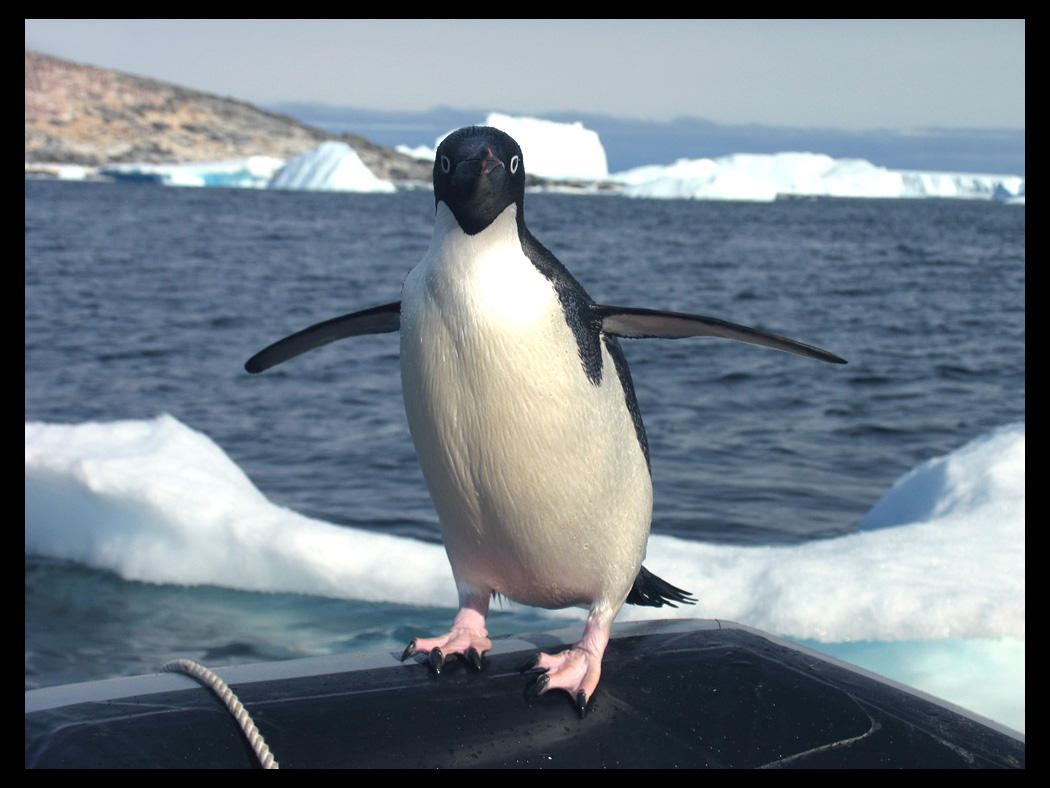
Friday, 31 October 2014, Press Release: Hollyford Track Guided Walks
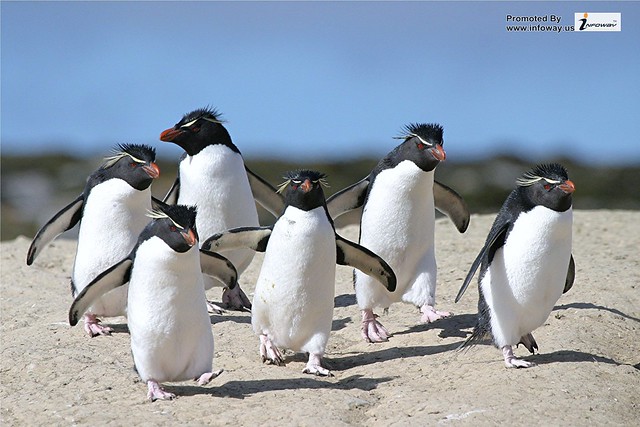
A waddle of
Fiordland Crested Penguins spotted by
staff
Media Release from Hollyford Track
Guided Walks November 30
2014
Rare Fiordland penguins delight
first walkers of the season on Hollyford
Track
Hollyford Track Guided Walks, owned and
operated by Ngāi Tahu Tourism, has opened for the summer
season and early walkers on the track have been rewarded
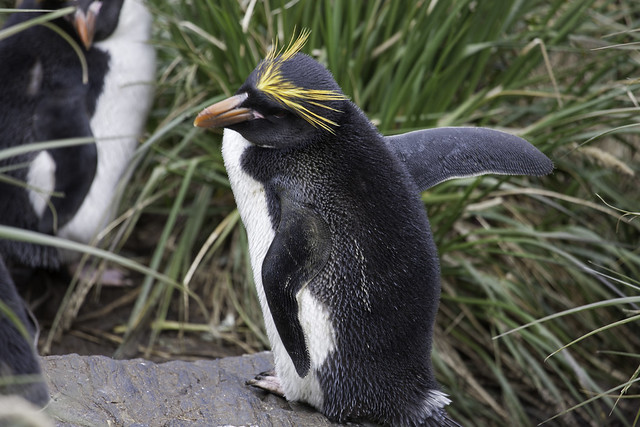
with regular sightings of the rare Fiordland Crested
Penguin.
The first walkers took to the track for the
company’s Three Day Guided Wilderness Experience walk in
mid-October and reports from on-site staff say the penguins
– also known as Tawaki - are regular visitors to the
valley at the mouth of the Hollyford River, near the lodge
at Martins Bay.
Hollyford Track Guided Walks operations
manager Travis Donoghue, said the “cute creatures” were
always a favourite moment with walkers who happen upon the
‘waddle’ regularly. “There’ve been frequent
sightings of them in the last few days and our guests have
really enjoyed getting so close to these wonderful birds
which are unique to the UNESCO World Heritage Site of
Fiordland National Park and surrounding areas of South and
West New Zealand. To see them in their natural
habitat is a truly special experience and once-in-a-lifetime
chance.The current population is between just 2500 and 3000
breeding pairs. “A sighting will always be synonymous
with Fiordland and New Zealand so our walkers are certainly
having a trip to remember,” said Mr Donoghue.
Due to the
migratory patterns of the Fiordland Crested Penguin it’s
expected they’ll be around the Hollyford region until
early December. The dedicated team have been on-site at
the lodge training and getting ready for the busy summer
with all indications pointing to another “stellar hiking
season”.
The walking season lasts until late April and
the company already has a number of walks fully booked,
especially during the busier peak summer times. “As
always we suggest people book early. With only 16 people in
each trip we do book-up well in advance.”
The walk
includes low-altitude hiking suitable for anyone of
reasonable fitness, native wildlife encounters, wilderness
jet-boating, historical sites and finishes with a scenic
helicopter flight to Milford Sound.
Further information on
all Hollyford Track Guided Walks is available at www.hollyfordtrack.co.nz
A funny video has emerged of a penguin tripping over a rock in front of a
crowd of tourists.
The footage - captured last month in Patagonia, Argentina
- shows a Magellanic penguin faceplanting over the rock before picking
itself up and continuing its journey.
According to the filmer around 500,000 Magellanic penguins visit the reserve
of Punta Tombo every year which is the largest nesting site in South
America.
A pair of penguins are preparing for parenthood by sitting on an egg-shaped stone at Dudley Zoo.
Keepers have discovered the pair taking it in turns to incubate the rock.
A pair of penguins are preparing for parenthood by sitting on an egg-shaped stone at Dudley Zoo. Credit: Dudley Zoo
Humboldt penguins pair for life and will lay eggs in the same
nesting boxes year-on-year, with both the male and female taking it in
turns to incubate eggs for between 40 – 42 days, as well as sharing
food-finding duties when the chick is born.
Gentoo penguins are the species normally associated with rocks, as
they will pass stones to one another as a token of their affection, but I
have seen some other Humboldts do this before as well as other bird
species such as owls; it’s as if they are practising for the real
event.”
A four-month-old Humboldt penguin named Kaya is blessed by a Catholic...
A four-month-old Humboldt penguin named Kaya is blessed by a Catholic...
A four-month-old Humboldt penguin named Kaya is blessed by a Catholic...
A four-month-old Humboldt penguin named Kaya is blessed by a Catholic...
October 29, 2014
MANILA — Roman Catholic priest Jacob Gomes blessed a
four-month-old Humboldt penguin before it took its first swim at the
Manila Ocean Park in the Philippines today (Oct 29). The park launched
its baby penguin attraction today and announced the winner of a contest
to choose the baby’s name, Kaya, meaning competence or ability in
Tagalog.
Before the penguin’s first swim, it was placed in one
side of a pool, separated from its penguin parents by a net. During the
blessing, the priest stressed the importance of environmental
conservation and the need for people to protect all species of marine
life, which are “a creation of God”. Kaya was born July 8 and is the
first penguin to be born in the country. Its gender is not yet known.
Harry Readhead for Metro.co.uk Tuesday, 28 Oct 2014
Penguin 184’s success could help scientists restore threatened penguin populations in future (Picture: SeaWorld)
The world’s first ever test-tube penguin has been pictured for the first time.
The chick, which has the unglamorous title of ‘184’ until it is given
a name, was hatched at SeaWorld in San Diego 12 weeks ago, though the
first images of her were only made public this week.
184, who is the first penguin to be born via artificial insemination,
represents a huge step for researchers in helping to diversify captive
penguin populations and aid their studies.
‘The goal of our research center is to study a species’ reproductive
biology, to learn as much as we can about that and use this to not only
monitor the health of not only our zoological populations but wild
populations as well,’ said Scientific Director Dr. Justine O’Brien, of
SeaWorld’s reproductive centre.
The baby Magellanic penguin has already transitioned from
hand-feeding to eating fish on her own, and has integrated with the
natural-born penguin population, biologists say.
Dr O’Brien believes the success of 184 could help scientists’ future
efforts to increase other threatened penguin populations, with a number
of species affected by oil spills, diminished fish supplies and climate
change. source
University of Delaware researchers have reported a connection
between local weather conditions and the weight of Adélie penguin chicks
in Antarctica. Credit: Megan Cimino/University of Delaware
Adélie penguins are an indigenous species of the West Antarctic
Peninsula (WAP), one of the most rapidly warming areas on Earth. Since
1950, the average annual temperature in the Antarctic Peninsula has
increased 2 degrees Celsius on average, and 6 degrees Celsius during
winter.
As the WAP climate warms, it is changing from a dry, polar system to a warmer, sub-polar system with more rain.
University of Delaware oceanographers recently reported a connection
between local weather conditions and the weight of Adélie penguin chicks
in an article in Marine Ecology Progress Series, a top marine ecology journal.
Penguin chick weight at the time of fledgling, when they leave the
nest, is considered an important indicator of food availability,
parental care and environmental conditions at a penguin colony. A higher
chick mass provides the chick a better likelihood of surviving and
propagating future generations.
In the study, Megan Cimino, a UD doctoral student in the College of
Earth, Ocean, and Environment and the paper's lead author, compared data
from 1987 to 2011 related to the penguin's diet, the weather and the
large-scale climate indices to see if they could correlate year-to-year
penguin chick weight with a particular factor. She also evaluated
samples from the penguin's diet to determine what they were eating.
"The ability of a penguin species to progress is dependent on the
adults' investment in their chicks," said Matthew Oliver, an associate
professor of marine science and policy and principal investigator on the
project. "Penguins do a remarkable job of finding food for their chicks
in the ocean's dynamic environment, so we thought that the type and
size distribution of food sources would impact chick weight."
Impact of weather and climate
Instead, the study revealed that weather and overall atmospheric climate seemed to affect weights the most. In particular, local weather—including
high winds, cold temperatures and precipitation, such as rain or
humidity—had the largest impact on penguin chick weight variations over
time. For example, westerly wind and air temperature can cause a 7-ounce
change in average chick weights, as compared to 3.5-ounce change caused
by wind speed and precipitation. A 7-ounce decrease in chick weight
could be the difference between a surviving and non-surviving chick.
A 7-ounce decrease in chick weight could be the difference between
a surviving and non-surviving penguin chick. Credit: Megan
Cimino/University of Delaware
Cimino explained that while penguins do build nests, they have no
way of building nests that protect the chicks from the elements. This
leaves penguin chicks unprotected and exposed while adult penguins are
away from the nest. Precipitation, while not considered a key variable,
can cause chick plumage to become damp or wet and is generally a major
factor in egg and chick mortality and slow growth.
"It's likely that weather variations are increasing the chicks'
thermoregulatory costs; and when they are cold and wet, they have to
expend more energy to keep warm," she said.
The wind can also affect the marine environment, she continued,
mixing up the water column and dispersing the krill, a penguin's main
source of food, which may cause parent penguins to remain at sea for
longer periods of time and cause chicks to be fed less frequently.
"This is an interesting study, because it calls into question what
happens to an ecosystem when you change climate quickly: Is it just
large-scale averages that change the ecosystem or do particular daily
interactions also contribute to the change," Oliver said.
Research team
Other co-authors on the paper include William Fraser and Donna
Patterson-Fraser, from the Polar Oceans Research Group, and Vincent
Saba, from NOAA National Marine Fisheries Service. Fraser and Patterson
have been collecting data on Adélie penguins since the late 1970s,
creating a strong fundamental data set that includes statistics
collected over decades, even before rapid warming was observed.
By correlating the relevant environmental variables through analysis
of data from sources such as space, weather stations, etc., the
researchers were able to scientifically validate a potential cause for
chick weight variation over time. Using big data analyses to
statistically sift through the possible causes allowed the researchers
to take a forensic approach to understanding the problem.
"Climate change strikes at the weak point in the cycle or life
history for each different species," Oliver said. "The Adélie penguin is
incredibly adaptive to the marine environment, but climate ends up
wreaking havoc on the terrestrial element of the species' history, an
important lesson for thinking about how we, even other species, are
connected to the environment."
Cimino will return to Antarctica next month to begin working with
physical oceanographers from University of Alaska and Rutgers, through
funding from the National Science Foundation. Using robotics, she will
investigate what parent penguins actually do in the ocean in order to
gain a broader perspective on how the penguins use the marine environment.
In particular, she hopes to explore other possible contributing factors
to chick weight variation such as parental foraging components that
were not part of this study.
"It's important for us to understand what's going on, especially as
conditions are getting warmer and wetter, because it may give us an idea
of what may happen to these penguins in the future," Cimino said.
Antarctic pioneer stumbled upon gangs of single penguins
that indulged in a string of stomach-turning sex acts that were kept
under wraps until now
The secret life of sex-mad "hooligan" penguins rampaging
around the South Pole was kept under wraps by a stunned Antarctic
explorer.
George Murray Levick endured the coldest temperatures on
earth, life-threatening blizzards, survived by eating blubber and was
part of the fatal 1911 Terra Nova expedition.
While Levick – a
surgeon, zoologist and photographer – survived the mission, Captain
Scott and two others perished in their tent on the Ross Ice Shelf.
But
of all the things that could have left Levick mentally scarred - it was
the debauched behaviour of the region's resident penguins that turned
his stomach the most, reports the Evening Chronicle
During
his time with the Scott expedition, Levick undertook a detailed study
of an Adelie penguin colony – and was so shocked by what he saw that his
findings were censored.
Getty
Do you come here often? A male penguin makes his move in the super cool surroundings of the Antarctica
Levick blasted the “hooligan” behaviour he witnessed – which included male penguins:
Having sex with dead females
Abusing and bullying chicks
Rape
Males having sex with males,
Levick
wrote his eye-opening observations in Greek, and printed just 100
copies of his penguin porn research, Sexual Habits of the Adélie Penguin, for limited use by scientists.
His X-rated paper was excluded from the official Scott report.
Levick had a particular hatred for the single male penguins he watched.
The
scientist with the 1910-13 Scott Antarctic Expedition wrote: “Half a
dozen or more hang about the outskirts of the knolls, whose inhabitants
they annoy by their constant acts of depravity.”
Levick's work was largely lost to science but later explorers confirmed his findings.
As
for Levick himself, he returned from penguins' answer to Magaluf to
serve in the Royal Navy during the First World War. He died in 1956.
If you happen to visit the Penguin Foundation at Australia's Phillip Island Nature Park, you may encounter an unusual sight - Little penguins waddling around in brightly colored turtleneck sweaters. Unfortunately, it is not because the flightless birds are trying to establish a new fashion trend, but because they are victims of oil spills. Confused? Read on!
According to the Foundation that rescues and rehabilitates the birds, the hand-knitted sweaters are crucial
in saving the lives of the helpless creatures when they get affected by
oil spills. Besides the danger of ingesting some, penguins exposed to
large amounts of oil are also more likely to die of starvation and
exposure. That's because the oil separates and mats their feathers,
allowing water to seep in. This makes the birds cold and heavy, and less
efficient at catching prey.
The good news is that if the birds are lucky enough to be rescued and
taken to centers like the one run by the Penguin Foundation, they can be
cleaned and released back to the wild, in no time at all. However,
there is still the danger of them ingesting
some of the poisonous substance before the cleaning process has been
completed. Given that a patch of oil the size of a thumbnail is enough
to kill the little bird, conservationists had to think of an innovative solution.
In 1998, a volunteer came up with the idea of attiring the Little
penguins with the sweaters and it worked like a charm. The Foundation
officials say that during the last major oil disaster near the area in
2001, the sweaters helped save 96% of the 453 contaminated penguins.
Over
the years, the researchers have fine-tuned the knitting pattern to make
sure that the wool does not damage the penguin's feathers and that
their flippers or beaks do not get entangled. The sweaters are knitted with 100% wool, which has a unique ability to act as a breathable insulator.
This helps keep the tiny penguin bodies at the perfect "Goldilocks
temperature" - neither too hot, nor too cold! The Penguin Foundation is
not the only one using this method to save the birds. The Tasmanian
Conservation Project has also been saving their oil affected Little
penguins using these adorable "wooly jumpers."
Of course, these flightless birds are not the only victims of careless
oil spills. According to the Penguin Foundation, over 100,000 birds of
all kinds are contaminated each year. Unfortunately, not all are as lucky as the Little penguins that end up at this sanctuary.
Also known as "blue" or "fairy" penguins, Little penguins are the smallest of the 17 species of the birds that are endemic to the southern hemisphere (Australia, New Zealand, Antarctica, sub-Antarctic islands, South America and Africa). The diminutive
animals that measure a mere 33cm (13in) tall and weigh just one
kilogram (2.2 lbs), used to waddle around southern Australia and New
Zealand in large numbers. However, over the years their numbers have
declined drastically, thanks to predators like feral
and domestic cats, as well as the spread of human settlement. As a
result, there are now only about a million of the cute birds left in the
colonies that are scattered around the region's various small islands
and some isolated coastal locations.
Resources: penguinfoundation.org,wikipedia.org, mirror.co.uk Story source
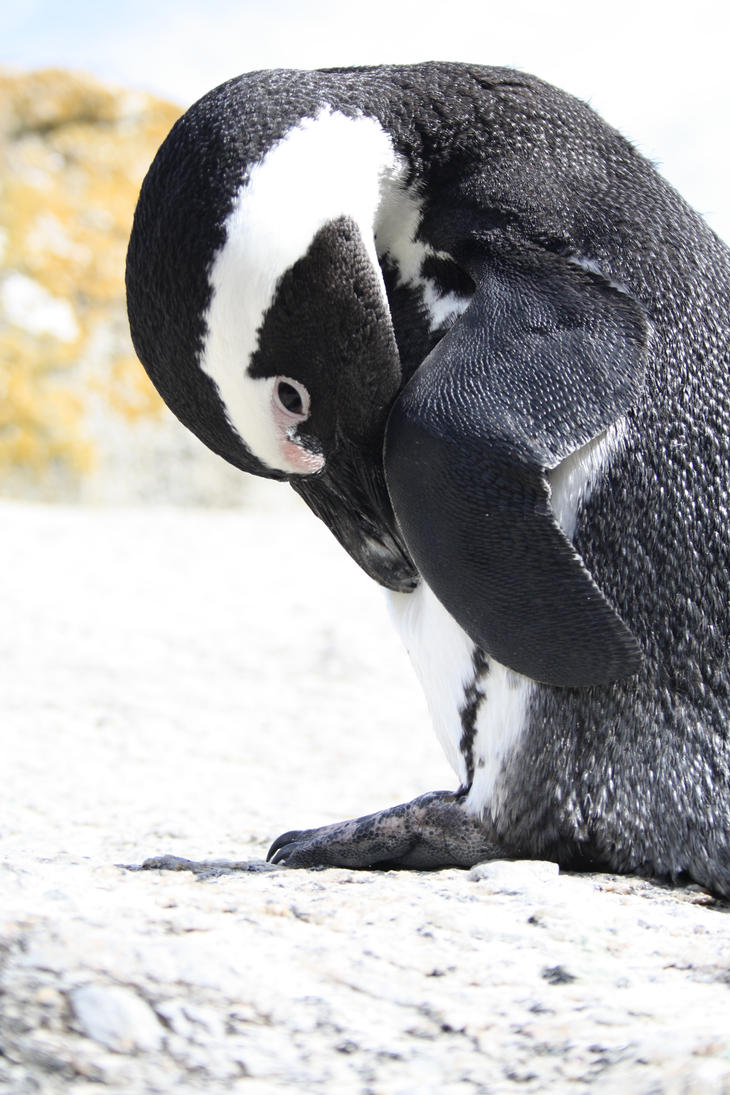
Group of African Penguins near Boulders Beach, South Africa. Photo by courtesy of Penguin Posse.
Abandoned
African penguin chicks are easy to spot. Their flippers are too long
for their bodies. Their chest bones are visible through their newborn
plumage. They haven’t been fed by their parents for weeks because the
adult birds are molting and unable to hunt in the ocean.
While
adult penguins can survive 21 days without food, baby chicks cannot.
Under normal conditions, the chicks would be out of their nests and able
to survive the fast. But sparse fish populations around the South
African shore limit chick’s growth and keep them nesting when adults
reach the critical point when they must molt.
Map
of Western Cape, South Africa. Black circles depict the location of
main African penguin breeding colonies. Chart by Richard B. Sherley,
Lauren J. Waller, Venessa Strauss, Deon Geldenhuys, Les G. Underhill and
Nola J. Parsons.
In response, researchers from the
University of Cape Town head-reared hundreds of malnourished chicks from
penguin colonies Dyer Island, Robben Island and Stony Point at the South African Foundation for the Conservation of Coastal Birds in Cape Town. The researchers admitted over 800 penguins in 2006 and nearly 500 in 2007. “Often, the abandoned chicks we’re bringing up look quite sad for themselves,” lead researcher Richard Sherley said. Most of the chicks were underweight for their age; researchers fed them a formula of liquidized fish and vitamins.
The
penguins were marked with flipped bands then released back into the
wild after an average month and a half of human care. The hand-raised
chicks were just as likely to survive as their naturally-raised
counterparts.
This success is promising for other seabird species
facing dwindling populations. So long as the birds don’t attach to their
surrogate human parents and can cope with living in captivity, humans
raising baby birds could be a solution.
In
the South African ecosystem, the baby penguins’ problems can be traced
back to fish populations. Sardines and anchovies are African penguins’
main food source. Between rising sea temperatures and overfishing,
especially of sardines, there aren’t as many fish to feast on as there
were in previous decades.
Less fish means smaller or less frequent
meals for the fledgling penguins. As a result, the baby birds are
growing slower and are still chicks when their parents begin to molt.
Unlike some birds, who shed a few feathers at a time, penguins must
replace all their feathers at once. Since they don’t have waterproof
feathers while molting, they stay on land and don’t hunt for the entire
process.
Hand-rearing the chicks could help conserve the species
in the short term, but the current colonies can only support so many
penguins. “We’re putting them back out into the colonies from
where they came,” he said. “We’re trying to slow down the decline of
colonies that are disappearing very rapidly.”
Sherley is curious
how the human-raised penguins would fare if they were released as
pioneers of new colonies on different parts of the South African shore.
The
South African government is also experimenting with fishing
regulations. The now-defunct South African Department of Environmental
Affairs and Tourism closed fishing around two pairs of islands. The
penguin chicks around St. Croix and Bird islands were , and the area will soon be off-limits for fishing permanently.
However, data for Robben and Dassen Island were inconclusive, and there
is ongoing debate about whether to allow or halt fishing around the
second pair of islands.
Supporters to educate viewers
ESTHER ASHBY-COVENTRY
Last updated 25/10/2014
MYTCHALL BRANSGROVE/Fairfax NZ
HI-VIS VESTS: Little blue penguin support group members in
their new vests, which they wear when responding to questions from
penguin viewers on the beach. Greg Adams and his mother Alwyn (right)
and Margaret McPherson (centre).
Fluorescent vests sewn by penguin fans are designed to help keep the creatures safe on Timaru's coastline.
Little blue penguin support group member Margaret McPherson designed
the bright green vests for members to wear while on rostered duty on
the beach at dusk. "It's so people know who to talk to or ask questions," McPherson said.
The $160 cost of material for the 21 vests was sponsored by a group
member's business and McPherson got help with sewing from friends and
fellow group member Alwyn Adams.
Made to fit all shapes and sizes, the vests have a reflective strip
along the back and a pocket in the front to hold information pamphlets
which, when printed, the members will distribute to penguin viewers.
Group member Greg Adams said visitors to the district were really
impressed that viewing the penguins was free and he hoped they could
keep it that way.
Educating the public helped to "stop idiots" disturbing the penguins, he said.
It was also a way of sharing information. Recently a group member
was made aware of where some chicks were, thanks to an eagle-eyed member
of the public.
The Little Rock Zoo has announced its fourth African penguin chick successfully hatched on September 11.
Unlike
the zoo's last three penguin chicks, this latest one was hatched by
penguins Mary Beth and Roy and foster parented by penguins Skipper and
Eze. Skipper and Eze are parents to the Zoo's last three chicks.
The
new penguin, a male, weighed only 2.3 ounces when born. He now weighs
six pounds and is growing strong. Penguin chicks grow quickly when they
are first hatched and if they are healthy.
The chick will not be
on exhibit until it is old enough to swim on its own. In the meantime,
he enjoys lounging on the steps of the Laura P. Nichols Penguin Pointe
exhibit.
According to the zoo, the birth of this penguin is a
significant achievement in conservation because of the genetic makeup of
penguins Mary Beth and Roy. Mary Beth and Roy were recommended to breed
by the Association of Zoos and Aquariums (AZA) Species Survival Plan
(SSP). The SSP is a conservation program of AZA that aims to protect and
conserve endangered and threatened species.
The African penguin
is an endangered species whose population has declined more than 95
percent since preindustrial times. The African penguin is threatened by
oil spills, overfishing, and climate change.
Gulf
World threw a birthday party for one of their oldest residents. Fat Boy
is turning 31 years-old. Staff wanted to honor this achievement
because it’s so rare for African penguins to live this long.
Stephanie Nagle the Education Coordinator at Gulf World was on hand for the celebration.
“He
is a little bit older so he is calmer than the others. He is the only
male in our habitat, so the other females are a little bit more active
than he is, but he still very healthy and we hope to celebrate many more
birthdays in the future,” says Nagle.
Gulf World is home to many different aquatic animals including penguins. Fat Boy is an African Black-Footed Penguin. This species is on the endangered list, so staff used today as an opportunity to educate the public on how to help the animal.
According
to Gulf World trainers, picking up liter on the beach to reducing the
amount of water you use everyday are ways to help Fat Boy and his family
live on forever.
One admirer loves the penguin for all kinds of reasons.
"I like how they can swim and dive. They are cool animals but just weird little birds,” says Bennett Schneider.
TUCSON (KGUN9-TV) - All Omar Casas Varela could think about two weeks ago was what a hug from a penguin might feel like. "I think they're going to be so soft," he said at a farewell party hosted by Make-a-Wish Arizona.
The young boy has a life-threatening illness that requires him to
receive a blood transfusion every two weeks, but his family says the one
thing that gets him through all those doctor appointments is his love
for these aquatic animals.
"He likes that the penguins are like a family like us," said Omar's mother Vanessa Molina. Make-a-Wish Arizona volunteers said Omar's wish to "hug a penguin"
was unusual, but they knew they had to make it happen. So when they
scheduled the family's vacation, they left room for two whole days
behind the scenes at Seaworld in Orlando, Florida.
Watch the video above to see Omar's wish come true!
The penguin floor cleaner cover helps your mop glide across surfaces (Picture: Felissimo)
Occasionally, even the most slovenly types are forced to wipe down the odd surface *sad face*.
And now you can put a bit of sparkle into the dullest of chores with the penguin multi-surface floor cleaning cover.
You may not have ever realised you needed it, but seeing this little
stuffed penguin gliding across your floors as you clean may just
brighten up the most menial of tasks.
The cuddly cover can be used with virtually any old mop – the hole in
its torso lets you slide it over the mop handle. Then, it will glide
over your tiled/wooden floors with ease, like a penguin on ice. What the world was missing (Picture: Felissimo)
The cover is sold by Japanese online shop Felissimo for around £20 plus postage.
When you’re not mopping the floors (which, yeah, is basically all the
time), or don’t actually own a mop – because Flash wipes – it also
doubles up as a tissue box. Or just put your tissues in its stomach-lining. Good (Picture: Felissimo)
Most pointless invention ever? Very possibly. But, for some reason, we still sort of want one. source
Penguins might be regarded as cute, comedic characters
because of the bumbling manner in which they walk, but these
birds have been shaped not by the air or land, but by the
sea. ''Even Ferrari can't design a shape as efficient,'' Prof
Lloyd Spencer Davis says. Any creature that has to spend a lot of time moving through a
dense medium such as water is likely to have been shaped by
evolution into a spindle. Such a shape reduces drag.
''A shark, a seal, a penguin - there might be slight
differences to their form - but in essence they are all
battling the same problem: drag,'' Davis writes in Professor
Penguin. ''They can have coefficients of drag that are better than we
can design with all our computers ... but as a consequence of
reducing the drag, they have these short legs. Natural history documentaries often mock penguins because
of the way they move on land, yet you'd never say about
(champion sprinter Usain Bolt), 'well, he sleeps in a funny
position'.''
Two of the most recognisable characteristics of penguins -
the way they walk and the way they dress - are a consequence
of their evolution to become diving birds that hunt in open
oceans. ''Penguins walk upright because their legs have been much
reduced in an effort to reduce drag. In essence, penguins
have such short legs that they end up walking upright on what
are essentially their anklebones. The waddling gait of penguins is not the best means of
moving on land. It is just one of the compromises that
penguins have had to accept on land in order to rule beneath
the waves.''
Davis points out that penguins' coloration, too, is more
dictated by the requirements of life in water than by those
of life on the land. ''They are open-ocean predators, feeding on krill, fish and
squid. They are also open-ocean prey, being fed on by the
likes of seals, and sometimes the odd whale or shark, too, if
some of the stories are to be believed. In the ocean there is
nowhere to hide, either for sneaking up on prey or for
evading predators. Camouflage comes in the form of the two-tone suit worn by
most oceanic dwellers: dark on top to blend in with the
depths when seen from above, light on the bottom to blend in
with the surface when seen from below. It is the dominant fashion of the water-obsessed:
barracuda, tuna, great white sharks, killer whales,
salt-water crocodiles.''
In short, Davis notes, penguins may look like they are
wearing tuxedos but, really, they go to the same tailors as
all other open-ocean predators.
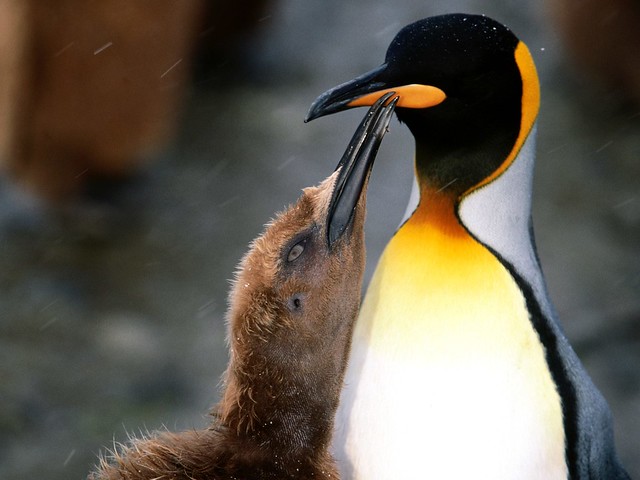


 The secret life of sex-mad "hooligan" penguins rampaging
around the South Pole was kept under wraps by a stunned Antarctic
explorer.
The secret life of sex-mad "hooligan" penguins rampaging
around the South Pole was kept under wraps by a stunned Antarctic
explorer.


 While
adult penguins can survive 21 days without food, baby chicks cannot.
Under normal conditions, the chicks would be out of their nests and able
to survive the fast. But sparse fish populations around the South
African shore limit chick’s growth and keep them nesting when adults
reach the critical point when they must molt.
While
adult penguins can survive 21 days without food, baby chicks cannot.
Under normal conditions, the chicks would be out of their nests and able
to survive the fast. But sparse fish populations around the South
African shore limit chick’s growth and keep them nesting when adults
reach the critical point when they must molt.