Pages
▼
Wednesday, December 31, 2014
Tuesday, December 30, 2014
Monday, December 29, 2014
Man-made nest helping reestablish penguin populations
Read more about the man-made nests and the work of Dr. Boersma: http://www.galapagos.org/conservation/increasing-the-galapagos-penguin-population/
source
New addition to penguin population
SAHIBAN KANWAL
Timaru is becoming known for its little blue penguins, but a penguin
of another breed has been spotted on the rocks around the Timaru port.
Just what that breed is, though, has drawn differing opinions.
According to the Department of Conservation (DOC) it is a yellow-eyed penguin, but South Canterbury Museum director Phillip Howe thinks it could be a crested penguin from Fiordland or Snares Island below Stewart Island.
Both parties looked at a photo of the penguin and drew different conclusions.
Howe said the penguin chick looked as though it could be crested. "The line above the eye, the colour, and the beak which is short and chunky unlike the beak of the yellow-eyed penguin, indicates it could be a Fiordland crested penguin chick or a Snares penguin chick."
DOC says the Fiordland crested penguin, or tawaki, is one of the rarest of New Zealand's mainland penguins. Adults stand about 60cm and weigh up to 4 kilograms. Juvenile birds have a thinner eyebrow stripe and a white chin and throat. Most birds have between three and six grey/white cheek stripes. They have an orange bill, which is slightly larger in adult males.
DOC partnership ranger George Iles identified it as an immature bird because of its down feathers. He thought it was possibly a yellow-eyed penguin which was confirmed by DOC's emergency staff.
The main population for this species is in Oamaru but they are found along the coastline between Banks Peninsula and Stewart Island.
A spokesman at the DOC emergency line said no immediate action would be taken as the yellow-eyed penguin was not considered to be in danger.
source
30/12/2014
JOHN BISSET/Fairfax NZ
UNKNOWN: This small penguin has been spotted on the rocks around the Timaru port, but there are differing views on its breed.
Just what that breed is, though, has drawn differing opinions.
According to the Department of Conservation (DOC) it is a yellow-eyed penguin, but South Canterbury Museum director Phillip Howe thinks it could be a crested penguin from Fiordland or Snares Island below Stewart Island.
Both parties looked at a photo of the penguin and drew different conclusions.
Howe said the penguin chick looked as though it could be crested. "The line above the eye, the colour, and the beak which is short and chunky unlike the beak of the yellow-eyed penguin, indicates it could be a Fiordland crested penguin chick or a Snares penguin chick."
DOC says the Fiordland crested penguin, or tawaki, is one of the rarest of New Zealand's mainland penguins. Adults stand about 60cm and weigh up to 4 kilograms. Juvenile birds have a thinner eyebrow stripe and a white chin and throat. Most birds have between three and six grey/white cheek stripes. They have an orange bill, which is slightly larger in adult males.
DOC partnership ranger George Iles identified it as an immature bird because of its down feathers. He thought it was possibly a yellow-eyed penguin which was confirmed by DOC's emergency staff.
The main population for this species is in Oamaru but they are found along the coastline between Banks Peninsula and Stewart Island.
A spokesman at the DOC emergency line said no immediate action would be taken as the yellow-eyed penguin was not considered to be in danger.
source
Sunday, December 28, 2014
Portly penguins stroll before tourists to keep them trim during winter
- Obese penguins are taken on walks through the snow at Asahiyama Zoo twice a day from December to March
- The 30-minute waddle is designed to keep them fit and healthy when they tend to be less active in their enclosure
- The Penguin Walk has become a world-renowned attraction with tourists flocking to the zoo to witness the event
By
Chris Kitching for MailOnline
Published:
28 December 2014
These
portly penguins are providing inspiration to those who have made a New
Year's resolution to get into shape after indulging over the Christmas
holiday.
With
camera-happy tourists looking on, the chubby birds are paraded through
the snow at Japan’s Asahiyama Zoo twice a day from December to March to
help them slim down.
The
30-minute waddle is designed to keep the penguins fit and healthy and
fend off obesity during the winter months when they tend to be less
active and accumulate more fat.
The chubby birds are paraded through the snow at Japan’s Asahiyama Zoo twice a day from December to March to help them slim down
Photographer Paul Brown, from London,
snapped these shots when he made a special trip to the zoo on the
northern island of Hokkaido
The Penguin Walk has become a world-renowned attraction with tourists flocking to the zoo to witness the extraordinary event. Luckily
the portly penguins are accustomed to the limelight and appear to enjoy
the attention as they pose for snaps, although some appeared
dishevelled.
Photographer
Paul Brown, from London, snapped these shots when he made a special
trip to the zoo on the northern island of Hokkaido. The
51-year-old said: ‘This is the first time I have seen the Penguin Walk.
I heard about it a while ago and have always wanted to see and
photograph it as it looks such fun and it really was.
The 30-minute waddle is designed to keep the penguins fit and healthy during the winter months when they tend to be less active
The Penguin Walk has become a world-renowned attraction with tourists flocking to the zoo to witness the extraordinary event
‘There
was a great atmosphere and everyone there seemed to be very happy. The
keepers walk the penguins twice a day around a fixed course through the
zoo, which takes about half an hour.’ Paul said the walk was a huge hit with visitors and he encountered visitors from Japan and countries all over the world. He added: ‘No other zoo I know of has a Penguin Walk like this. It really is unique.
The keepers walk the penguins twice a day around a fixed course through the zoo, says 51-year-old photographer Paul Brown
Mr Brown said the flightless birds
were relaxed and had the appearance of a group of friends who were out
for a casual stroll in the snow
‘The
children loved the penguins, they were waving and clapping their hands
but were also very well behaved as staff told them to stay seated so as
not to scare the penguins. The penguins were really professional and ignored their adoring fans and the constant clicking of cameras. They
had obviously done this before and didn't need any coaxing along the
path. They stayed clear of the crowd at all times, but never once did
they appear scared, taking the whole event in their stride, or should
that be waddle.’
Paul Brown says the children loved the penguins and were waving and clapping their hands but were also very well behaved
The portly penguins are accustomed to the limelight and appear to enjoy the attention as they pose for snaps during their walk
He
said the flightless birds were relaxed and had the appearance of a
group of friends who were out for a casual stroll in the snow. ‘From time to time one or another of them would stop and stretch its neck and wings, give them a little shake and then move on. It
was really well organised and they had people with signs in Japanese
and English, walking ahead of the penguins telling people with cameras
not to use flash. It was really fun to watch.’
Penguins diving off an iceberg into Antarctic waters
- Penguins captured diving of an iceberg and into the freezing water in their Peterman Island habitat
- Antarctic Gentoo, Adelie and Chinstrap penguins pictured under the water in these stunning images
- Photographer Justin Hofman braved sub zero temperatures to take amazing underwater pictures
By
Hayley O'keeffe
Published:
2 November 2013
Gentoo, Adelie and Chinstrap penguins were photographed enjoying a splash on Peterman Island in the Antarctic peninsula.
These playful penguins are not fazed by the sub-zero temperatures as they dive into freezing water from a giant iceberg
Photographer Justin Hofman braved the adverse weather conditions to capture the unique moment from a different perspective. He even went into the freezing -2 degrees Celsius water to take the photographs. But he says that getting into the water to capture the shots has enabled him to look at the birds with a new perspective.
The huge colony are pictured slowly making their way to the edge of the huge iceberg before jumping into the water
The penguins are pictured above and below the icy water on Peterman Island in the Antarctic peninsula
A penguin gets ready to take a leap into the water. Justin Hofman braved the sub zero temperatures to get these amazing shots
Mr Hofman, 30 from Grand Terrace, California, said: 'While working in the Antarctic, I have seen more penguins than I can count. Some colonies can have 100,000 penguins all working hard to breed successfully. And with careful boat handling, I was able to bring the boat right up to the icebergs, hang my camera over the side and take plenty of shots.' He added: 'A few of the shots were taken while I was snorkeling.
This stunning image of a penguin enjoying an afternoon swim was captured by Californian photographer Mr Hoffman
'It's colder than you can really imagine. The temperature of the water is often below freezing. The salt lowers the freezing point of water, taking it down to -2 C. Because I'm trying to move stealthily and limit any erratic motions, I tend to get cold quickly since I'm not generating a lot of body heat. Most outings last less than an hour and occasionally I can hold out for only 30 minutes at a time. Seeing these dumpy little birds, who look so awkward on land, making a living in the most harsh environment on the planet is amazing.'
A penguin stamps along the snowy top of the
iceberg, perhaps deciding where to jump in. These photographs capture
the birds both above and below the surface
Saturday, December 27, 2014
Penguins of the Day
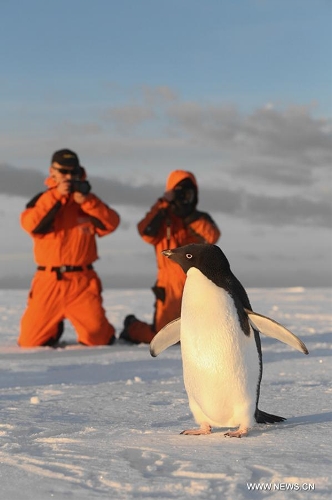
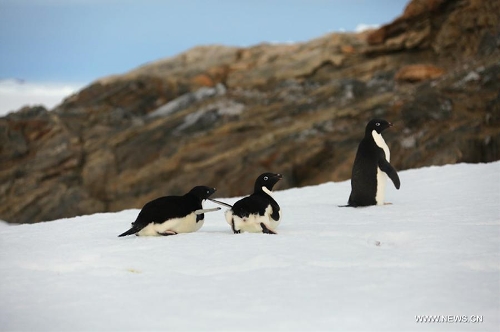
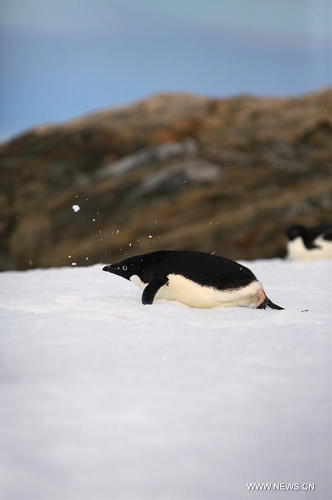
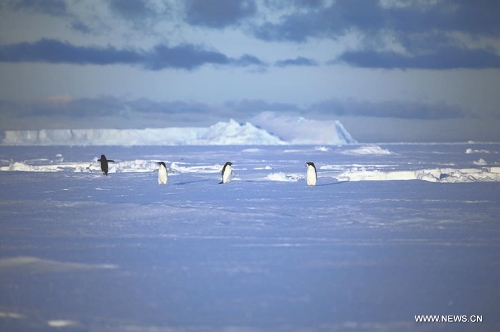
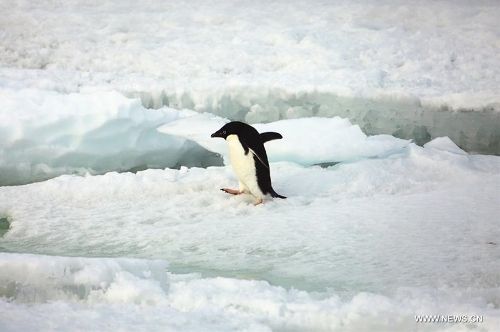
Photo taken on Dec. 26, 2014 shows penguins on the ice near China's
Zhongshan Antarctic Station in Antarctica. (Xinhua/Bai Yang)
Source:Xinhua Published: 2014-12-27
SeaWorld Orlando welcomes eight penguin chicks
NBC-2.com WBBH News for Fort Myers, Cape Coral
Dec 27, 2014
In the last 10 days, eight penguin chicks hatched at SeaWorld Orlando's newest attraction – Antarctica: Empire of the Penguins.
The attraction features a colony of over 250 penguins from four species. Of the eight new chicks that hatched, two were Gentoo, four were Adelie and two were Rockhopper.
The chicks ranged in weight from two to four ounces – equivalent to about two to four slices of bread.
The chicks are currently being raised by their parents inside the attraction – with routine check-ups from the SeaWorld Orlando aviculture team.
source
Dec 27, 2014
In the last 10 days, eight penguin chicks hatched at SeaWorld Orlando's newest attraction – Antarctica: Empire of the Penguins.
The attraction features a colony of over 250 penguins from four species. Of the eight new chicks that hatched, two were Gentoo, four were Adelie and two were Rockhopper.
The chicks ranged in weight from two to four ounces – equivalent to about two to four slices of bread.
The chicks are currently being raised by their parents inside the attraction – with routine check-ups from the SeaWorld Orlando aviculture team.
source
Friday, December 26, 2014
Thursday, December 25, 2014
Young penguins are protected from the cold by their loving parents as they huddle together in Antarctica
- The breeding colony of Emperor Penguins were pictured in Antarctica
- They had trekked up to 75 miles over ice to reach the breeding spot
- Images show penguin parents huddling around young to keep them alive
By
Sam Matthew for MailOnline
Published:
23 December 2014
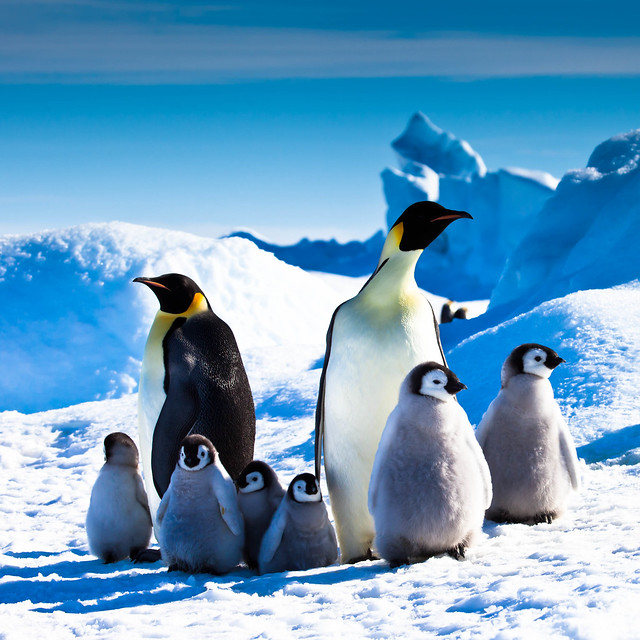
Huddled together trying to stay warm, these heart-warming images show that penguins really do make the best parents. The adult Emperor Penguins surround their young as they struggle to survive the freezing temperatures and deadly winds. This breeding colony were captured clustered together in Antarctica where they face a daily battle to keep their young alive.
Scroll down for video
Huddled together: Adult Emperor
Penguins surround their tiny young as they struggle to survive the
freezing conditions in Antarctica
Perfect parents: Mothers and fathers face a daily battle against the harsh condition to keep their young alive
This tiny snow speckled chick is being looked after by his father while his mother goes off for two months to look for food
The tiny fluffy chicks cluster together to keep warm as the temperatures plummet
Is this the real life Mumbles for the
animated movie Happy Feet? The tiny chick braves the cold to move away
from the other chicks
A group of young penguins play together on the ice in Antarctica
Keeping each other warm: These youngsters are around 40 to 50 days old
Speckled with snow, the tiny chicks, keep close to their mothers and fathers in the midst of the icy blast. The tiny chicks bare an uncanny resemblance to Mumbles, from the Bafta winning movie Happy Feet. In the animated film, Mumble's is cast as an outsider because he has a terrible singing. Emperor penguins famously trek up to 75 miles over the ice to reach their breeding colony.
Emperor penguins sleeping chicks, covered in snow, sheltering in brood pooches
A creche of chicks snuggle together as their parents search for food
These four little chicks follow one adult emperor penguin as they march over the ice sheet
Keeping all the little ones together. Emperor Penguins form creches for their young so they can go off and look for food
Here the female penguin lays a single egg and hand it over to the male to cradle on his feet. This
handover must be done without the egg once touching the ground
otherwise the chick inside would die from the freezing temperatures.
The female then makes the long trek back to the sea to feed. The
male is left to withstand the Antarctic cold for more than two months -
during which time he will eat nothing - to protect his egg from the
extreme cold.
When
the female returns she brings with her their now hatched chick's first
meal - finding her mate and young among the crowd thanks to his vocal
call.
A brave penguin chick poses for photographer Fred Olivier
She takes over caring for the chick while he makes the arduous journey to the sea.
They then take it in turns to care for their chick and forage at sea.
When
the youngsters are around 45-50 days old they huddle together to form a
crèche while both parents head out to sea - returning periodically to
feed their chicks before they are old enough to fend for themselves.
source
source
Wednesday, December 24, 2014
Penguins of the Day - a visit to a rookery
in Pictures
Third visit to a thriving penguin colony
For the third year in a row, Alain Hubert visited a penguin colony on Antarctica’s Princess Ragnhild Coast. The number of chicks is greater than ever, which indicates the penguins are thriving.
By the looks of it, the penguin colony seems to be doing better every year.
© Alain Hubert / International Polar Foundation
Penguin chicks awaiting the return of their parents ... and the food they bring back!
© Alain Hubert / International Polar Foundation
Adult emperor penguins gather on the edge of the ice shelf to go fishing.
© Alain Hubert / International Polar Foundation
Every chick requires attention
from both parents to be able to survive. Males and females are both very
dedicated to rearing their young.
© Alain Hubert / International Polar Foundation
A penguin chick is begging for food, knowing very well that fish is on the menu.
© Alain Hubert / International Polar Foundation
This looks really good!
© Alain Hubert / International Polar Foundation
A parent regurgitating freshly caught fish to feed a chick.
© Alain Hubert / International Polar Foundation
No penguins in the water ... there must be a predator in the neighbourhood!
© Alain Hubert / International Polar Foundation
Indeed...a few minutes later, a leopard seal jumps up onto the ice!
© Alain Hubert / International Polar Foundation
This, ladies and gentleman, is an
emperor penguin killing machine. Our cameraman was pretty startled when
he saw the leopard seal.
© Alain Hubert / International Polar Foundation
Our newcomer, sniffing away at feathers.
© Alain Hubert / International Polar Foundation
The smart penguins knew the waters were not safe!
© Alain Hubert / International Polar Foundation