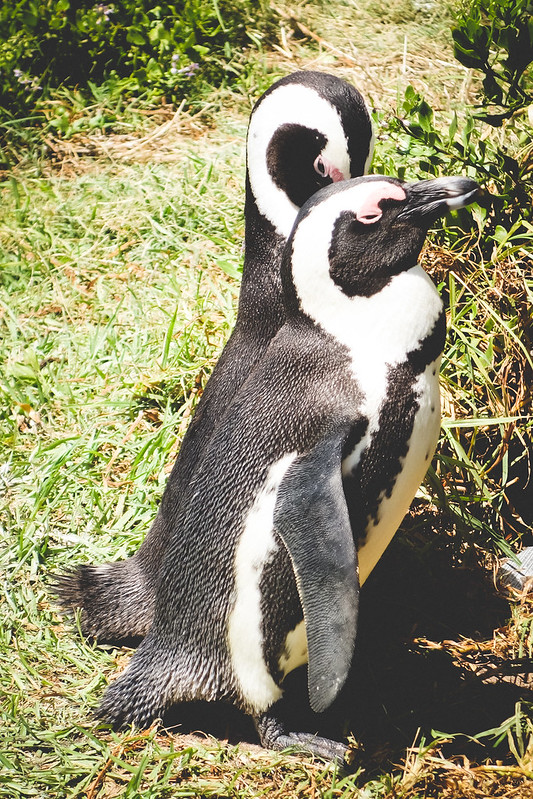
HEARTBROKEN: Mauao Area Wildlife Trust
chairwoman Julia Graham (left) says the damage done to penguins by
people drinking on Moturiki Island at night is horrific. Pictured with
DoC partnership ranger Tireni Ratema. PHOTO/GEORGE NOVAK
The death of four baby blue penguins from nothing but "human
stupidity" has broken the heart of Mauao Area Wildlife Trust chairwoman
Julia Graham.
Mrs Graham monitors the penguins on Moturiki
(Leisure) Island but has noticed an alarming increase of people drinking
on the liquor-free island late at night and trashing the environment.
Two
young penguins were trapped and starved to death because empty beer
bottles were shoved into the entrance of their burrow, she said.
"The burrow was completely blocked off so the parents couldn't get to their babies to feed them."
Another two healthy eggs were abandoned by their parents after increasing activity around their burrow.
"The
main problem is people drinking there at night. One, we have a lot of
nocturnal animals there and you may not realise you've parked yourself
right in front of a burrow.
"You're actually stopping that bird
from being able to get out to feed their babies. Even two hours could
mean life or death for a young bird," she said.
"Two, once
they've had a few drinks they're more likely to leave their bottles
around and they'll go off trashing the island, swinging off trees and
breaking branches."
"The damage that gets done is just horrific.
"It's not good. I cried, I cried like a baby. It breaks my heart."
Summer was a particularly problematic time, she said.
"The
rubbish that gets left behind is just terrible. This time of the year
the [human] population increases so you're going to get a lot more
rubbish."
The trust would be increasing nightly patrols of the area for the summer period, she said.
"We don't want to be like this but we feel like it's the only way to get our point through."
She
was thinking of the future, hoping in years to come she would take her
grandchildren to Moturiki Island and the little blue penguins would
still be there.
"Go, enjoy it, it's a beautiful place ... It's special and unique. We should love and cherish it."
Billy
Hughes, an aviculturalist from Monterey Bay Aquarium, holds Rey, an
18-month-old African penguin, as she awaits her pre-surgery exam
Tuesday. Rey sits on a Ziploc bag of ice to keep her cool. Sue
Cockrell/Enterprise photo
Rey sits on a
Ziploc bag filled with ice to keep her well-insulated, feathery body
cool on Tuesday while she awaits her eye exam at the UC Davis Companion
Exotic Animal Medicine & Surgery Service.
The 18-month-old African penguin from the Monterey Bay Aquarium has
been sedated, so she is fairly mellow as a team of veterinarians buzz
around the exam room, preparing to anesthetize Rey and test her
cataract-ridden eyes.
To see if she is a good candidate for the surgery, Dr. Lionel Sebbag
said, Rey will undergo an ultrasound, followed by an electroretinogram,
which will check the functionality of her retinas in response to light.
“The retina has to function well or she won’t benefit from the surgery,” Sebbag said.
Spoiler alert: Not all stories with adorable young animals end the way we hope.
Rey is at UCD because of the School of Veterinary Medicine’s experts
in both ophthalmology and exotic species. One of her handlers from the
aquarium, aviculturalist Billy Hughes, said the staff at Monterey Bay
Aquarium did an initial check on Rey after she hatched and noticed
discoloration. At follow-up exams, he said, it became more obvious that
she had cataracts in both eyes.
“African penguins live 10 to 15 years in the wild, and into their
late 30s in captivity,” Hughes said, making the surgery for the young
penguin a worthy gamble.
The sedation is necessary for the preliminary exam — collecting blood
samples and the like — followed by anesthesia for the more
comprehensive tests. Sebbag explained that a dog would not need the
initial sedation and also could be awake for the operation, but a bird
has to be fully under for cataract surgery.
About once or twice a year, Sebbag added, the UCD Vet Med Teaching
Hospital does eye surgery on a bird. “Last time was an African gray
parrot,” Sebbag said. He also admitted for Rey, “the surgery technique
would be challenging because of the small size of the eye.”
The best case for Rey would be successful cataract removal that left
her farsighted. When a person undergoes cataract surgery, Sebbag
explained, a lens is implanted to improve his or her vision. But for
this small bird, there is no commercial lens available.
“She will have much more functional vision,” Sebbag said, the goal for this penguin. As the team of veterinary students, residents, technicians and
doctors tend to the penguin for nearly an hour — putting in eye drops
every five minutes, checking her heart rate and blood pressure, and
inserting an IV for fluids — Rey stays fairly still atop her Ziploc bag
of ice, which helps counteract the warm exam room conditions.
Speaking of IVs, this is no easy feat. Guzman explained that Rey
needs IV fluids during anesthesia because it tends to cause
hypertension. But it’s tricky to find where the catheter should go on a
creature most of them have never before handled. Guzman and Dr. Alessia
Cenani, anesthesiology resident, squeeze and poke around Rey’s flippers
and feet until they find a favorable spot to insert the tiny tube: under
her flipper.
As the anesthesia overtakes Rey’s almost 6-pound body, she flaps her
flippers in a dreamlike trance. The team of vets is not immune to this
cuteness, and murmurs of “aww” float around the room.
Sebbag talked a bit about what Rey’s post-operative care might
involve — the staff of veterinarians at the Monterey Bay Aquarium might
video-conference with the ophthalmologists in Davis, or maybe Rey would
have to make a return trip to UCD.
However, this planning can wait. It was determined that Rey was not a perfect candidate for the cataract removal surgery.
“Upon final examination,” explained Rob Warren, Vet Med Teaching
Hospital spokesman, “there was no activity in one of her eyes,” meaning
she is most likely blind in that eye.
“They decided to wait on the surgery on the other eye,” Warren
continued. “In case it wasn’t successful, the penguin may have been left
completely blind. They want to wait to decide on that risk.” source
King penguins back from the foraging trip. (T. Powolny)
Penguins
are the cuddly faces of the Southern Hemisphere and among the most
recognizable birds known to brave the chilly Southern Ocean. But like so
many other charismatic favorites of the animal kingdom — especially
those that inhabit the world’s coldest places — they’re starting to
suffer the effects of climate change.
The
king penguin, an iconic black, white and yellow bird second only in
size to the emperor penguin, is among the latest species to feel the
heat. King penguins raise their chicks on the sub-Antarctic islands
north of Antarctica and dive for fish in the frigid waters at the
northern reaches of the Southern Ocean. But their breeding and foraging
behaviors may be at risk as ocean temperatures heat up in the Southern
Hemisphere. New research shows that warm sea-surface temperature
anomalies in the region can cause shifts in the marine environment where
they feed, forcing the birds to travel farther and dive deeper for
their food — and causing declines in their populations.
Variations
in the climate of the southern Indian and Atlantic oceans depend on
several important factors. These include the influences of El Niño and La Niña, which cause phases of warmer and cooler temperatures,as well as changes in atmospheric conditions in the Southern Hemisphere known as the Southern Annular Mode.
These kinds of climatic variations can cause sea-surface temperatures
to rise and fall from one year to the next. And these temperature
changes can, in turn, change marine ecosystems by driving fish and other
organisms into different regions.
A study published
Tuesday in the journal Nature Communications shows that these climatic
changes — and their resulting effects on marine food webs — can have
serious implications for king penguin populations. Looking at these
natural oscillations can give scientists an idea of what to expect as
temperature changes in the future become increasingly driven by climate
change, which will shift climatic variations definitively toward a
warming trend.
King
penguins typically forage for food in an area of the Southern Ocean
known as the Antarctic polar front, a region where the colder water in
the south meets the warmer water to the north and draws an abundance of
plankton, krill and fish. In some years, though, if sea-surface
temperatures in the northern part of the Southern Ocean get too warm,
the polar front can be pushed southward. This means king penguins have
to travel farther from their island homes to get to the best feeding
areas.
The study’s authors, led by Charles Bost of
the Chize Centre for Biological Studies at the French National Centre
for Scientific Research, tracked the foraging patterns of king penguins
living on the Crozet archipelago in the southern Indian Ocean between
1992 and 2010. They wanted to find out how sea-surface temperature
changes might affect the birds’ foraging behavior, and whether changes
in their behavior could also affect their population sizes and
reproductive success. The study may be among the first to provide
“information at the same time on the at-sea movements, diving, breeding
success and long-term population dynamics” of king penguins in response
to climatic changes, lead author Bost told The Washington Post.
The
researchers found that in warm years, the Antarctic polar front shifted
south — in fact, a 1-degree Celsius increase in sea-surface temperature
caused the front to move south by 130 kilometers (or about 80 miles) —
forcing the penguins to travel significantly farther to get to their
prime feeding grounds. This is especially problematic for the birds
during breeding season, when penguin parents take turns incubating eggs
and raising chicks and must travel back and forth between the islands
and the polar front much more often to relieve their partners of
parenting duties, a time-consuming and exhausting endeavor.
The
research suggests that having to travel so much farther on these
foraging trips could have damaging effects on the king penguin
population. In 1997,the southern Indian Ocean
experienced a particularly unusual El Niño-driven warming event, which
drove the polar front south and forced king penguins to travel twice
their normal distance during foraging trips. The researchers observed
that they also dove about 30 meters deeper for their food in this year
compared with other years.
Many
penguins did not survive these extreme conditions. In the same year,
the researchers observed a 34 percent decline in the adult king penguin
population — a loss so severe that it took the population five years to
work its way back up to pre-1997 numbers. The penguins’ breeding success
was also lower that year than at any other time throughout the study
period.
The study didn’t
include observations of fish or other prey, but the researchers note
that the changes in penguin foraging behavior — and the subsequent
effects on the penguin population, itself — were probably driven by
changes in prey availability, as fish in the region almost certainly
migrated to follow the shifting polar front. This behavior would be
consistent with many previous studies, which have shown that changing
ocean temperatures are capable of driving marine animals outside their
typical ranges in search of more suitable conditions.
This
is worrying news, because global climate change is only expected to
continue driving ocean temperatures up, particular in the Earth’s polar
regions. If prey species continue to migrate in response to the shifting
climate, then king penguins won’t be the only species affected;
additional predators, such as other seabirds or seals, will likely also
be affected.
The authors
wrote: “Future climatic scenarios indicate a warming of the surface
waters that should lead to a progressive southward shift of the [polar
front]…and potentially representing a serious threat for penguins and
other diving predators of the Southern Ocean.” So while the effects
observed in this study were mostly caused by natural temperature
oscillations brought on by El Niño/La Niña effects and other climatic
variations, climate change will be the major future driver of
temperature changes in the region.
The effects for the
king penguin, specifically, could be even more severe if the polar front
continues moving farther south each year. During the breeding season,
king penguins can only spend about 22 days at sea before coming back to
relieve their partner and take care of the chicks. So one concern is
that the front could move beyond this travel distance. If king penguins,
which are relatively stable now, according to Bost, were to decline too
drastically, that could also have a major impact on the marine food web
in the Southern Ocean, perhaps leading to an overabundance of the small
fish that the penguins feed on.
So
the study can be seen as an early look into what’s to come for marine
animals in the Southern Ocean if sufficient action isn’t taken to halt
global warming. As Bost noted, “Long-term studies of at-sea foraging
ecology of marine predators are essential to use it as sentinels of
short-term and long-term change in the marine environment.”
And
if the research is any indication of what might happen, it’s a future
that could end up without some of the world’s most recognizable and
beloved animals.
Oddball is based on the true story of a maremma sheepdog who saves a colony of little penguins.IT
was looking like a box office sleeper, but Oddball, the delightful
Australian film about a Maremma dog that protects a colony of penguins,
has bolted to the $10 million mark in its sixth week following its
release.
The film’s box office tally was yesterday at $10,117,946.
In a
record-breaking year for home grown cinema, Oddball has overtaken
Roadshow Films’ other breakout family hit for 2015, Paper Planes, which
finished with an impressive $9.65 million haul.
Starring Shane
Jacobson, Sarah Snook, Alan Tudyk, Deborah Mailman and Coco Jack
Gillies, the film tells the story of a chicken farmer who lives near the
Victorian town of Warrnambool which is located adjacent the small rocky
island, Middle Island, where a colony of penguins is under attack from
foxes. Shane Jacobson with Kai who both star in the new film "Oddball". Picture: John AppleyardWith
a mischievous Maremma on notice from the pound, the chicken farmer and
his grand daughter hatch a plan to protect a wild penguin sanctuary and
help the seaside town.
“Oddball
has captured the hearts of Australians of all ages and it has been
thrilling to see how this film has been so warmly embraced by
audiences,” said Joel Pearlman, CEO of Roadshow Films.
Monday, 26 October 2015
| Agency: dna | From the print edition
By Chaitanya Marpakwar
Getting penguins to Mumbai has been the dream project of Shiv Sena president Uddhav Thackeray.
Uddhav Thackeray will have to wait for his dream project
Six Humboldt penguins
are going to miss their December date with the city, courtesy the
Brihanmumbai Municipal Corporation (BMC). A civic body goof up in
allotting the contracts has ensured that an agency responsible for the
construction and upkeep of the penguin enclosure could not be appointed.
Getting penguins to Mumbai has been the dream project of Shiv Sena
president Uddhav Thackeray, whose party rules the BMC. With no bidder
turning up to construct the enclosure, however, the BMC was forced to
tweak the tenders and re-float them.
"We have booked the penguins already. But we had to re-float the
tenders since there were no bidders. We have now separated the purchase
and maintenance components," said a senior civic official. The penguins
were to arrive in December this year but as the enclosure work was not
completed, the purchase has been deferred. Three male and three female
penguins worth Rs2.57 crore have been purchased from a Thailand firm. An
additional Rs6.50 crore will be spent on the maintenance of these
penguins for five years. The BMC has already paid the token amount to
the supplier.
Initially, the zoo authorities had clubbed the purchase and
maintenance contract. One of the tender conditions stated that the
contractor will require a full-time veterinarian with at least 30 years
of work experience. Several contractors then complained that such
conditions were not practical and refused to bid. The plan is to have an
aquarium on the premises of the penguins' enclosure. The entire
project, including five-year maintenance, is expected to cost Rs 19
crore. The Humboldt penguin is a South American species that breeds in
coastal Peru and Chile. It is named after the freezing water current it
swims in, which gets its name from German explorer Alexander von
Humboldt. The medium-sized penguin grows 50-70 cm.
The BMC had first announced its plan to get penguins for Byculla zoo
in 2011. It sought the advice of Thailand-based HKS Designer and
Consultants International, which suggested the names of three wildlife
firms and also provided cost estimates. Additional municipal
commissioner and in-charge of the zoo, SVR Srinivas said, "We have
sorted out the issue. We are in the process of re-floating the tenders.
There is a slight delay but work will begin soon." The ambitious Rs
150-crore Jijamata Udyan project will see the introduction of a jaguar, a
zebra, exotic fish, a tiger, an Asiatic lion, a wild dog, bison and a
deer at Byculla zoo.
A total of 24 enclosures for animals and birds will be constructed on
the seven-acre Mafatlal Mill plot adjoining the eastern side of the
zoo. The plot was handed over to the zoo last year. The revamp plan,
whose theme is 'Living Together', was recently approved by the Central
Zoo Authority of India.
Stranded
on a beach in Uruguay amid hundreds of oil-drenched dead birds, the
little penguin’s luck was running out. Then British schoolteacher Tom
Michell rescued him, prompting an extraordinary transformation in both
their lives…
I
had only been strolling along the seashore for ten, maybe 15, minutes
on that beautiful afternoon when I caught sight of the first of them:
black, unmoving shapes.
As
I walked on they grew in number until the whole beach appeared to be
covered with black lumps in a black carpet. Hundreds of oil-drenched
penguins lay dead in the sand.
Each
wave that broke piled more birds on top of those already there. Then
out of the corner of my eye I saw movement. One valiant bird was alive: a
single surviving soul struggling amid all that death.
Although
it was lying on its belly and covered in tar, the penguin was moving
its wings and holding its head up. I felt a surge of hope.
Could
it survive if cleaned? I had to give it a chance. I lifted the furious
creature, which was twisting and turning in its efforts to escape, and
discovered for the first time how heavy penguins can be.
Carrying
the bird at arm’s length was exhausting work, but I had to get it back
to my friends’ apartment, where I was staying on holiday, to clean him
up.
The
Bellamys’ flat was elegant and tasteful – the last place to bring an
oil-soaked penguin. After filling the bidet with warm water, I began to
clean him with washing-up liquid. Suddenly the exhausted penguin lay
still.
Within
moments, from being terrified and hostile, it became a docile and
cooperative partner in this clean-up operation. It was as if the bird
had suddenly understood that I was trying to rid it of all that
disgusting oil rather than commit murder.
I
drained the bidet and filled it with warm water. The penguin’s eyes no
longer bulged like goldfish bowls. It was turning its head from side to
side, regarding me quizzically.
At
the end of an hour’s work I had a recognisable penguin. His black
feathers were black again and his tummy feathers, though not pristine,
were at least a greyish sort of white.
Slowly
my focus moved beyond the bird to the bathroom. His shaking after each
wash had deposited a thin film of dirty detergent, oil and water over a
fair proportion of the walls and over me, too.
I
placed him in the bath while I cleaned both the bathroom and myself and
then I prepared to release the penguin back into the sea.
I expected him to rush in and swim away, happy to be free once more. But he didn’t. He walked straight back to my side.
Worse
still, he was looking at my face, directly into my eyes. I picked him
up and carried him out on to the rocks and told him he couldn’t come
with me. I waited for a large wave and skipped back up to a higher
point. He disappeared from view but after a few moments there he was
again, running up the beach after me.
I
had no choice but to take him back with me. Not just to the flat, but
to Argentina, where I was teaching at a boys’ boarding school in Buenos
Aires…
On the day following our return to college, I put the penguin out on the terrace while I had a bath before breakfast.
The
time had come. I had to tell the college staff about Juan Salvador (as I
had named him). It was quite apparent that he wasn’t about to drop
dead; in fact, on the contrary, he appeared to be thriving on a diet of
fish-market sprats and was utterly content living at my effort and
expense.
He
didn’t appear to be looking for ways to escape or to be pining for the
company of other penguins. His friendly, enthusiastic and inquisitive
behaviour was really very endearing.
Once the news was out, Juan Salvador and I received a near-continuous dribble of visitors throughout the day.
After
dinner my peers sat on chairs on the roof terrace and, as the port was
passed to the next person on the left, the bag of sprats was passed to
the next on the right. Juan Salvador captivated the assembly by running
to each person as they held up a fish for his delectation. That was the
first of so many times when I observed how completely at ease he was
with humans.
He
would greet visitors to his terrace with warmth. A guest would feel as
though he had just arrived at the house of an old and valued friend.
On
that first night, the penguin had been standing by me and appeared to
be wondering if, possibly, there was room for just one more sprat, when I
noticed his eyes flicker and his head nod. He fell fast asleep,
although still standing up, gently leaning against me, replete and
apparently totally at peace with the world.
The
following day was the last before the return of the students so I
decided to see how my new compadre would cope with a walk and some more
motivating exercise than the confines of the terrace allowed.
I carried Juan Salvador out on to the grass, where we walked slowly under the eucalyptus trees.
Wherever
I went he followed, staying within a few feet of me at all times. With
growing confidence I walked faster and the penguin ran at full speed to
keep up. For penguins, running involves holding their wings out and
rotating their bodies to maximise the distance of each pace; few people
can resist laughing at the sight.
When
we arrived back at the school house, I walked up the two steps to the
front door. The penguin, however, bumped into the first step as though
he hadn’t seen the obstacle. He bounced back and sat down. I picked him
up and carried him inside.
He
was always happy to be carried and never struggled to get away. My flat
was at the top of a grand flight of solid wooden stairs. I began to
climb and turned to see what he would do next.
Again
he bounced off the bottom step but this time he studied the obstacle,
first with one eye, then with the other, until suddenly he appeared to
understand.
Without
further ado he walked back to the step and hopped up, landing on his
belly on the first tread, bumping his head on the next riser. Undeterred
he stood up and hopped up the next step, but this time he landed
diagonally across the step on his tummy and then repeated the process,
zigzagging up behind me.
Hugely impressed by Juan Salvador’s astuteness I wanted to see how he would manage descending and ran back down the stairs.
Without
hesitation he launched on to his belly and tobogganed – bump, bump,
bump – down the flight of stairs at great speed, came to a sliding stop
and stood up. While he was never destined to be the fastest ascender, he
could come down a single flight faster than anybody and I was later to
discover that, unbeknown to me, the boys had arranged races against the
bird and he won every time!
The
boys were delighted to be allowed to feed him and very soon I had
volunteers to wash down the terrace regularly and buy fish from the
market each day.
Responsibility
can so often bring out the best in youngsters and there was no shortage
of willing helpers ready to let the ‘best’ be brought out of them by
tending to the needs of Juan Salvador.
On
every occasion that he heard boys going by, the penguin would
animatedly run up and down his terrace, straining to see, and invariably
some of the boys would go up to him and talk to him and feed him fish.
It
wasn’t long before a group of ‘off-sick’ students asked if they could
take Juan Salvador with them as they exercised around the fields while
the others were playing rugby.
Why
he always stayed on his side of the touchline and remained close to his
companions I cannot say, but he attended many rugby games with
different minders and, though he would rush up and down the touchline,
keeping close to the play as though keen to miss none of the action,
never did he encroach on to the pitch or get too close.
It
didn’t take long for the under-14 team to realise that a penguin was
precisely the sort of macho mascot that a fearless rugby team needed to
strike dread into the opposition.
From
the very first day, one youngster in particular wanted to help with the
care of Juan Salvador – Diego Gonzales, a diffident, shy 13-year-old
who gave the impression of being frightened of his own shadow.
He was not academically gifted and in the competitive atmosphere of college his shortcomings were always apparent.
For
the majority of the boys, swimming wasn’t a major sport, mainly because
it wasn’t rugby. It hadn’t been a notably warm start to the season that
year so by the end of the pool’s first fortnight in operation the water
wasn’t particularly inviting.
As
soon as the evening swimmers had departed, I signalled Diego and two of
his friends who had been exercising Juan Salvador on the fields nearby
to bring him to the enclosure so that we could see if he would swim.
No
one would object if he fouled the water just before it was drained (it
was completely devoid of any filtration system and had to be emptied
every two weeks to be cleaned) and if he refused to get out I would be
able to retrieve him once the pool was emptied.
He
had been living at college for several months by then and in all that
time he had never been able to swim. Diego placed him next to me and, as
I walked to the water’s edge, Juan Salvador followed in my footsteps.
He
surveyed the still water without apparently comprehending its nature.
‘Go on!’ I said, miming a dive and gesticulating a swimming action.
With
a single flip of his wings, he flew like an arrow from a bow into the
water across the pool and collided headlong with the wall on the
opposite side. There were groans and sharp intakes of breath from the
boys.
Juan
Salvador rose to the surface, spluttering and dazed, but then he ducked
below the water again. Using only a stroke or two he flew at great
speed from one end of the pool to the other, executing dramatic turns
before touching the sides. It was a bravura performance of aquatic
acrobatics.
Diego and the boys were as bewitched as I was. Then Diego asked quietly if he could swim with him, ‘Please!’
‘All right, then, but be quick.’
I
had never seen him so animated before. Without hesitating or pausing
for final confirmation he dived into the cold greenish water and swam
magnificently, so elegantly that their pairing wasn’t ridiculous at all.
The penguin swam around him, spiralling the boy.
They
appeared to be synchronising their movements and swimming in unison. I
had never seen such interaction between two different species.
The
demonstration gave all the appearance of having been choreographed to
highlight their respective skills, as in a duet for violin and piano.
The penguin swam around the boy making figures of eight as though he
were spinning a cocoon or weaving a spell. Words cannot describe the
magic that was in the air and the water that evening.
For technical merit and artistic performance this display would have scored full marks from any judge, but that was not all.
After
they had got out of the pool, standing quietly chewing the corner of
his towel was a well-built, lithe youth who, I was confident, could
outswim almost anyone in college. It was a revelation. Diego wasn’t that
sad little chap we had become used to but a boy with a very special
talent.
‘Diego you swim really well – brilliantly, in fact!’
‘You
think?’ Diego was looking directly at the bird. I followed his gaze and
saw Juan Salvador preening his feathers with his beak as though nothing
out of the ordinary had just happened. I also observed with huge
pleasure that he was as dry as a bone. The waterproofing stripped by the
detergents I had used to clean him was at last fully restored.
As
we returned to the school house, Diego talked nonstop and told me that
his father had taught him to swim at their home on the river. It was the
first time I had heard him open up and talk freely about his life and
his home.
That
was one of those extraordinary seminal moments that makes teaching so
worthwhile. There had been a rebirth, a new beginning. The ugly duckling
had become a swan and the most astonishing part was that the boy had
not yet perceived that his life was on the cusp of a radical change.
Overnight he appeared to grow three inches. Even his clothes seemed to
fit him better. He had earned the respect of his peers.
Over
the next few weeks he improved academically and became a popular boy.
Success breeds success. When the swimming gala was held the results were
as everyone anticipated. He won every race and broke every college
record. Diego was a hero and everyone wanted to be his friend – and Juan
Salvador, the extraordinary penguin, had had something to do with it.
Tom
Michell looked after Juan Salvador for a year until the penguin died
suddenly in 1977. Tom has now retired from teaching and lives in the UK.
This is an edited extract from Tom’s book The Penguin Lessons, which
will be published by Penguin (of course!) on 5 November, price £9.99*.
For an exclusive video clip of Juan Salvador swimming in the school
pool, go to mailonline.co.uk/you
A penguin dressed as a lobster for Halloween at the Long Island Aquarium. Long Island Aquarium
The Long Island Aquarium is taking the cute-potential of
Halloween to the next level and dressing up their African Penguins for
the holiday.
The penguins are all named after comedy television show characters.
Pam is dressed as a lobster, Angela is a pumpkin, Phil wears a bowtie
and suit, and Sheldon is a mermaid.
Four penguins dressed in various Halloween costumes at the Long Island Aquarium. Long Island Aquarium
The four penguins will be the stars of the aquarium's Bats, Barnacles
and Broomsticks Halloween Party, hosted the day after the holiday.
"We started doing this last year at Christimas," Darlene Puntillo, director of marketing and advertising at the aquarium, tells Newsweek. "It was so cute, so adorable, and they didn't seem to mind. We had one in a Santa outfit running through the aquarium."
Phil the penguin dressed in a bowtie and suit for Halloween. Long Island Aquarium
While in costume, the penguins host a parade of sorts and make their
way through the aquarium. "They like getting out of the exhibit and
having a run of the aquarium," Puntillo explains. "People love it. The
reaction is fantastic."
Two penguins, Pam and Angela, dressed as a lobster and pumpkin, respectively. Long Island Aquarium
The penguins aren't the only animals in the holiday spirit at the
Long Island Aquarium. Some of the seals don't mind wearing hats.
"They're so good natured," Puntillo says of the animals.
Other animals who aren't so keen on dressing up get Halloween-themed
toys, treats and a Jack-O-Lantern. "Most of the animals will end up
getting a Jack-O-Lantern of some sort. Some are with our coral reff, our
Japanese spider crabs, the monkeys. Everyone gets treats for the
holidays and they'll have a special day. We try to make the holidays fun
for the animals," Puntillo tells Newsweek.
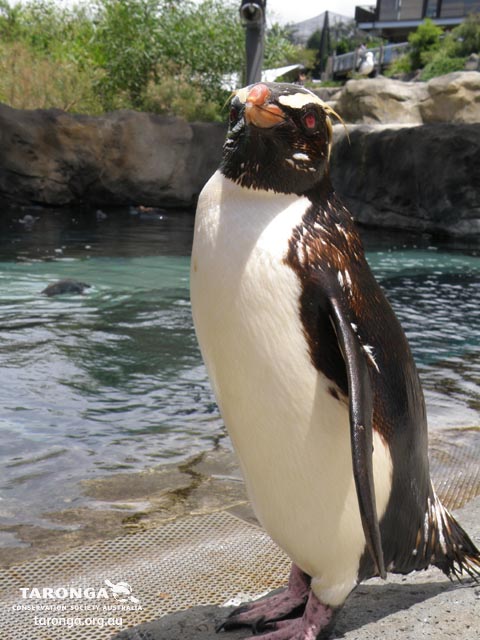
Taronga Zoo's Munro the penguin weighed in at a healthy 3.3kg ahead of his summer moulting.
Unlike most who avoid the dreaded
bathroom scales in the lead up to summer, Munro the penguin happily
stepped up to the challenge during his morning weigh-in at Sydney's Taronga Zoo.
The
frail Fiordland Crested Penguin was brought to the Zoo suffering from
malnutrition after swimming 2000km across sub-Antarctic waters in 2006
weighing only about 2.0kg and has since tipped the scales at a healthy
3.3kg.
"All we need to do is place the scales down and he hops straight on," keeper Jose Altuna said on Friday.
"It's a very positive experience for him and he knows he'll get a tasty fish afterwards."
Munro's mission now is to bulk up in preparation for moulting season, so he'll be consuming 1.2kg of fish each day.
During moulting season Munro won't eat for three weeks but he'll have 2kg of reserve fat to keep him going, Mr Altuna added.
Adelie penguin numbers in East Antarctica have
doubled over the past 30 years, giving scientists hope that the icy
ecosystem is in good health.
In contrast to the western side of
the continent, East Antarctica's climate has remained relatively stable
over the past three decades.
"[On the western side] the duration
of the sea ice season has got shorter by something like 30 or 40 days
per decade. And temperature's been increasing," said Dr Colin Southwell,
from the Australian Antarctic Division.
"In East Antarctica the
changes appear to be more subtle. We know the winds have increased ...
temperatures have only changed a small amount."
The Adelie is a medium-sized penguin, standing up to 70 centimetres tall in the classic tuxedo colouring.
They
are amongst the species famous for using pebbles as a courtship gift.
They use the pebbles to build nests around the whole of the Antarctic
coastline.
Using historical data from 100 penguin colonies in the
East Antarctic — approximately south of the Indian Ocean — the team of
researchers found Adelie penguin numbers had almost doubled since the
1980s.
To make sense of the patchy historical data,
Dr Southwell said the scientists spent considerable effort
"standardising" the data.
"If you go down to any breeding colony
at different times of the year, there will be different numbers of birds
there. So what you've got to do is try to standardise to the same time
of year ... which is really hard to do," he said.
"We put out a
network of cameras across East Antarctica to see how the numbers change
within the breeding season and how much they change from year to year.
We used that information to adjust all the counts."
Penguin numbers particularly jumped about five years after a period of low sea ice.
Dr Southwell speculated that a lack of sea ice might expose more ocean in which young penguins could find food.
While
it would appear that Adelies might benefit from predicted climate
change, Dr Southwell cautioned against too much optimism.
"There
have been predictions for East Antarctica that a decrease in sea ice
would initially be good but then not necessarily and could in fact be
detrimental," he said.
"The rationale is that any creature — including humans — can have too much of a good thing."
Dr
Southwell said they chose to study Adelie penguins because, as a top
predator in Antarctica, their health relied on the health of the animals
they ate.
"They can tell us things about what's happening in the
ocean but we can access them relatively easily because they live on
land," Dr Southwell said.
He said some Antarctic organisations
used the Adelie penguin as one of a suite of species that gave an
indication into the health of the Southern Ocean.
Jinjing, native to chilly Patagonia, keeps returning to a widower on a warm Brazil beach
A Magellanic penguin that migrates
from Patagonia and a retired bricklayer in a Brazilian fishing village
have struck up an unusual friendship. Photo: Paul Kiernan/The Wall
Street Journal
By Paul Kiernan
Oct. 22, 2015
PROVETÁ, Brazil—On a steamy tropical island in Brazil, a tuxedoed traveler found a soul mate.
Why
else would a penguin named Jinjing, native to chilly Patagonia roughly
2,000 miles away, keep returning to a warm stretch of sand in Rio de
Janeiro state during mating season?
João Pereira de Souza, a retired bricklayer, has shared his homestead and sardine supply for four years with the seabird.
The
penguin disappears into the sea for days—sometimes months—only to
return to the spot where Mr. de Souza raises chickens by the beach in
this remote fishing village of 1,300 residents on the island of Ilha
Grande.
During the bird’s visits, the two go for long walks on the beach, swim together in the surf and converse in pidgin penguinese.
“When he returns he’s so happy to see me,” Mr. de Souza says, “he comes up to my neck and hoots.”
Mr.
de Souza, a 71-year-old widower, says the visits started March 20,
2011, when he discovered the bird oil-soaked, lying on the beach by his
shanty.
He moved the ailing avian under his shade tree, force-fed it fish and took it to the water’s edge, expecting it to swim away.
“He
took a drink of water and then came back onto the beach. So I gave him
three more sardines and that was it: He never left me again,” Mr. de
Souza says on a recent afternoon as Jinjing nibbles affectionately at
his hand.
He looks down: “Isn’t that right, Jinjing?”
Jinjing’s
name is a term of endearment in parts of Brazil, and the bird is a
local favorite. “He’s the village mascot,” says Carlos Eduardo Arantes,
the community administrator.
“It spends 10, 12, 15 days away and
then comes back to the same house,” says Mário Castro, a fisherman who,
like most Provetá residents, is well-versed in Jinjing’s story. “It’s an
incredible thing, huh?”
The penguin typically leaves for longer
in February, returning in June. Mr. de Souza says he guessed it was male
and assumed it swam to Argentina to “line up a girlfriend” for
Carnival.
The beach village of Provetá, in southeastern Brazil, where Jinjing the penguin washed ashore in 2011.
Penguin experts say Jinjing’s heart probably desires more than the free fish from Mr. de Souza.
Magellanic
penguins like Jinjing are known for migrating thousands of miles
between Patagonia breeding colonies and feeding grounds farther north.
They typically mate in September, lay eggs, then rear chicks between
December and February.
“It’s all theoretical. I mean, who knows
what goes on in the mind of a lone penguin,” says Dyan deNapoli, a
veterinary nurse who used to take care of penguins at Boston’s New
England Aquarium and has a website called The Penguin Lady.
Because
Jinjing visits Mr. de Souza’s during breeding season, she says, “it’s
possible that he has redirected his natural instinct to mate toward this
guy.” The nibbling is “allopreening,” she says, a courtship behavior
among certain birds.
Another hint at Jinjing’s designs on his
caretaker: “He’s jealous for me,” Mr. de Souza says as the penguin eyes a
visiting reporter with unambiguous suspicion. “He doesn’t let any dog
or cat near me or else he goes after them and pecks.”
When a
neighborhood dog approaches a few minutes later, Jinjing lunges, beak
agape and flippers flaring. The pooch skedaddles. Protectiveness of
mates is common as the birds drive off competitors, Ms. deNapoli says.
Mr.
de Souza played hard-to-get shortly after Jinjing first arrived,
putting it on a boat headed to a different beach. The captain tossed it
overboard miles away.
Jinjing beat the boat back.
“I never saw a critter get so attached,” Mr. de Souza says. “You can let him go wherever you want, but he’ll come right back.”
During visits, Jinjing stays outside in a special enclosure, otherwise following Mr. de Souza around much of the time.
The
man addresses the bird in a high-pitched voice. He says the penguin’s
call to him, an extended honk, sounds like his own first name:
“Joaaaao!”
When Mr. de Souza strolls the beach with his feathered
friend, they sometimes walk on the sand together, or Jinjing swims
alongside.
Occasionally, Jinjing gets in the water and calls out
to him, says Mr. de Souza’s daughter. When Mr. de Souza gets in for a
swim, she says, Jinjing excitedly circles him.
Despite their
reputation as cold-water animals, penguins aren’t unheard of in Brazil,
where northbound currents occasionally deposit them, weak and hungry.
Overfishing and climate change may be driving them farther into the
tropics, some scientists say.
A team of Magellanic-penguin
researchers at the University of Washington, reviewing Jinjing’s photo,
say he looks like a young male and his behavior sounds consistent with
male breeding patterns.
“If a female is not successful at laying
eggs with one mate, she’ll leave him,” says Caroline Cappello, one of
the researchers. “The males sort of just try to get any lady they can.”
Ms.
Cappello says Jinjing’s behavior reminds her of a male Magellanic
penguin near her team’s Argentina field site, which grew fond of the
researchers more than a decade ago and hasn’t found a mate since.
“Every
morning when we go down to get our gear out, he comes waddling out from
his nest and says hi,” she says. “I don’t know what he thinks is going
to happen.”
Jinjing has won celebrity through local television
broadcasts. Fishermen give Mr. de Souza sardines when he goes to the
nearest city for his social-security check.
Magellanic penguins live roughly 20 years on average, so the friendship may last a while.
Mr.
de Souza’s daughter, Mery Alves de Souza, says he fusses so much over
Jinjing that it is hard to persuade him to visit his real children in
Rio de Janeiro, six hours away.
In June, he planned to stay in
Rio a week but returned home after two days, fearing Jinjing wouldn’t
get enough to eat. “We call him and tell him to come visit and he says,
‘OK, OK,’ ” she says. “But then he doesn’t.”
The rugged Otago
Peninsula dramatically splits off from New Zealand's South Island near
Dunedin, resulting in a gorgeous stretch of soil that honestly feels
more island than peninsula.
This locale is an easy day trip from
Dunedin, and one of the main draws of the Otago Peninsula is the chance
to see wildlife like albatross, seals and penguins in the wild.
I repeat: real, live, penguins.
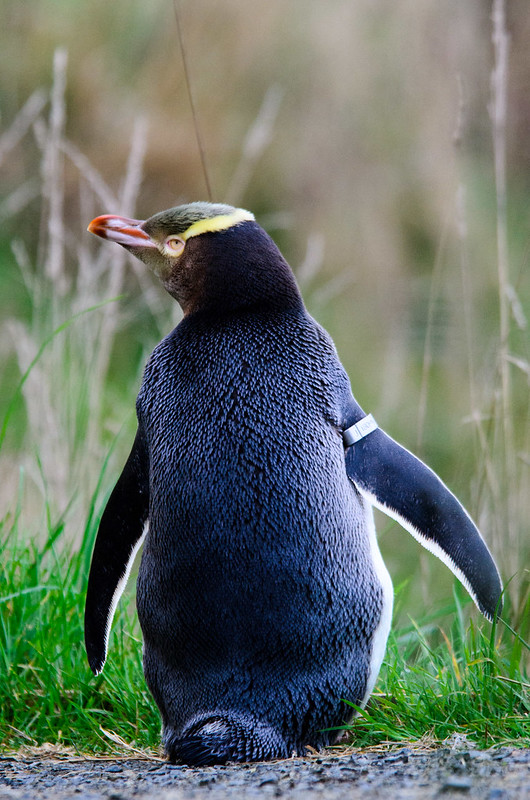
Yes,
the peninsula is home to both endangered Yellow Eye penguins and Little
Blue penguins, which use its coastal waters and sands to breed and
nest. And the best part is, you can go out and see them for free!
Seeing
them is never a sure thing, of course, as wild animals are
unpredictable. But odds are if you head out to Pilot Beach around sunset
and wait, you will soon be treated to a procession of Little Blue
penguins coming home after a long day of doing whatever it is penguins
do.
Instead
of making it a day trip like most people, we decided to spend the night
out on the peninsula, thus increasing our odds that we would see our
fair share of the adorable little tuxedo wearing furballs. We even
decided to stay at Penguin Place, which is a rehabilitation center
dedicated to helping the Yellow Eye penguin thrive. When we arrived, we
were told that they offered tours of their facility, including something
called “up close penguin encounters” — for a price mind you — but we
decided to save our dollars and just get the “Little Blue” show on the
beach for free, thank you very much.
We bided our time in our
room, and then as dusk was approaching, shuffled down the driveway of
Penguin Place and off to the beach where the penguins made their much
ballyhooed arrival each evening. We took our position among a small but
dedicated crowd, all excited to see some penguins. Some took selfies,
some made polite conversation with fellow penguin-heads, and still
others put on head-to-toe penguin outfits, hoping it would attract the
real thing.
Ok, maybe I made that last one up.
As darkness
slowly started to descend upon us, there were no penguins in sight, but
no one was panicking. We went with it, assuming this must be the normal
procedure. Then all of a sudden something shiny was spotted in the
water. We waited. We hoped. Then we sadly discovered it was just a
seal's head. Normally, the sight of a seal in the wild would be enough
to get excited about, but we weren't interested in seals on this
evening, so we rolled our eyes at the opening act and kept our eyes
focused on the prized penguins.
Minutes went by, wind whipped,
morale sagged, and — most importantly — light disappeared, and we now
found ourselves a slightly smaller mass huddled together on the beach.
That's
when I heard it — the pitter-patter of tiny feet on the beach. I called
out to everyone "I can hear them, they're finally here!" People rushed
back from their car, fired up their cameras and got ready for the
long-awaited payoff.
Except they weren't there.
To this day,
I still don't know what I heard that night on the beach, but it
definitely wasn't penguins.
After one more false alarm that turned out
to be a soda can floating in the water, the dejected group dispersed. We
hitchhiked with a friendly local family back to Penguin Place, and once
we were loaded into the back of their SUV, the Mom of the family leaned
back to us and said something that has stuck with me ever since:
"Shame the penguins were a no show, huh?"
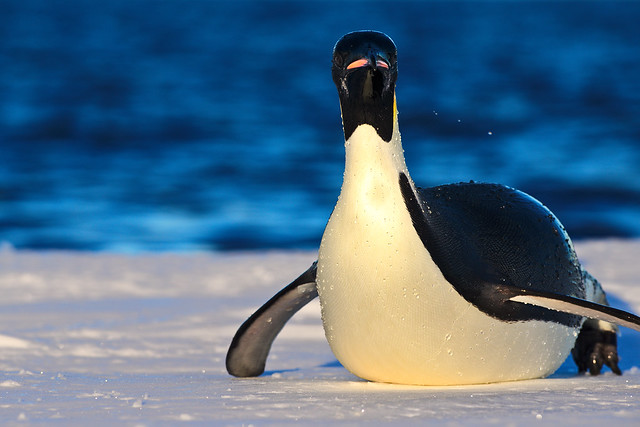
Emperor penguins eat, sleep and breed in
one of the harshest environments in the world -- icy Antarctica, in
temperatures that can dip below -40 in the winter. It would be easy to
assume that they have the thickest, densest feathers in the bird world.
But
a new study reveals that’s not the case -- and that penguin coats are
much more complex insulating structures than previously believed.
The findings, published in the Proceedings of the Royal Society B,
could lead to a better understanding of penguin physiology -- and
perhaps one day inspire makers of insulating materials.
Lead
author Cassondra Williams, a comparative biologist at UC Irvine, said
she first became interested in this question when she and her colleagues
read in popular media and elsewhere that penguins had the highest
feather density among birds -- but they couldn’t find an original source
for that statement.
The
numbers in the literature related to the penguins’ contour feathers
-- the stiff, shapely plumes that resemble those used in quill pens. The
contour feathers encase the body and the insulating layers below,
keeping the cold water out and maintaining the body’s sleek profile.
Estimates on these feather densities were all over the place -- some
said there were 11 feathers per square centimeter; others said there
were around 46.
But
Williams and her coauthors had access to the bodies of penguins that
had died on the ice, and they decided to put the mystery to rest, using
three different birds. They soon found that counting penguin feathers
was no easy task.
“Anytime we would try to even pull out a feather
or separate the feathers with just our fingers, a lot of downy bits
would come up,” she said, resulting in “a lot of tiny bits of downy
feathers flying in the air.”
So the researchers snipped off the
feathers -- as if giving the birds a close haircut -- and then counted
the clipped feather shafts.
To
their surprise, they found that while the feather density varied
slightly from penguin to penguin, the contour feather density was around
9 per square centimeter -- less than a fourth as many as described in
many previous papers.
And the emperor penguin definitely did not
have the highest density of contour feathers in the bird world, they
added: The white-throated dipper's feather density is more than six
times higher.
But a big surprise lay beneath those contour
feathers. Penguins, as it turns out, have several types of feathers,
including after-feathers -- little downy bits that are attached to the
contour feathers -- and plumules, downy feathers that are attached
directly to the skin. The emperor penguins had about four times as many
downy plumules as contour feathers, so the plumules probably play a
major part in the penguins’ insulation.
Strangely, few papers had ever mentioned the presence of these plumules and the role they play, Williams said.
Nor
did other scientists seem to notice even tinier feathers called
filoplumes, which are hard to see without a microscope. These tiny
feathers, which look like long stems with barbs at the very end, are
used by flying birds to help sense when their plumage is disheveled, so
they can groom it back into a more aerodynamic shape.
Though this
idea hasn’t been tested, it’s possible that these penguins are using
filoplumes to keep their contour feathers streamlined to minimize drag
in the water.
The findings may cause scientists to modify their
understanding of how penguin bodies work and how they move. For example,
researchers have long thought that penguins store air in their
insulating feather coats so that they can release tiny bubbles that
allow them to further reduce drag as they swim. Williams said these
delicate, downy plumules could produce even tinier bubbles than the
contour feathers, improving that drag reduction even more.