Friday, November 6, 2009

Meet Bert and Ernie


EcoWorld Aquarium Nicknamed Two Little Blue Penguin Chicks "Bert and Ernie"
Wed, 11/4/2009 - 7:56 AM

By John Reuhman

Picton, New Zealand - New father Regan Russell is taking extra care of the latest arrivals at EcoWorld Aquarium. The two Little Blue Penguin chicks have been affectionately nicknamed “Bert and Ernie”.

In response to a distress call from a concerned member of the public Regan, EcoWorld's manager, rescued the two starving penguin chicks from the Picton Foreshore.

“The chicks are very lucky to be alive. I found them in a poor state, starving and shivering. They were next to the mauled body of an adult penguin. Mum maybe.

It looks like a dog might have attacked the penguin and killed it.

I went back the next day and sadly I found two more dead penguin chicks. They look like might have also been savaged by a dog, perhaps one of those randoms allowed to run loose on the Picton Foreshore ! We hear quite a bit about penguins being hammered in and around Picton”.

Regan and the staff at EcoWorld Aquarium are really taken with Bert and Ernie, who are thriving on their diet of salmon smelt.

“The new penguin chicks are in safe hands getting twice daily feeds of salmon smelt. They're really ravenous. We weigh them each day to check on their progress. We hope they'll be released back into the wild around Christmas time.

We expect to be caring for more injured penguins over the summer. We've established a refuge and safe breeding area with 10 nest boxes. The penguins will be free to come and go as they please”.

Korora or Little Blue Penguins (Eudyptula minor), are found all along New Zealand's coastline and often fall prey to rats, cats, dogs and other predators. Little Blue Penguins are in decline in the wild, especially in areas where they are not protected from predators. The Department of Conservation now ranks them as “Lower risk – near threatened”.

If anyone finds an injured or ill Little Blue Penguin they should contact the local DOC office.

Photo: 1 year old Finn Russell gets up close with new local Ernie

To view EcoWorld Aquarium's web page on Zoo and Aquarium Visitor, go to: http://www.zandavisitor.com/forumtopicdetail-3116-EcoWorld_Aquarium

Source:
http://www.zandavisitor.com/newsarticle-2478-EcoWorld_Aquarium_Nicknamed_Two_Little_Blue_Penguin_Chicks_Bert_and_Ernie

The story of penguin’s love for zookeeper


Peter Vollbracht and Sandy

From The Times
November 5, 2009
Germany transfixed by story of penguin’s love for zookeeper

Roger Boyes in Berlin


When Sandy started her search for a mate, Peter must have looked quite a catch: almost 6ft, no beak but an impressive moustache, fluent guttural German rather than an irritating high-pitched squawk. Put him in a tux, she must have thought, and he would do — a man to lay eggs with.

The tale of Sandy, 14, a South African penguin, and Peter Vollbracht, 47, a zookeeper, is a saga of enduring love, separation and fidelity that has captivated Germany — a parable for a society troubled by high divorce rates and marital breakdowns.

Penguins are till-death-do-us-part monogamous and as a result are very selective when choosing a mate. Yet soon after arriving at Münster Zoo in northwest Germany at the age of 2, Sandy had Mr Vollbracht in her sights.

There must be something about German zookeepers.

The celebrity polar bear at Berlin Zoo, Knut, became attached to his keeper Thomas Doerflein, who strummed Elvis songs while the cub was in intensive care. Mr Doerflein hand-reared the bear, rescued him from the compound in Berlin zoo, helped him through teething, taught him to swim and to dribble a basketball. Mr Vollbracht went down a similar route. He and Sandy became inseparable. When the keeper took the zoo’s 80 penguins for their daily waddle, Sandy would skip to the front so she could walk next to her man.

Despite what the advertising world may have you believe, it is extremely difficult to pick up a penguin. If humans get too close they think they are under attack, and hack at them with their sharp beaks. But Sandy allowed Mr Vollbracht to carry her around. Soon she became Germany’s most strokable penguin. School classes, lovers seeking inspiration, even clinically depressed patients advised that man-to-bird touching could be helpful, all flocked to the zoo. Inevitably, the two appeared on television and in films.

Penguin Overboard, a made-for-television drama, features the kidnapping of Sandy; her rescue brings together a female zoo director and a shabby-looking but warm-hearted keeper. For some Germans at least, Sandy seemed to possess Cupid-like match-making powers.

But then Mr Vollbracht slipped a disc and was off work for two months. Sandy must have assumed he had died and she was therefore no longer bound by her penguin vows. She found an adequate mate, Tom — no moustache, no gumboots, but at 5 years old, significantly younger. Last year Tom and Sandy started a family, and had two chicks. “Ultimately it was better for her to live a normal penguin life,” said Mr Vollbracht, who is married with a human wife and two children.

Six weeks ago Tom died. The chicks were fostered out, and Sandy, back on the singles market, immediately took up with her old flame.

“After Tom died she was looking for someone and I was there,” he said. One day Sandy will have to find another penguin, but for now she is happy with Mr Vollbracht.

“We can’t find her a partner,” said Mr Vollbracht. “It’s her decision.”

Source:
http://www.timesonline.co.uk/tol/news/world/europe/article6903709.ece

March of the Penguins - Limited Edition Giftset


March of the Penguins - Limited Edition Giftset
Written by Jess Goodwin
Wednesday, 04 November 2009

Movie Score:

8.0
Picture:

8.0
Sound:

8.0
Extras:

9.0
Score:

8.0
Director(s): Luc Jacquet
Writer(s): Jordan Roberts and Luc Jacquet
Starring: Morgan Freeman
Genre: Children & Family • Documentary
Website: http://www.warnerbros.com/
Release Date: November 03, 2009
Rated: G
List Price: DVD - $35.99
Amazon:

March of the Penguins, Luc Jacquet's 2005 documentary about Antarctica's emperor penguins and their harrowing annual journey to complete the circle of life, will melt even the iciest of hearts. It showcases an odd dichotomy — unbearable cuteness and sniffle-inducing sadness — that will pull at your heartstrings no matter how many times you watch it. If you don't shed a tear or two, out of sorrow or otherwise, you're probably a sociopath.

Narrated by Morgan Freeman (before there was any question about whether or not it was okay to be Morgan Freeman), the story appeals to a number of emotional triggers; you'll laugh, you'll cry (hopefully), you'll worry. The movie's stance on its subject matter is for the most part objective, but the content is delivered in such a way that you can't help but feel for these penguins. As Freeman points out, “They're not that different from us, really.” They're mating rituals echo our own, as does their devotion to their children. The similarities are what get you — they may just be animals, and it may just be nature taking its course, but it's still sad when a penguin, weakened and fatigued, gets left behind to disappear into the cold, or when a couple loses its chick to the harsh weather, or their own inexperience or bad luck. We don't know what the penguins might be thinking, if it can even be explained in a way that we would understand, but we can imagine that a mother cries out when she returns from her long quest for food to find that her chick has not survived, or the crushing disappointment a father might feel when his newly-hatched chick freezes to death. One particularly heart-wrenching moment reveals a mother penguin bemoaning the loss of her chick, frozen in a surprise blizzard.

This is surely what made this film as wildly popular as it is. It did well at the box office, bringing in roughly fifteen times as much as it was made for, and took 2005's Academy Award for Best Documentary Feature, along with a slew of other awards. Audiences young and old loved it, and even if you've already bought March on DVD, this new edition is well worth it.

DVD Bonus Features:

Why is it worth it? The extras! Along with March, Disc One includes “Of Penguins and Men,” an hourlong documentary about the making of March of the Penguins; National Geographic's “Crittercam: Emperor Penguins,” featuring footage taken by cameras attached to some of the penguins; “8 Ball Bunny”, a classic Looney Toons cartoon about Bugs Bunny's attempts to help the adorable albeit overly-sensitive little Playboy Penguin, who gets left behind while his stage show heads out of town; and the trailer.

On Disc Two of this edition is another hourlong documentary, On the Wings of Penguins, which chronicles the African penguin, or “jackass penguin.” It seems a bit more geared toward the kids, what with the kitschy music and sometimes goofy post-production shot edits; but it's informative and cute, and while by no means comparable to March, is a decent supplement.

The set also includes a stack of stills from both March and Wings, and, what may be the best part of this release, the softest stuffed toy penguin ever.

Source:
http://www.justpressplay.net/movie-reviews/929-dvd-reviews/6121-march-of-the-penguins.html

Image of the Day


DSC_1978
Originally uploaded by orclimber

Thursday, November 5, 2009

Image of the Day


Walk on the beach
Originally uploaded by Faland 95
King Penguins at Volunteer point, Falkland Is.

Wednesday, November 4, 2009

Tuesday, November 3, 2009

Satellite to spill penguin secrets

empororpenguinchick.jpg
The study will reveal where emperor
penguin chicks go to feed and how deep
they dive.
Image: Robyn Mundy

Satellite to spill penguin secrets
Tuesday, 03 November 2009
Australian Antarctic Division


With the help of satellite trackers, the foraging habits of emperor penguin chicks will be studied by Australian scientists this summer.

Researchers from the Australian Antarctic Division will fit tracking equipment to several chicks at the Amanda Bay Colony, near Davis station.

The trackers will provide real-time data on where the fledglings travel and how deep they dive.

Seabird ecologist, Dr Barbara Wienecke, said previous research has focused on the feeding behaviour of adult birds.

"We know the adults can travel up to 140 km a day and dive to a depth of more than 500 metres in search of fish," Dr Wienecke said.

"What we don't know is how these amazing skills are developed, so by tracking the fledglings we will be able to record from their very first dive through to when they become highly-skilled predators."

The study will help scientists get a clearer picture of the emperors' foraging areas and where there could potentially be an overlap with commercial fishing fleets.

"If the top few metres of a particular area are fished out this could have a huge impact on the juvenile emperor penguins which may not have the ability to dive deeper for their food," she said.

Dr Wienecke will spend three months in Antarctica undertaking the research.

Source:
http://www.sciencealert.com.au/news/20090311-20150-2.html

Monday, November 2, 2009

Changing Diet

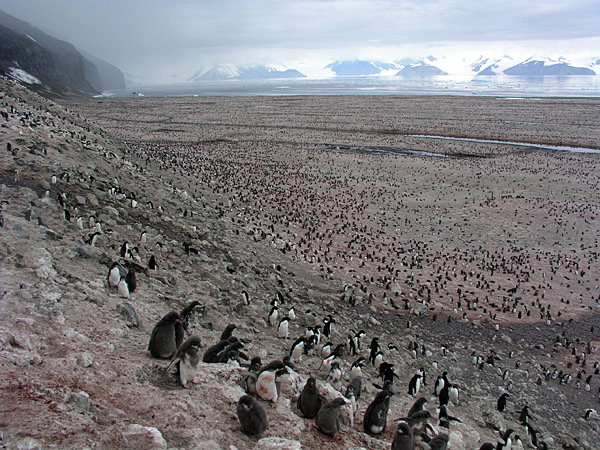
Cape Adare is home to the largest Adélie penguin colony in Antarctica. Until about 200 years ago, when humans decimated whale and seal populations, the penguins subsisted mainly on fish. But the ensuing surplus of krill created by the dearth of top predators caused a shift in diet. Photo Credit: Steve Emslie


Photo Credit: Michael Polito
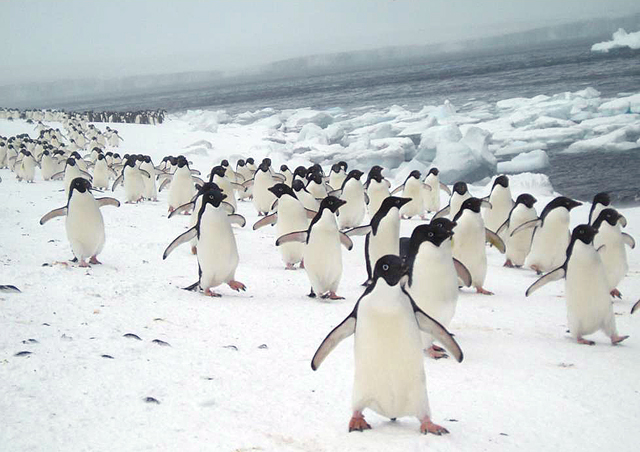
Adélie penguins march along Brown Bluff at the northern end of the Antarctic Peninsula.

Changing diet
Krill surplus 200 years ago may have caused penguins to shift prey preferences
By Peter Rejcek, Antarctic Sun Editor
Posted October 30, 2009

Most of us have heard the oft-repeated phrase, “You are what you eat.” Turns out it’s not just a way for your mother to nag you about your poor eating habits.

By studying the tissue remains of penguins in Antarctica, scientists are not only learning more about the modern diet of the continent’s iconic seabird but also what was on the menu thousands of years ago. And that information can provide insight into past climate and penguin behavior, as well as how the species could respond to future climate changes.

Steve Emslie External Non-U.S. government site, a marine ornithologist in the Department of Biology and Marine Biology External Non-U.S. government site at the University of North Carolina Wilmington External Non-U.S. government site, and his team are in the midst of a five-year grant from the National Science Foundation (NSF) External U.S. government site to determine how changes in climate and penguin prey dynamics have influenced the seabird population.

Much of their work involves collecting tissue samples, such as eggshells and feathers, from existing penguin colonies and long-extinct ones around the Antarctic Peninsula and the Ross Sea regions. Then they analyze the samples in the lab, looking at the ratios of carbon and nitrogen stable isotopes, which can provide important clues to what’s been on the dinner plate throughout the year.

“It’s mainly based on the fact that you are what you eat,” explained Emslie, who will return to McMurdo Station External U.S. government site and Ross Island this summer season to continue his fieldwork as the principal investigator (PI) on the project. “Whenever you eat something, you’re absorbing the carbon and nitrogen isotopes that are stored in that food. That ratio of carbon and nitrogen isotopes will be a part of your tissues as long as you’re eating that food.”

For example, shifts in carbon isotope ratios can indicate if a bird feeds inshore or in the marine environment. Nitrogen isotope ratios indicate how far up or down an animal feasts on the food chain.

“We look at that as a way to assess diet and how it has shifted through time as well with the Pygoscelis penguins, and also through space by the different colonies in the different regions of the Antarctic,” Emslie said.

In a study published two years ago in the journal Proceedings of the National Academy of Sciences, Emslie and collaborator William Patterson suggested that the krill-centric diet of today’s Adélie penguin is a recent phenomenon, a shift that occurred maybe 200 years ago. Their suggestion is based on a change in the nitrogen stable isotope ratio in penguin tissue.

Two hundred years ago is about the time when whalers began decimating the waters around Antarctica of krill-eating whales and seals, creating what Antarctic scientists in the 1960s and 1970s labeled as a “krill surplus,” Emslie said.

“It makes sense,” he said. “Krill per gram are just as rich in protein as fish but during a krill swarm, you can gather a lot more food a lot more quickly than you could in a school of fish. We think that’s probably why they did that switch — when krill became more abundant — even though fish were probably still available.”

Now the scientists are testing the idea further by looking at gentoos, another Pygoscelis penguin, a mostly subantarctic bird that is pushing its way across the northern end of the Antarctic Peninsula as the climate there warms and the Adélie population declines.

“We’re not sure it will show up because gentoos are known to eat a lot more fish and squid in their diet anyway compared to Adélies,” Emslie said.

The scientists know the shift in diet for the Adélies in the Ross Sea region is relatively recent because tissue samples dating back at least 40,000 years from extinct colonies in the region suggest a diet richer in fish. “Surprisingly, there weren’t any noticeable shifts [in diet] between warm and cold [periods] that are known from ice core records,” Emslie said.

“That was kind of a surprise as to why there would be a sudden shift in diet historically that wasn’t related with these climate intervals,” he said, referring to the krill surplus that resulted from whaling.

Emslie said it’s difficult to pin down an exact date on when Adélies began to prefer krill, but it was certainly happening by the beginning of the 20th century based on an analysis of Adélie eggs stored in explorer Robert F. Scott’s Hut on Cape Evans that were collected from a nearby colony sometime between 1911-1917.

“They became a nice historical sample to run isotope analysis on to see if the dietary switch had occurred by the early 1900s, and the data suggest that it had,” Emslie said. “On the peninsula you would expect it to occur first because it was hit hard first by the sealers and whalers.”

Research suggests modern Adélie diet not as krill-centric as scientists once thought

Michael Polito External Non-U.S. government site, a graduate student in Emslie’s lab External Non-U.S. government site and co-principal investigator on the project, has been working around the Antarctic Peninsula collecting penguin tissue samples from extant, or existing, colonies. By comparing the data from the stable isotope analysis to what other penguin researchers have found by physically looking at the stomach contents of the penguins, Polito hopes to refine the isotope methodology.

“They’re both useful, especially when you can use them together you can get more information than you could get just by one method alone,” he said.

For instance, it’s possible to determine the exact species of fish from stomach contents, but underestimate the mass of fish consumed, as fish digest rapidly in a penguin’s stomach, Polito said. In contrast, the stable isotope method can’t readily determine what fish species the penguins are eating, but it can provide a good estimate on how much fish the penguins consume versus krill and other prey in the ocean.

In addition, stomach content data are limited to when the penguins are on land rearing their chicks. The isotope method can also provide information about penguin diets outside of the breeding season.

And based on early results, it appears the Adélies aren’t always as reliant on krill as one might suppose from looking at what’s in their bellies during the austral summer.

“We’re definitely finding that the isotopes in general do predict a higher composition of fish in the diet than the stomach content do. It still looks like during the chick-rearing period krill are still dominant,” Polito said. “Based on the isotope data, fish appear to be relatively more important to penguins during the pre-breeding period than the breeding period.”

That finding is important but puzzling. Researchers working along the Antarctic Peninsula have reported that Adélie colonies are disappearing, their fate apparently linked to the diminishing sea ice in the region from warming temperatures. Krill also use sea ice as a key habitat. Hence, the Adélies face a double climate whammy — loss of their sea ice habitat and loss of a primary prey.

But if fish still remain a staple, why are Adélie numbers declining so dramatically? Scientists don’t really have an answer at this point. Emslie noted that part of the problem is that fish have become highly depleted as well from fisheries. “That means they have no other choices left,” he said of the Adélies.

Polito’s work to improve the isotope methodology also involves determining what other variables may be at work influencing the carbon and nitrogen ratios. For example, it turns out the size of the krill — from the juvenile stage to the adulthood — might affect their stable isotope ratio.

“Once we know how variable krill is and why it’s variable, that’s going to allow us to predict with greater accuracy the penguin diet itself.

“The modern work that we do is really designed to gain more insight about the past as well as the future,” Polito added. “We want to know how penguins respond to changes in their environment, be it climate or food availability.”

NSF-funded research in this story: Steven Emslie, Michael Polito and William Patterson, University of North Carolina Wilmington, Award No. 0739575

Source:
http://antarcticsun.usap.gov/science/contentHandler.cfm?id=1938

Penguins on the Edge

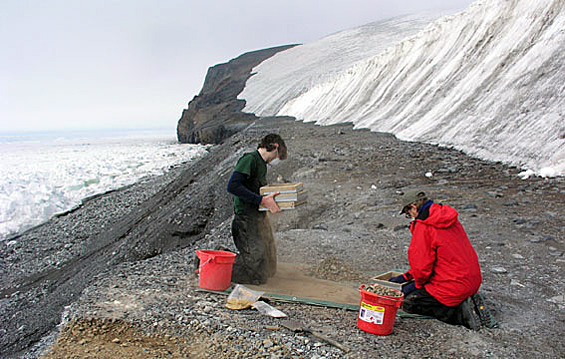
Scientists use screens to sift through dirt on Beaufort Island, searching for remains of ancient penguin colonies. Ornithologist Steve Emslie has found remains as old as 40,000 years on Beautfort Island.


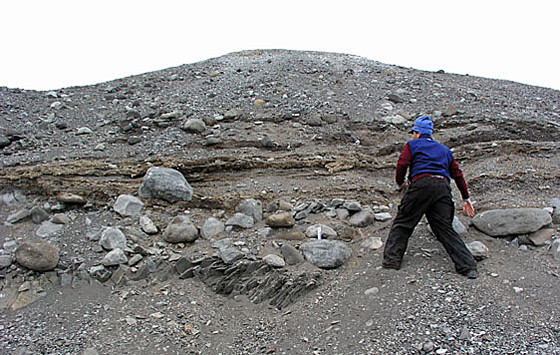
A scientist examines molt layers in a glacial moraine on Beaufort Island.

Penguins on the edge
Location of ancient colonies follow the ebb and flow of Antarctic ice
By Peter Rejcek, Antarctic Sun Editor
Posted October 30, 2009

Location, location, location. For marine ornithologist Steve Emslie External Non-U.S. government site, the long-abandoned homes of Adélie penguins in Antarctica are markers in time that help define how far the continent’s ice sheets advanced and retreated for the last 45,000 years.

“The whole pattern of the colonies coming in and out of the Ross Sea fits really nicely with the forward and backward movement of the ice sheet,” said Emslie, the principal investigator on a National Science Foundation External U.S. government site grant to study how population dynamics of the three Pygoscelis penguin species in Antarctica relate to changes in prey availability and climate.

Scientists have a pretty good idea of what the climate in Antarctica was like over the last 45 millennia thanks largely to the atmospheric record from ice cores. Less well known is the location of the ice sheet edge as the atmosphere alternately warmed and cooled.

By locating and dating Adélie penguin colonies, mainly in the Ross Sea region, Emslie has been able to interpret how the ice moved. That’s because penguins re-establish their seasonal colonies in the same ice-free areas every year unless conditions force them to move.

For instance, in a study published in Geology in 2007, Emslie and his colleagues, geologists Larry Coats and Kathy Licht, determined from the existence of former colonies along the Victoria Land coast that open water existed in the southern Ross Sea from about 40,000 to 27,000 years ago. Then the ice began to advance, reaching as far as Coulman Island, about 300 kilometers north of the current edge of the Ross Ice Shelf External U.S. government site.

The climate pendulum began to swing the other away about 13,000 years ago with the start of the warmer Holocene. As the ice retreated back south, the penguins returned and re-colonized the coast, especially the Scott Coast in the southern Ross Sea, Emslie said.

Then, about 2,000 years ago, a cold snap or perhaps the presence of too much sea ice, caused the penguins to leave their colonies for a thousand years, most apparently retreating to Cape Adare far to the north, where radiocarbon dates indicate that occupation began there at that time.

“Cape Adare is now the largest Adélie penguin colony in the Antarctic, but it is definitely not the oldest,” Emslie noted.

Even after ice conditions became more favorable for the Adélies to return south, they didn’t, except for some apparently intrepid birds that founded the large colonies around Ross Island today, according to Emslie.

“So far, the data indicate that Adélie penguins, even though they’re super abundant on Ross Island today, that only occurred in the last 500 years,” he said. “They still have not reoccupied the Scott Coast, probably because of persistent annual sea ice that blocks access to that shoreline.”

Emslie and members of his research team, including a geologist from China, will revisit previous sites at Cape Bird and Cape Crozier to collect more tissue samples such as feathers, eggshells and even mummified bodies. The scientists use the organic material for radiocarbon dating — measuring the radioactive decay of radioisotope carbon-14 — to determine the age of the remains.
Molt layers in a glacial moraine.
Photo Credit: Steve Emslie
A scientist examines molt layers in a glacial moraine on Beaufort Island.

The field plan also calls for searching for more remains on Beaufort Island, which hosts the oldest samples, dating back more than 40,000 years.

Emslie’s group is one of very few using the historical location of animals like penguins to interpret ice conditions in the past. Another team, led by Brenda Hall External Non-U.S. government site with the University of Maine External Non-U.S. government site, has done similar work in the region using abandoned elephant seal colonies. [See previous article: Cradle to grave.]

Any differences? Well, it sounds like it’s much easier to locate lost penguin colonies than elephant seal colonies, where there are no definite signs to mark the remains, requiring the researchers to get down on hands and knees to search for bits of tissue from skin and hair.

Not so with Adélie penguin colonies, where the birds stack pebbles into little mounds to make a nest.

“Once you have an eye for what an abandoned colony looks like, they stand out pretty well. You can often see them from a distance away,” Emslie said. “I scan large areas with binoculars and tell whether or not abandoned sites are possible.”

Then it’s a matter of digging into the ground in tightly controlled increments, screening for samples. “You excavate them like an archaeological site,” he explained.

“There’s no other place in the world where you can have such good preservation of the same species through time that is also a good indicator of environmental change like the Adélie penguin. There’s nothing in the Arctic that we can use like that,” Emslie said.

“I think it’s pretty remarkable, pretty unique to be able to do this in the Antarctic with these preserved, ancient colonies, some as old as 40,000 years looking like they were abandoned yesterday.”

Source:
http://antarcticsun.usap.gov/science/contentHandler.cfm?id=1941

Image of the Day

This are just some of the Little Fairy Penguins that come ashore every night at Low Head , Tasmania

Did you know that Fairy Penguins are the smallest of Penguins and the only ones to bread in Australian Waters, Bass Strait is the main area of Fairy Penguins in Australia but they are also found in southern waters from Fremantle to Southern Queensland, only breeding as far south as around Port Stevens in New South Wales.

Little penguins in baby boom

Little penguins in baby boom
LORNA EDWARDS
November 1, 2009

LITTLE penguins are experiencing a baby boom at the Phillip Island and St Kilda colonies.

Breeding started early at the Phillip Island colony of 26,000 birds and researchers hope many penguins will have a second brood this season.

The St Kilda population had declined by a quarter to 750 birds last year but with more chicks this spring, researchers estimate their numbers will improve to more than 800 this year.

''It's great to have a nice early start to the breeding season as we haven't had one of those for 10 years,'' said Phillip Island Nature Park research manager Dr Peter Dann. ''There's obviously a lot of food about and that is the primary reason that penguins are doing well.''

Earthcare St Kilda penguin research co-ordinator Zoe Hogg said she believed the decline of the St Kilda population last year was caused by bay dredging reducing anchovy numbers, a primary food source.

''They didn't do very well last year but they are coming good and are obviously well fed,'' she said. ''I don't know if it is the fact there is no disturbance because they feed at the mouth of the Yarra River and in the channel.''

While the St Kilda penguins begin their breeding cycle earlier, most Phillip Island penguins are in the late stages of incubation. About 70 per cent of the eggs hatch into chicks. The chicks then become fledglings and head to sea after eight weeks.

Source:
http://www.watoday.com.au/national/little-penguins-in-baby-boom-20091101-hrn9.html