Friday, April 2, 2010

Nothing Says Easter

Nothing Says Easter Like a Penguin Chick

Film & TV Editor
Photo credit: Ryan Hawk/Woodland Park Zoo

Move over snow leopard cubs, the Woodland Park Zoo has a new baby on the block. A Humboldt penguin chick hatched yesterday. The wee baby penguin (only 2.1 ounces!) is the first offspring for mother Dora and father PJ, both three years old. And there's more where that came from: there's another five eggs--across three penguin pair nests in the zoo's Humboldt colony--at least three of which are believed to be fertile. Dora and PJ have another egg showing "pipping activity," and that egg is expected to hatch on Easter Sunday.

This'll be the first set of penguin babies hatched since the zoo got their Humboldt penguins last year and started on their species survival plan to breed this endangered bird. The chicks and parents will need some time to bond in private, so it won't be until early summer that you'll be able to see these little guys in the cute feathery flesh. By that point, the chicks will have molted from the grayish brown, downy feathers they're born with to completely gray feathers. It won't be till next year that they'll take on their adult look.

Source

Image of the Day


King penguins
Originally uploaded by photographe2
Taken 5 Feb 2010 at Volunteer Point, Falkland Islands.

Thursday, April 1, 2010

Montgomery Zoo Announces Two African Black-footed Penguin Hatchlings

Posted: Apr 01, 2010 3:21 PM CDT Thursday, April 1,2010 4:21 PM EST Updated: Apr 01, 2010 3:21 PM CDT 


The following is a news release from the Montgomery Zoo.
                                                                              
                                  
Montgomery Zoo Announces
Two African Black-footed Penguin Hatchlings

There is excitement at The Montgomery Zoo with the hatching of two Black-footed Penguins.  The eggs were laid on December 19, 2009 and December 22, 2009.  After a maternal incubation period of 39 and 40 days respectively, the eggs hatched January 27th and January 31, 2010.

The chicks named Pen and Guin are growing and doing well because of the care given by their devoted parents. The chicks will be in the nest until mid-April.   You should be able to begin seeing to chicks out of the nest with the rest of the colony beginning around April 11--18, 2010.  After their  initial debut the chicks will be out daily near the African Elephant exhibit pending any severe weather conditions or health related issues.
The Montgomery Zoo currently houses three male and three female penguins. The penguin exhibit is located at the corner of the double decker viewing station at the African Elephant exhibit. 

The Black-footed penguins are native to the rocky beaches of South Africa and do quite well in our Central Alabama habitat.  They reach breeding maturity typically at four years of age.   Penguins breed in nesting colonies with the same mate for life.  Generally, they use the same nest every year.  Penguins typically lay eggs twice a year and the parents share equally in attending the nest.

The City of Montgomery Zoo and Mann Wildlife Learning Museum are open daily from 9:00am to 5:30pm.  Discount combo admission to both Zoo and Mann Museum are: Adults: $14.00, Children 3-12 years old $10.00 and Seniors 65+: $14.00, Children 2 years and younger are FREE.   The admission for adults to the Zoo is $10.00, senior citizens 65+ $9.00 and children ages 3 to 12 years old is $7.00.    Montgomery Zoo members and children 2 years and younger are admitted FREE.

The Montgomery Zoo and Mann Wildlife Learning Museum are located off the Northern Blvd, between Coliseum Blvd and Lower Wetumpka Road.  The address for the Montgomery Zoo is 2301 Coliseum Parkway.  For more information, please call (334) 240-4900 or visit our web sites
www.montgomeryzoo.com and www.mannmuseum.com.  Follow us on Facebook, Twitter and My Space.

The Montgomery Zoo is a department of the City of Montgomery, Alabama.

Happy April Fools' Day from Penguin News Today!

Image of the Day


Galapagos Islands-672
Originally uploaded by Tristan27
Galapagos Penguin

The Galapagos Penguin (Spheniscus mendiculus) is a penguin endemic to the Galápagos Islands. It is the only penguin to live on the equator and can survive due to the cool temperatures resulting from the Humboldt Current and cool waters from great depths brought up by the Cromwell Current. Its nearest relatives are the African Penguin, the Magellanic Penguin and the Humboldt Penguin.

The Galápagos Penguin occurs primarily on Fernandina Island and the west coast of Isabela Island, but small populations are scattered on other islands in the Galápagos archipelago. The Galapagos Penguin is one of the smallest penguins. It is the only penguin to cross the Northern Hemisphere which means they live farther north than any other warm weather penguin. 90% of the Galapagos Penguins live among the western islands of Fernandina and Isabela, but they can also be seen on Santiago, Bartolome, northern Santa Cruz, and Floreana.

The penguins stay in the archipelago. They stay by the Cromwell Current during the day since it is cooler and return to the land at night. The average size for the penguins is 48-50 cm (19-20 in) and 2.5 kg (5.5 lbs). They have a black head with a white border running from behind the eye, around the black ear-coverts and chin, to join on the throat. They have blackish-grey upperparts and whitish underparts, with two black bands across the breast, the lower band extending down the flanks to the thigh. Juveniles differ in having a wholly dark head, greyer on side and chin, and no breast-band. The female penguins are smaller than the males, but they are still a lot alike.

They eat small schooling fish, mainly mullet, sardines, and sometimes crustaceans. They only go search for food during the day and normally within a few kilometers of their breeding site. They depend on the cold nutrient-rich currents to bring them food.

The Galapagos Penguins breed as many as three times a year, since they don’t have a specified breeding season. Because of this, they are able to choose when to breed, and they ultimately decide this depending on food supplies. Before they breed, the penguins molt, and they may do this twice a year. While the birds are molting, they usually stay out of the water. They are able to go to the sea for food rather than starve though since the water is so warm in their area. Since they molt right before breeding, they are sure that they will not starve during the molting process. Granted, that may mean that there is not enough food during the breeding season, but the survival of the adult penguins is more important than the younger ones since they are the ones that make sure the species does not go extinct.

Because of the Galapagos Penguin’s smaller size, it has many predators. On land, the penguins must keep an eye out for crabs, snakes, owls, and hawks, while in the water they must avoid sharks, fur seals, and sea lions. They face many hazards due to humans, as well as the hazards of unreliable food resources and volcanic activity. Illegal fishermen interrupt the penguins’ nesting area by knocking down mangrove trees, and they are often caught in fishing nets by mistake. Much balance has to take place to ensure that the Galapagos Penguins do not become extinct.

Most nests are seen between May and January. The nests are made within 50 meters (164 ft) of the water on the shore. Adults stay near the breeding area during the year with their mate that they have chosen for life. When the penguins are breeding, incubation takes 38–40 days with both parents helping out. After thirty days of the chicks being born and both parents sharing responsibility of taking care of them, the chicks have feathers that are brown above and white below. The purpose of this is to protect the chicks from the strong sun more so than keeping them warm.

The Galápagos Penguin mates for life. It lays one or two eggs in places such as caves and crevices, protected from direct sunlight, which can lead to the eggs overheating. One parent will always stay with the eggs or chicks while the other is absent for several days to feed.

The parents usually only rear up one child. If there is not enough food available, the nest may be abandoned. The temperature at the islands stays between 15-28 degrees Celsius (59-82°F). During the El Niño seasons, the penguins put off breeding since the food becomes short from the effects of El Niño; this in turn makes the chances of raising offspring successfully unfavorable when compaired to the chances of dying in the attempt. They usually breed when the sea surface temperature is below 24 degrees Celsius (75°F) which results in more food for them.

The strong sun is the main problem for the penguins in the Galapagos Islands. The main way they cool off is by going into the water, but they have had many behavioral adaptations because of all the time they spend on land in the warm weather. There are two ways that help cool the penguin in the warmer weather on land. One is by stretching out their flippers and hunching forward to keep the sun from shining on their feet since they can lose heat from their flippers due to the blood flow there. They also pant because they can cool off from the evaporation from the throat and airways.

The species is endangered, with an estimated population size of around 1,500 individuals in 2004, according to a survey by the Charles Darwin Research Station. The population underwent an alarming decline of over 70% in the 1980s, but is slowly recovering. It is therefore the rarest penguin species (a status which is often falsely attributed to the Yellow-eyed penguin). Population levels are influenced by the effects of the El Niño Southern Oscillation, which reduces the availability of shoaling fish, leading to low reproduction or starvation. However, anthropogenic factors (e.g. oil pollution, fishing by-catch and competition) may be adding to the ongoing demise of this species.

On Isabela Island, the introduced cats, dogs and rats attack penguins and destroy their nests. When in the water, they are preyed upon by sharks, fur seals, and sea lions.

Isabella
Shaped like a sea horse, Isabela is the largest of the the islands in the Galapagos, more than 4 times larger than Santa Cruz the next largest. Isabela is 80 miles (100 km) in length and though it is remarkably beautiful it is not one of the most visited islands in the chain. Its visitor sites are far apart making them accessible only to faster boats or those with longer itineraries. One of the youngest islands, Isabela is located on the western edge of the archipelago near the Galapagos hot spot. At approximately 1 million years old, the island was formed by the merger of 6 shield volcanoes - Alcedo, Cerro Azul, Darwin, Ecuador, Sierra Negra and Wolf. Five of the six volcanoes are still active (the exception is Ecuador) making it one of the most volcanically active places on earth. Visitors cruising past Elizabeth Bay on the west coast can see evidence of this activity in the fumaroles rising from Volcan Chico on Sierra Negra. Two of Isabela's volcanoes lie directly on the equator - Ecuador and Volcan Wolf. Volcan Wolf is the youngest of Isabela's volcanoes and at 5,600ft (1707 m) the highest point in the Galapagos. Isabela is known for its geology, providing visitors with excellent examples of the geologic occurrences that have created the Galapagos Islands including uplifts at Urbina Bay and the Bolivar Channel, Tuft cones at Tagus Cove, and Pulmace on Alcedo. Isabela is also interesting for its flora and fauna. The young island does not follow the vegetation zones of the other islands. The relatively new lava fields and surrounding soils have not developed the sufficient nutrients required to support the varied life zones found on other islands. Another obvious difference occurs on Volcan Wolf and Cerro Azul, these volcanoes loft above the cloud cover and are arid on top. Isabela's rich animal, bird, and marine life is beyond compare. Isabela is home to more wild tortoises than all the other islands. Isabela's large size and notable topography created barriers for the slow moving tortoises; apparently the creatures were unable to cross lava flows and other obstacles, causing several different sub-species of tortoise to develop. Today tortoises roam free in the calderas of Alcedo, Wolf, Cerro Azul, Darwin and Sierra Negra. Alcedo Tortoises spend most of their life wallowing in the mud at the volcano crater. The mud offers moisture, insulation and protects their exposed flesh from mosquitoes, ticks and other insects. The giant tortoises have a mediocre heat control system requiring them to seek the coolness of the mud during the heat of the day and the extra insulation during the cool of the night. On the west coast of Isabela the nutrient rich Cromwell Current upwelling creating a feeding ground for fish, whales, dolphin and birds. These waters have long been known as the best place to see whales in the Galapagos. Some 16 species of whales have been identified in the area including humpbacks, sperms, sei, minkes and orcas. During the 19th century whalers hunted in these waters until the giant creatures were near extinction. The steep cliffs of Tagus Cove bare the names of many of the whaling ships and whalers which hunted in these waters. Birders will be delighted with the offerings of Isabela. Galapagos Penguins and flightless cormorants also feed from the Cromwell Current upwelling. These endemic birds nest along the coast of Isabela and neighboring Fernandina. The mangrove finch, Galapagos Hawk, brown pelican, pink flamingo and blue heron are among the birds who make their home on Isabela. A colorful part to any tour located on the western shore of Isabela, Punta Moreno is often the first or last stopping point on the island (depending on the direction the boat is heading). Punta Moreno is a place where the forces of the Galapagos have joined to create a work of art. The tour starts with a panga ride along the beautiful rocky shores where Galapagos penguins and shore birds are frequently seen. After a dry landing the path traverses through jagged black lava rock. As the swirling black lava flow gave way to form craters, crystal tide pools formed-some surrounded by mangroves. This is a magnet for small blue lagoons, pink flamingos, blue herons, and Bahama pintail ducks. Brown pelican can be seen nesting in the green leaves of the mangroves. You can walk to the edge of the lava to look straight down on these pools including the occasional green sea turtle, white-tipped shark and puffer fish. This idyllic setting has suffered from the presence of introduced species. Feral dogs in the area are known to attack sea Lions and marine iguanas.

Galapagos Islands

The Galápagos Islands (official name: Archipiélago de Colón; other Spanish names: Islas de Colón or Islas Galápagos) are an archipelago of volcanic islands distributed around the equator in the Pacific Ocean, some 900 km west of Ecuador. It is a UNESCO World Heritage site: wildlife is its most notable feature. Because of the only very recent arrival of man the majority of the wildlife has no fear of humans and will allow visitors to walk right up them, often having to step over Iguanas or Sea Lions.The Galápagos islands and its surrounding waters are part of a province, a national park, and a biological marine reserve. The principal language on the islands is Spanish. The islands have a population of around 40,000, which is a 40-fold expansion in 50 years. The islands are geologically young and famed for their vast number of endemic species, which were studied by Charles Darwin during the voyage of the Beagle. His observations and collections contributed to the inception of Darwin's theory of evolution by natural selection.

Tennessee Aquarium Penguins News

Tennessee Aquarium's Penguins Will be Given Nesting Rocks on Thursday

Wed, 3/31/2010 - 9:46 AM
By Thom Benson

Chattanooga, TN - Anticipation is building at the Tennessee Aquarium as staff members prepare for another season of romance at Penguins’ Rock. Keepers began by giving the gentoo and macaroni penguins complete physical examinations. While this was going on behind the scenes, other staff members gave the exhibit a thorough cleaning. “We try to disturb the birds as little as possible while they’re nesting, so this is as spotless as the exhibit will be for the next several months,” said Aquarium aviculturist Loribeth Aldrich.

The rocks the birds will use to construct nests have been sorted and sanitized, ready to be given to the penguins at the start of breeding season on April 1st. “Once we give the birds the rocks, the exhibit becomes a busy beehive of penguins scurrying about building nests and stealing rocks,” said senior aviculturist Amy Graves. “This will be especially fun for spring break visitors who sign up for the Keeper Kids penguin observation activity. They’ll get a bird’s eye view of the action.”

Paulie and Chaos, the role model penguin parents who successfully raised Pepper last year, are expected to remain together. They are frequently observed guarding the site where they nested last year. Pepper is often seen standing nearby. “In the wild penguins are monogamous for the breeding season, but may pair up with a different mate the following season,” said Graves. “Penguins on exhibit frequently remain mates for life. It appears as though Chaos and Paulie have a very strong bond.”

Graves anticipates that most of the gentoos will pair up with the same mates again this season, but there are a few twists to watch. “I’ve seen Blue courting Flower which is a little strange. But when this happens, Nipper will waddle over and interrupt them and chase Blue off,” Graves said.

The macaroni storylines could become as interesting as any reality show on television. “You never know about the macaroni pairs until the last minute,” Graves said. “The wild card is always Hercules. He’s our largest macaroni and all the little females absolutely adore him. In fact, all the macaroni females have been seen standing with him at one time or another.” Visitors may want to check the flipper band color chart frequently to see which lady ends up with the dashing Hercules. “His favorite, the one he seems to stand most often with, is Shamrock,” said Graves. “He was with Sweet Pea last year, but she’s been seen a lot with Merlin lately. So who knows?”

While the first rocks will be given to the penguins on April 1st, this process will take several weeks according to Dave Collins, the Aquarium’s curator of forests. “We are going to use nesting platforms this year,” Collins said. “This will allow us to keep the exhibit cleaner without disturbing the birds. It will also help keep the nests separated and away from the narrow points of the walkway. Those locations were challenging for keepers to travel last season.”

Macaroni penguins don’t reach reproductive maturity until they are nearly five years old. So to Pepper, the Aquarium’s first penguin chick from last season, the rocks will be new toys. “I think she’ll enjoy playing around with the rocks. She’ll see the other penguins building nests and she’ll know she is supposed to be doing something, but she won’t quite understand the method behind the madness so to speak,” Graves said.
Visitors can expect to see nest building and courtship activities for about the next six weeks. If the birds are successful, the first eggs may appear at the Tennessee Aquarium around the middle of May.

The Tennessee Aquarium inspires wonder and appreciation for the natural world. Admission is $24.95 per adult and $14.95 per child, ages 3-12. Each ticket purchased helps support Aquarium conservation programs. The IMAX® 3D Theater is next door to the Aquarium. Ticket prices are $8.50 per adult and $6.00 per child. Aquarium/IMAX combo tickets are $29.95 for adults and $19.95 for children. Excursions aboard the new River Gorge Explorer depart daily into “Tennessee’s Grand Canyon.” Cruise tickets are $29.00 per adult and $21.50 per child (3-12). Advance tickets may be purchased online at www.tnaqua.org or by phone at 1-800-262-0695. The Aquarium, located on the banks of the Tennessee River in Chattanooga, is a non-profit organization. Open every day except Thanksgiving and Christmas, the Aquarium and IMAX are accessible to people with disabilities.

To view Tennessee Aquarium's web page on Zoo and Aquarium Visitor, go to:  http://www.zandavisitor.com/forumtopicdetail-364-Tennessee_Aquarium

Source 

WCS Agreement Protects Argentine Penguins

Happy Feet: WCS Agreement Protects Argentine Penguins

By VICTORIA CAVALIERE
Updated 11:05 AM EDT, Thu, Apr 1, 2010

The punk-rock penguins of Argentina are gaining a new marine protected area, part of an agreement sought by the Wildlife Conservation Society to protect a million acres of seascape and the unique creatures who call it home.

The Bronx-based WCS said Wednesday that the new "Penguin Island Marine Park" in Argentina's southern province of Santa Cruz will safeguard 650 square miles of coastline, which is home to the country's only colony of rockhopper penguins.
 
Rockhopper penguins -- who true to their name bounce from rock to rock -- are sometimes described as "punk rock" penguins because of their spiked plumes, bright yellow "eyebrows" and pink feet. The global population of Southern rockhoppers has fallen sharply by about one-third in the last thirty years to roughly one million pairs, WCS said. Currently, the species is classified as “vulnerable” by the International Union for the Conservation of Nature.  Their counterparts in the Indian and Atlantic Oceans, the Northern rockhopper, are classified as endangered.

In addition to Argentina, colonies of the southern rockhopper are found in Antarctica and the Falkland Islands.
While Argentina’s coastline is largely undeveloped, its wildlife is threatened by pollution caused by offshore oil drilling and transport, and by entanglement in nets used by commercial fishing fleets, WCS said.
The park’s creation represents a joint effort by the WCS and the Government of Santa Cruz and Argentina’s National Parks Service.

“This decision by Argentine officials represents a significant commitment by the government to protect an extraordinary marine ecosystem,” said Director of the Wildlife Conservation Society’s Latin American Programs Avecita Chicchon. “The creation of this park will help to ensure a future for the this threatened species in this region and will protect the area's unique natural heritage."

Humboldts Incubate Eggs--It's That Time of the Year

Wednesday, March 31, 2010

Penguin pairs are incubating eggs

Posted by: Shawn Pedersen, Animal Collection Manager

Penguin fans—we’ve got some exciting news for you! Over the last few weeks, three pairs of Humboldt penguins have been busy incubating two eggs each in the burrows we’ve constructed for them in their new exhibit.

This is great progress for our birds and shows us they are comfortable in the exhibit we’ve built for them. These are the first eggs at Woodland Park Zoo to come from this flock of penguins that debuted last May, and we’ve been tracking the development of the eggs around every two weeks with a process called candling. With candling, you use a high powered and focused light for just a few quick seconds to see if the egg is fertile, alive and developing as it should be. You can see some photos of the process below:
 

Depending on how far along in the incubation process the egg is, you should be able to see veins after about a week’s time, and should be able to see movement in the egg about half way through the incubation process.

So far, we have candled the two eggs from the first pair on days 14 and 28 of incubation, and progress continues to look good. Incubation is approximately 41 days for this species.

If all goes well, the chicks may start hatching soon, and we’ll share updates with you as they develop!

Photos by Ryan Hawk/Woodland Park Zoo.

penguins-p-p-p-pick-up-a-pebble


By Cara Sulieman

LOVE IS in the air at Edinburgh Zoo as the penguin mating season gets under way.


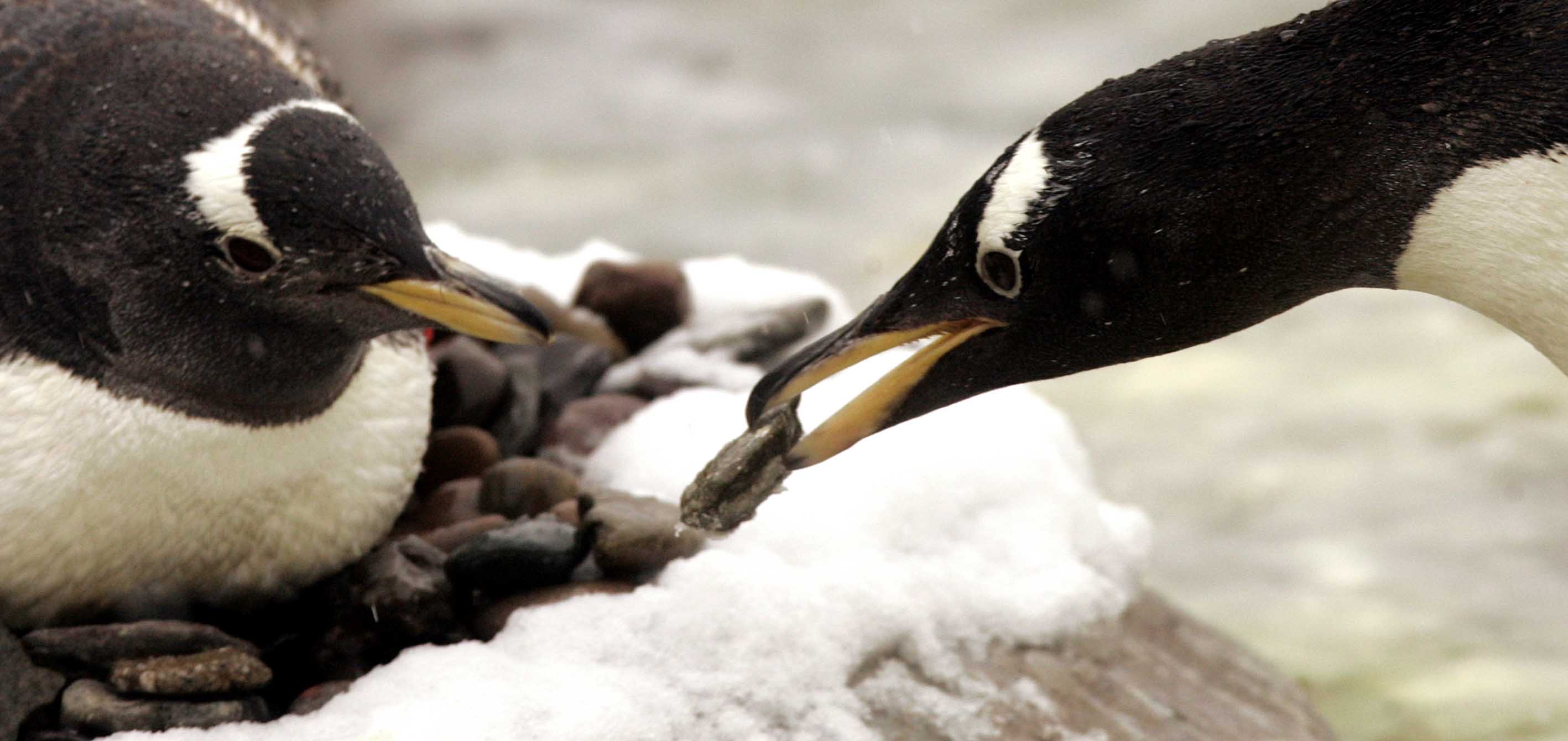
The female gentoo penguins have taken their place on the nesting rings scattered around the enclosure and are waiting for male penguins to offer them a token of love in the shape of a pebble. This unique courting ritual will be played out over the following weeks – and will be broadcast live on the zoo’s webcam. The female bird will only take the pebble that catches her eye, and the male that gives it to her becomes her mate. But there are also cases of “pebble envy” within the group, with sneaky male penguins trying to nab the best looking pebbles from other nests for their own sweetheart.


“Pebble motivated squabbles”

Roslin Talbot, Head Keeper at Edinburgh Zoo said: “Penguins are one of the visitors’ favourite animals in the zoo and this time of year is always a good time to see them as there is lots of activity going on. “Pebble envy is natural gentoo behaviour but as males compete for their female’s affections then we do witness lots of pebble motivated squabbles.”

The birds – which have a bright orange beaks and white stripes on their heads – usually lay two eggs which should hatch in May. Last year the gentoos celebrated a record-breaking mating season with 30 chicks hatched from 112 eggs.

It was the arrival of three king penguins from a 1914 expedition that gave the zoo its global reputation, as these were the first penguins ever seen outside their South Atlantic homeland. Penguins remain one of the most popular attractions at the zoo, with the daily “penguin parade” continuing to attract large numbers of visitors to this day.

The penguin population at the zoo is also celebrating after the birth of a king penguin chick born last October.
Staff recently confirmed that the chick is a male after a blood sample was taken to determine his sex.
Wednesday, March 31, 2010

Source