Rescued penguins to join flock at San Francisco Zoo

Awwww. (Audrey Whitmeyer-Weathers/The Chronicle)
Just in time for winter, six rescued penguins are marching into the San Francisco Zoo.
Three years ago in Brazil,
373 Magellanic penguins
searching for food became stranded hundreds of miles from their normal
feeding grounds. Commercial fishing, which depletes the supply of small
fish, oil pollution and climate change have all made it hard for
penguins to eat in the usual places.
Six penguins deemed too weak to survive in the wild on their own were
donated from the Monterey Bay Aquarium to the San Francisco Zoo,
bringing its total number to 51.
The penguins will waddle into public view for the first time at 9:30 a.m. Thursday at the zoo’s Penguin Island.
source
~~~~~~~~~~~~~~~~~~~~~~~~~~~~~~~~~~~~~~~~~~~~~~~~~~~~~~~~~~~~~~~~~~~~~~~~
Adventure Aquarium in Camden to host African Penguin Awareness Weekend
Published: Tuesday, November 01, 2011
By
Gloucester County Times
CAMDEN — Adventure Aquarium will host African Penguin Awareness Weekend this Saturday and Sunday.
In
support of these adorable, flightless feathered friends, the aquarium
is encouraging penguin enthusiasts to waddle on down to the Camden
Waterfront this weekend — Nov. 5 and 6 — to help support some of the
cutest little tux-wearing tykes on the planet.
The weekend will feature an array of “penguin-centric” activities.
African
Penguin Awareness Weekend will include chances to meet an African
Penguin during up-close penguin appearances and speak with biologists
about these adorable sea birds, take photos with an African Penguin
during one of three daily photography sessions, see and purchase penguin
artwork in a gallery setting originally created by Adventure Aquarium’s
African Penguins, learn more about the aquarium’s Penguin Adoption
Program and purchase your very own penguin footprint to sign and display
for just $1.
Adventure Aquarium is located at 1 Riverside Drive
in Camden. Admission is $22.95 for adults and $17.95 for children ages 2
to 12.
For more information visit,
www.adventureaquarium.com.
source
~~~~~~~~~~~~~~~~~~~~~~~~~~~~~~~~~~~~~~~~~~~~~~~~~~~~~~~~~~~~~~~~~~~~~~
Santa Barbara Zoo Penguin gets new shoe
The Santa Barbara Zoo penguin who wears a custom-made shoe on his right foot now has some new Halloween foot-ware.
Lucky now has an orange and black shoe with a “Jack o’ Lantern face inside Teva’s hand logo.
Adventure shoe company Teva made the shoe for the Humboldt penguin, whose leg did not develop normally.
“We
couldn’t be happier to watch as Lucky adjusts to his healthier and
happier life with his new shoe,” said Teva’s public relations manager
Jaime Eschette. “It’s only fitting to celebrate with his first Halloween
shoe to get him in the spirit for the holidays.”
Teva is also planning to make other shoes for Lucky based on holiday themes.
“These shoes may have saved Lucky’s life,” said Zoo CEO Rich Block.
“Now he can, jump and swim like any other penguin, albeit a very stylish
one. He’s become a favorite of our guests and our staff.”
Humboldt penguins
are threatened in their native habitat along the Pacific Coast of South
America from Peru to Chile, where their populations are in serious
decline. The Zoo opened the Crawford Family Penguin House in June 2006
and now houses 18 individuals.
source
~~~~~~~~~~~~~~~~~~~~~~~~~~~~~~~~~~~~~~~~~~~~~~~~~~~~~~~~~~~~~~~~~~~~~~
Being 5: Penguin Edition
Posted by: Nora Venne, Education
Happy 5th birthday, Zoomazium!
We’re celebrating 5 years of child’s play in Zoomazium with a look this
week at what it means to be 5 for humans and different animals. Then
the party continues this Saturday and Sunday,
Nov. 5 and 6, with cupcakes, live entertainment and birthday-themed
activities at Zoomazium including enrichment treats for some of the
zoo’s notable 5-year-old residents.
In this blog post, we spoke with penguin keepers at Woodland Park Zoo to
learn more about what it is like to be 5 years old for a Humboldt penguin.
Q: Human children
at age 5 are still very young and completely dependent on their families
for care. Give us a brief description of what life looks like for a
penguin. Is age 5 young or older for this animal?
A: Humboldt
penguins are much further along in their maturity by age 5 than humans
are. That’s because the average life span of a Humboldt penguin is
around 20 – 25 years in the wild; 25 – 30 years in captivity. Penguins
grow incredibly fast. A Humboldt penguin chick at age 40 – 60 days (when
it is still on the nest) already weighs as much as its parents—about 7
pounds! At 1 year of age, young penguins lose their juvenile feathers
and get in their full adult plumage complete with stripes and spots.
They reach reproductive age at 2 – 3 years.
 Q:
Q: For humans,
kindergarten is just starting at age 5. Sometimes we go to school away
from our parents and start being independent during the day. When do
penguins start becoming independent from their families and how do they
learn to do so?
A: Penguins begin
to become independent at 70 – 90 days when a fledgling leaves the nest
and is no longer dependent on its parents for food. In the wild,
penguins typically spend their lifetime in the colony, however, once
they are fledged and eating on their own, there is little interaction
between parents and chicks.
Q: Although we are
beginning to be more independent at age 5, we still must be able to
tell familiar people from strangers and know where home is. How does a
penguin know its family and friends from others?
A: As these birds
are a social species and can live in colonies numbering in the hundreds
and thousands, penguins use a few methods to identify each other.
Humboldt penguins each have a series of spots and stripe patterns on
their ventral side and under their flippers. Each pattern is unique to
each individual, much like fingerprints on humans. Penguins also use
vocalizations to communicate. It is believed that each individual
penguin has its own voice unique to itself. This is another way penguin
parents can distinguish their young in a crowd and vice versa.
Q: Kindergarten is
also a time of learning. We learn our numbers, letters and other useful
skills for life (like how to tie our shoes). What kind of skills do
penguins need to learn for life and when and how do they begin learning?
A: Upon fledging
(at around 70-90 days), Humboldt penguin young are led to the water
where parents and members of the colony introduce them to the
fundamentals of survival. These fledgling juveniles quickly learn to
swim and hunt for fish such as anchovies and sardines. Though swimming
and fishing are innate behaviors to penguins, exposure, practice, and
repetition of these activities when they are young will be of continuing
benefit to the colony as they grow older. The sooner individuals can
develop these important skills, the sooner they can participate in
foraging and hunting strategies and contribute to the colony. Practice
makes perfect!
 Q:
Q: An important
step in Kindergarten is learning to share and make friends. How do
penguins make friends and interact with each other?
A: Penguins, in
general, are highly social creatures that typically live in groups of
hundreds and even thousands. A social structure within a group develops
over time and often dominant individuals are at the forefront.
Competition is the name of the game when it comes to penguin survival.
Adapting highly acute senses like eyesight, hearing, touch, and
vocalizations (called braying) help penguins to distinguish and express
who is friend or foe. Body posturing (using head, flippers, bill),
though not easily interpreted by humans, is something penguins seem to
use a lot to communicate. Penguins also bill fence when fighting, and a
mate will tend to their partner's feathers or preen them when
comfortable and relaxed.
source


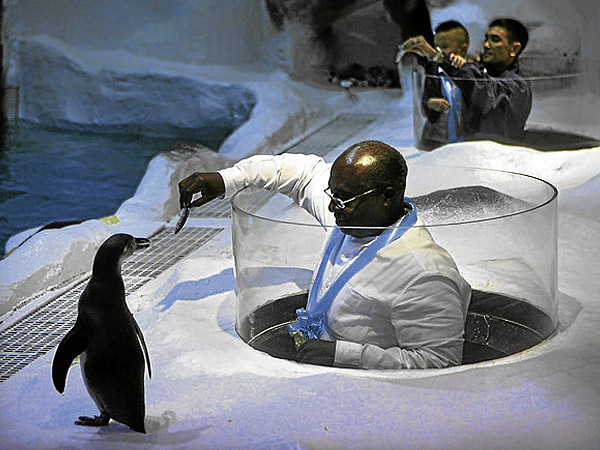


 View full sizeAdventure
Aquarium guests who partake in the "Positively Penguins" experience
will learn all about penguins from biologists and get to see their eggs
(below) and feathers.
View full sizeAdventure
Aquarium guests who partake in the "Positively Penguins" experience
will learn all about penguins from biologists and get to see their eggs
(below) and feathers. View full sizeView penguins eggs while participating in the "Positively Penguins" experience this weekend at Adventure Aquarium in Camden.
 View full sizeBiologist
Jenn Hutchins sits with Little Ditty after he created a painting with
his feet at Adventure Aquarium in Camden. Visitors who purchase a
penguin painting will help in the effort to save endangered wild African
Penguins.
View full sizeBiologist
Jenn Hutchins sits with Little Ditty after he created a painting with
his feet at Adventure Aquarium in Camden. Visitors who purchase a
penguin painting will help in the effort to save endangered wild African
Penguins.


 Davis
Davis
 Casey
Casey
 McMurdo


