Saturday, November 10, 2012

Two penguin chicks born in Oxfordshire wildlife park

By Alis Lewis
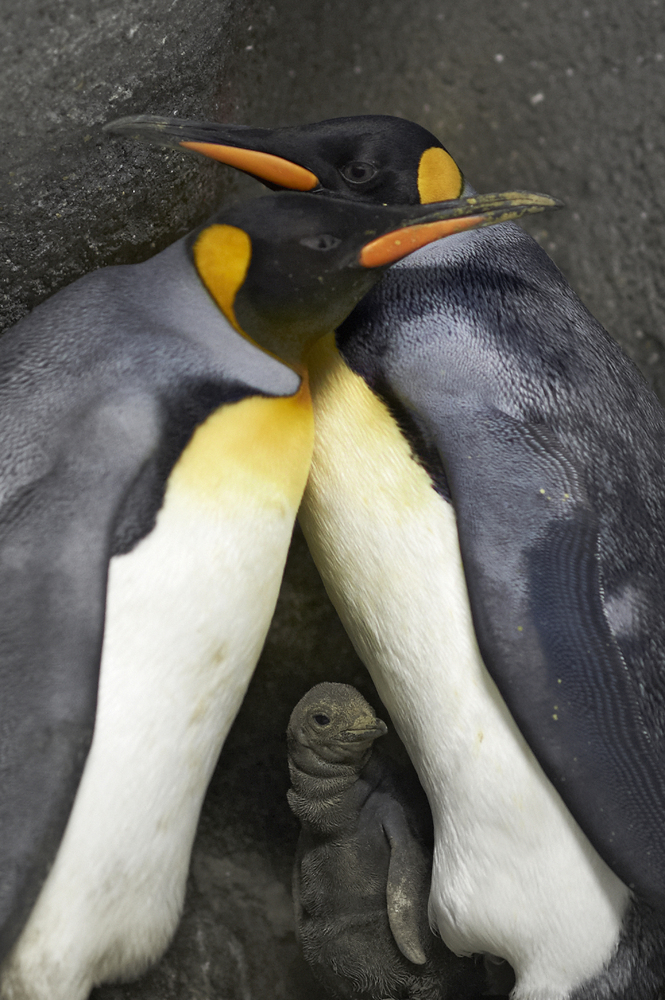
Penguins Heather and Steven have  hatched at the Cotswold Wildfire Park in Oxfordshire a few weeks ago.
These were the first penguin chicks to be born at the park, located in Burford, in the past five years.

Steven (pictured right) and Heather hatched at their home at the Cotswold Wildife Park last month – the first penguin chicks to have been born at the park since 2007.

They will be introduced to the rest of the group in their pool later this month.
Curator Jamie Craig said: “Spring is long since over but something is still in the air at the Park!
“After several barren years, our penguins have produced two chicks which have been hand reared by the bird team.

“This is quite a labour intensive process for the keepers and it is with a hint of sadness that they will be following their integration into the penguin colony.”
The penguins are not the only new arrivals at the park. Four otter cubs – or kits – have recently been born and are reported to be in good health.

But visitors will have to be lucky to catch them – they can prove allusive as they usually only rise from their nest at feeding times or in the late afternoon.
Craig added: “The otters have also surprised us recently and after several weeks of secrecy with the adults keeping a close guard on the holt, the cubs can now be seen out and exploring their home.”

source

AWWW--Denmark's Gay Penguins Become Fathers

Posted:

In what the Toronto Star describes as an "apparent world first," a Danish zoo's King penguin chick has two "adoptive" fathers.

After a female penguin abandoned one of her eggs, zoologists at the Odense Zoo decided to see how two male penguins would handle the egg. As it turns out, they were "natural parents."
"With King penguins, they mix it between the male and female. One stands with the egg while the other goes to feed and then they shift," zoologist Nina Christensen is quoted as saying. "It was the same with this pair. They both incubated the egg.”

Odense Zoo's penguins aren't the first "gay" couple to become parents, even though they are a first as far as King penguins are concerned. Two male Chinstrap penguins at New York's Central Park 'adopted" and then reared an egg, as depicted in the controversial children's book "And Tango Makes Three." Meanwhile, zoologists at Germany's Bremerhaven Zoo helped two "gay" Humbolt penguins hatch and nurture an egg in 2000.

 source

Image of the Day

http://www.desibucket.com/db/02/24641/24641.jpgI'm walking!

Friday, November 9, 2012

Image of the Day

Call of the wild by sugarfreebabe
Call of the wild, a photo by sugarfreebabe on Flickr.

Gay penguins become fathers (Video)


A bromance in a Danish zoo between two male penguins has resulted in their adoption of a baby penguin, and may be the world's first example of gay fatherhood of its kind, a Toronto Star article reported Thursday, November 8, 2012.

The two penguins began their bromance a couple of years ago at Odense Zoo, and although it's not completely unusual in itself, what was unusual was the keepers noticed the two males tried to steal other couples' eggs during brooding season. The job of sitting on an egg is typically shared by both male and female penguins and their relationships are usually monogamous. In this case, when the two males were unable to snitch an egg from another couple, they took to sitting on dead herring to incubate them.

A Toronto Star article stated "The keepers realized they seriously wanted to stay with an egg."
“This year has been extraordinary,” zoologist Nina Christensen told the Star on Thursday.
The parental problem was resolved when one of the zoos' females also started to act oddly, by first laying an egg with one male, dumping him, and moving on to have another egg with another male - then abandoning both him and the egg.

The Star quoted Christensen as saying, "In the lifetime monogamy of the King penguin world, this was “extraordinary."

“Now we have an extra egg and this pair that have been standing with fishes.”
Christensen arranged to have the gay penguins parenting skills tested on a ball, gradually moving on to the egg, and found they were natural parents.

“With King penguins, they mix it between the male and female. One stands with the egg while the other goes to feed and then they shift. It was the same with this pair. They both incubated the egg," Christensen was quoted as saying in the article.

The article said, "The chick hatched about a month ago and the new little family remains separated from the colony while they bond but will soon rejoin them. Penguins recognize their offspring by their distinctive cries, indistinguishable to humans, and this trio are no different, Christensen said."
She said it was hard to tell if this behavior is common in nature, as male and female King penguins look identical, and so from a distance difficult to determine the genders of roosting parents. However, in captivity, this is absolutely a first!

There are two male African penguins at the Toronto zoo who also enjoy a gay relationship, but the pair have not chosen to be parents as of yet.

source

Thursday, November 8, 2012

Image of the Day

Dat Penguin!  
Dolphin curiosity!

Image of the Day

Chinstrap Penguins: Decline due to global warming, not tourism

Antarctica (global-adventures.us):

The breeding population of chinstrap penguins has declined significantly as temperatures have rapidly warmed on the Antarctic Peninsula. A new study indicates that changing climatic conditions, rather than the impact of tourism, have had the greatest effect on the chinstrap population.

“We now know that two of the three predominant penguin species in the peninsula - chinstrap and Adélie - are declining significantly in a region where, in the last 60 years, it’s warmed by 3 degrees Celsius (5 degrees Fahrenheit) annually and by 5 degrees Celsius (9 degrees Fahrenheit) in winter,” said Ron Naveen, founder of Oceanites, Inc. “By contrast, Gentoo penguins are expanding both in numbers and in range. These divergent responses are an ongoing focus of our Inventory work effort.”

Chinstrap Penguins: Decline due to global warming, not tourismThe Antarctic Site Inventory (ASI) has been collecting and analyzing Antarctic Peninsula-wide penguin population data since 1994, and these new findings have important implications both for the advancement of Antarctic science and the management of Antarctica by the Antarctic Treaty nations. The United States is a signatory to the Treaty.

“Our Deception Island work, using the yacht Pelagic as our base, occurred over 12 days and in the harshest of conditions - persistent clouds, precipitation and high winds, the latter sometimes reaching gale force and requiring a lot of patience waiting out the blows. But, in the end, we achieved the first-ever, one-season survey of all chinstraps breeding on the island,” Naveen said.

There has been speculation that tourism may have a negative impact on breeding chinstrap penguins - especially at Deception Island’s largest chinstrap colony, known as Baily Head. Naveen oversaw the Deception Island census effort. Lynch, the Inventory’s chief scientist, undertook subsequent analyses.
The results and analyses shed new light on the massive changes occurring in this region, Heather Lynch, a scientist at Stony Brook University, says. “Our team found 79,849 breeding pairs of chinstrap penguins at Deception, including 50,408 breeding pairs at Baily Head,” Lynch said.

“Combined with a simulation designed to capture uncertainty in an earlier population estimate, there is strong evidence to suggest a significant decline, greater than 50 percent, in the abundance of chinstraps breeding at Baily Head since 1986-87. The decline of chinstrap penguins at Baily Head is consistent with declines in this species throughout the region, including at sites that receive little or no tourism; further, as a consequence of regional environmental changes that currently represent the dominant influence on penguin dynamics, we cannot ascribe any direct link in this study between chinstrap declines and tourism.”

The Baily Head analysis was abetted by Lynch’s analyses of high-resolution satellite imagery. Images for the 2002-03 and the 2009-10 seasons suggest a 39-percent decline during that seven-year period, providing independent confirmation of this population decline.

“While there has been considerable focus in the policy and management community about the potential impact of tourism on these penguin populations, we cannot forget the overwhelming evidence that climate is responsible for the dramatic changes that we are seeing on the peninsula,” Lynch says. “If tourism is having a negative impact on these populations, it’s too small an effect to be detected against the background of climate change.”

The research was funded in part by the National Science Foundation (NSF) and The Tinker Foundation. The image shows an adult Chinstrap Penguin with juveniles. Photo: NOAA/Public

source

Tuesday, November 6, 2012

Image of the Day

A smelly date with penguins but she's in her element

Singaporean in Antarctica gathering data on penguins for research. -ST
Goh Shi Ting

Mon, Nov 05, 2012
The Straits Times 


Ms Goh examining a Leach’s Storm Petrel chick during a field trip earlier this year to Buldir Island, off Alaska. Her latest stint will take her to Livingston Island, off the Antarctic Peninsula.
 
SINGAPORE - While most Singaporeans get to watch penguins only in animal shows on TV and in movies like March Of The Penguins, field assistant Michelle Goh has the chance to do far more - she will be "settling in" among the birds for four months.

The 26-year-old, who left Singapore last Monday, will be based on Livingston Island, off the Antarctic Peninsula, as she collects data on native gentoo and chinstrap penguins.

She has been hired by an American scientist from the National Oceanic and Atmospheric Administration in the US, who is conducting Antarctic marine research for conservation purposes.
For four months, Ms Goh will work with six American scientists and field assistants to keep tabs on penguins that have been tagged with a global positioning system (GPS) tracking device. The researchers will compile a variety of information about the birds, such as how much they weigh and when they lay their eggs.

This will be the first time that Ms Goh, who has a master's in animal conservation from Imperial College in London, will be working with penguins.
Though they look lovable on screen, she knows conducting research on them is another matter.
"Penguins are not easy to handle. They struggle a lot," she said. "I've been told to hold them down by putting them between my legs and shouting 'eeeaaa' so they stay still."

"Without a doubt, this job will make it to Dirty Jobs," she added, referring to the popular Discovery Channel TV show that features extreme work conditions. "I've been to penguin colonies and they are really smelly."

She noted that when people try to hold the birds, they get scared so they defecate.
"There's no point showering every day when we crawl on hands and knees and put our faces on the wall covered with their droppings," she said.

She spoke to The Straits Times two hours before check-in last Monday while stuffing her bag with a fleece jacket, an e-book reader and a soft toy for the 50-odd hour journey to Antarctica.
Her flight will take her to London, Sao Paulo in Brazil, and Santiago and Punta Arenas in Chile. She will then go on a three-day boat ride to reach her final destination.

She will be paid about $5,000 for the whole stint. This time next year, she will return to supervise the next field assistant, for double the salary.
As it is now summer in the southern hemisphere, the temperature does not hit unbearable lows. It is likely to hover around 0 deg C.

When asked why the job appealed to her, Ms Goh said: "There are very few Planet Earth moments, but when they happen, it's really amazing.
"For example, when a bird takes down another bird... when birds mate... and chicks hatch."
Her passion for seabirds grew out of her interest in their behaviour and survival instincts.
"Also, seabirds migrate a lot but they always seem to come back home."

Ms Goh herself returned to Singapore early last year after having lived abroad for nine years since she was 17. She had gone to Norway to study for the international baccalaureate diploma before enrolling at Brown University for a degree in biology, specialising in animal behaviour.
After graduating with a master's, she came back to Singapore, living with her parents in a landed property at Burgundy Estate in Bukit Batok.

But it was not long before she packed her bags again, and made three field trips - to New Zealand, and Alaska and California in the US - on unpaid volunteer stints.
It is a "privileged" lifestyle, admitted Ms Goh, noting that she would not be able to sustain this freelance work without her parents' support.

Her father is a Singapore Airlines pilot and her mother is a financial consultant. She has a younger brother who is a pilot trainee.
"A lot of people tend to think I'm going on a holiday when I do my fieldwork because I'm not really earning as well," she said. "But it is real work."

Being away all the time has made it hard for her to maintain meaningful, long-term relationships.
"In the field, I see the other researchers every single day, and when we leave the field, I never see them again, which is really annoying," she said.
"My best friend in Singapore calls me a 'part- time' friend," she added, noting that while she is in Antarctica, she can keep in touch with her friends only via e-mail.

"Also, there's this boy I'm seeing right now. I really like him, but I'm leaving again, so it's hard."
On the career and relationship fronts, the future might look uncertain, but her wanderlust will probably prompt her to set out again for new frontiers when the next opportunity pops up.
Where to next?

"The next place I want to go to is the Arctic Circle, to see the polar bears before the ice melts," she said.
source

Monday, November 5, 2012

Pen-casso: A West Norfolk penguin gets arty


KLFM News

A modern day masterpiece, created by a penguin at the Hunstanton Sea Life Centre, is being sold at an auction in Norfolk to raise money for charity.

The art work was created after Dimi, one of the resident penguins at the Sea Life Sanctuary, plucked up the courage to wade into water colours left out by the staff.
Dimi then proceeded to create a colourful pastiche of penguin footprints on a blanks canvas to produce an original 'penguini'.

The Operations Manager from the Sea Life Sanctuary, Jana Sirova, chatted to KL.FM's Will Roe about Dimi and the project, listen here:


Auctioneer, Gary Barnes said: "We are absolutely delighted to be involved in the sale of this original and unusual painting.  My children enjoy visiting the penguins at Hunstanton Sea Life Sanctuary as do so many other people.  I suspect there will be a huge amount of interest in it."

Some critics have likened the Penguini style to Andy Warhol's 'Flowers,' while others feel it has more in common with the 'bright and wild' Fauvism movement championed by Matisse.

The auction is on Sunday, hosted by Barnes Auctioneers in Norwich, to raise funds for a brand new Sea Life Marine Conservation Trust, helping fund a wide range of environmental projects.

"It was actually just a bit of fun and a productive way of keeping our resident penguins stimulated," confessed one of their carers, aquarist Hollie Stephenson (pictured).

"Like all animals, penguins need new distractions every now and then to keep them stimulated and healthy, and their art project certainly got their attention.

"It was meant to be a collaboration by all the penguins, but in the end Dimi was the only one with artistic flair."

Dimi is the only one of the nine resident Humboldts – an endangered South American species – yet to find a partner, and staff speculate he found some solace in his artwork for his lonely heart.

Hollie added: "It took nearly a month for the penguins to pluck up the confidence just to walk on a blank piece of white paper, and it was not until the shallow paint trays had been in their enclosure for another four weeks that Dimi finally decided to go for a paddle.

"Dimi enjoyed his brief paddle in the paint, but after leaving his prints on the paper decided he didn't really like having paint on his feet and wouldn't go near the paint trays again.

"So this is the one and only painting he will ever be doing."

source

Image of the Day