Saturday, February 7, 2015

A close encounter with the #penguins of South America

19 hours ago  • 

The sun seems to burn brighter in Patagonia. “The scientists say the ozone is thinner in Patagonia,” Claudia Hume said. Hume was my host and personal guide for my stay in Puerto Madryn, Argentina.
To my untrained eye, it looked to be true.

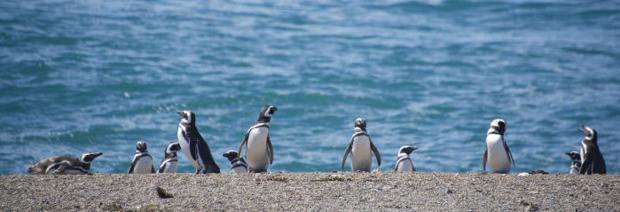
For sure, the penguins that stood in the sun in front of me would probably also agree as they attempted to keep cool in the intense light.


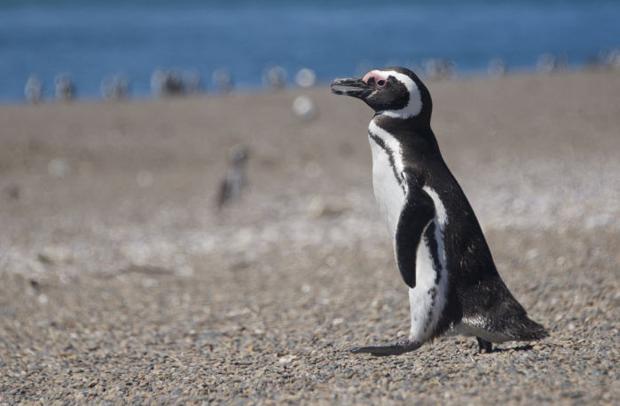
The Magellanic penguins are found on the southern coasts of South America and are named after Portuguese explorer Ferdinand Magellan, who spotted the birds in 1520.

These cute little sea birds grow to be about 2 feet tall and weigh between 6 and 14 pounds. This weight can vary, depending on whether they have a full stomach of food they are bringing for their chicks.

For me, a visit to the Henrly Doorly Zoo in Omaha always included a stop by the penguin exhibit. To see them in the wild, by the thousands, is a whole different experience.

With the help of a friend, I was invited to visit the Estancia San Lorenzo, a location that shelters a reproduction colony of Magellanic penguins. The estancia, or ranch, sits on the shores of the San Matías Gulf, inside the Punta Norte area on the Valdés Peninsula. The entire peninsula is a Unesco World Heritage site and one of the best places to see wildlife in Argentina.

Every year, from August until March, around 200,000 breeding pairs of penguins continue their life cycle at the Estancia San Lorenzo colony. They nest, breed, mate and wait for their eggs to hatch. 

Both parents feed the young and teach them basic strategies to become independent in the sea. “The penguins mate for life, and come back to the same location year after year,” Hume explained. “The male reclaims his burrow from the previous year and waits to reconnect with his female partner.”
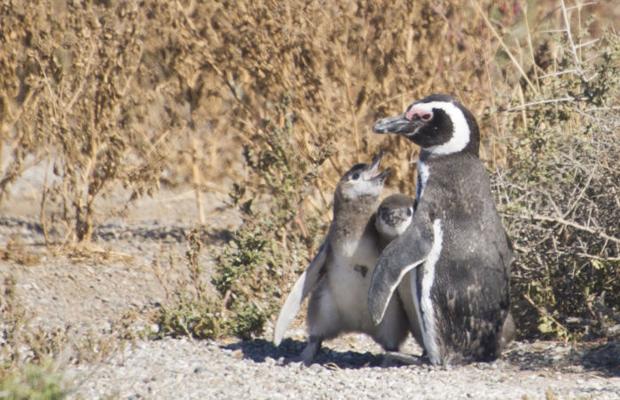
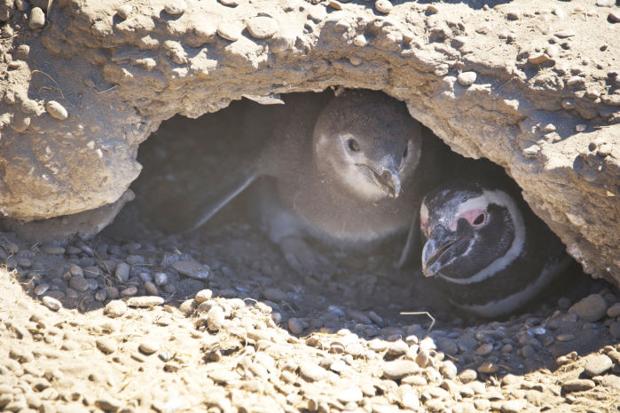
As far as my eye could see in the scrub brush, penguins stood guard over nests and the two chicks they housed. The nests were built under bushes or in burrows. By mid-January, the chicks had grown considerably but were still covered with gray fuzz.


The parents take turn at sea, for sometimes as long as two weeks, where each one fills its stomach with fish and squid. When it returns, the two chicks pester the parent nonstop for the rich food its stomach holds.

One of the current challenges for Magellanic penguins is the impact climatic change is having on food supplies. Researchers have discovered the penguins have to go farther to find food, and some apparently don’t make it back before the chicks and the other parent have starved to death.

One of the best moments with the penguins was watching a fat parent as it waddled up from the blue ocean across the tan sand with a full stomach. It stepped from one side to the other and looked like it was almost going to topple over. One penguin was so full, it just lay down on its stomach and rested for a couple of moments before jumping back up and continuing its march toward the nest.


Walking around as a guest of the penguins found me face-to-face within an arm’s reach of these smartly dressed birds. As I approached a penguin, it would cock its head back and forth out of curiosity. It was like it was trying to size up what kind of penguin I was. Eventually, it would close its eyes and go back to sleep.

I kept my close encounters brief, not wanting to add more stress to an already stressed parent. The penguins at San Lorenzo are habituated but are still wild, which allows for a personal and up-close encounter with one of nature’s adorable creatures. “I’ve never seen it but would like to, when in March and the time is right all the juveniles will enter the sea at the same time. Off they go, learning how to swim and survive,” Hume said. “Overnight the beach becomes empty until next August, when the cycle continues once again.”

I’d like to see that, too.


Friday, February 6, 2015

#Penguins of the Day (Catch-up Post)

Jumping Gentoos 

Jumping Gentoos by Peter Orr

Gentoo penguin dash 

Gentoo penguin dash by Peter Orr

Gentoo arriving on the beach at Grave Cove 

Gentoo arriving on the beach at Grave Cove by Peter Orr

Too cold, even for #penguins?

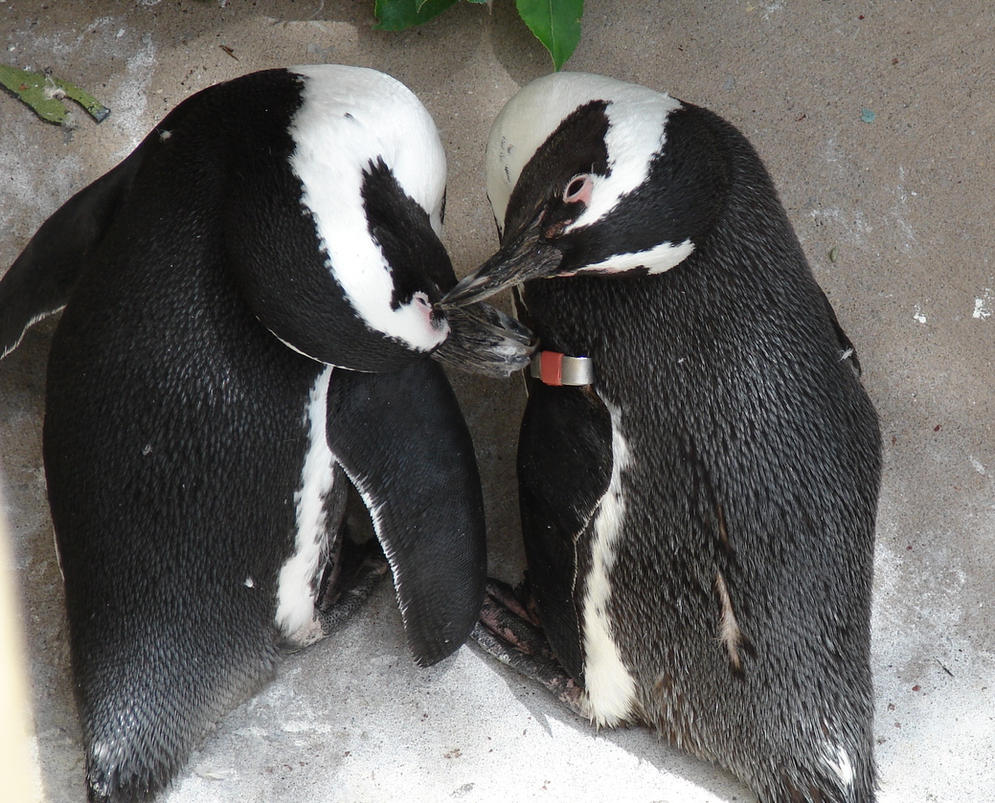
A senior biologist watches as a young African black-footed penguin meanders around a small playpen at the Adventure Aquarium in Camden. (ED HILLE / staff file photo)


It's so cold even penguins are heading inside.

At the Adventure Aquarium in Camden, officials are advising visitors that the penguins will be "off exhibit" Friday "due to today's extreme cold."

The temperature at Philadelphia International Airport has hovered in the mid-teens overnight and early this morning, with wind chills in the single digits.

The high today is expected to reach just 29 degrees, according to the National Weather Service. Winds of 8 to 16 mph are expected throughout the day.
And that's just too cold for the aquarium's African black-footed penguins. Visitors will have to go indoors to see them indoors.

The aquarium's website says the birds are one of 17 penguin species worldwide - and aren't a species accustomed to the cold. "They prefer more moderate climates," the aquarium says.

So, they're in luck for the weekend: The weather service is calling for a high temperature of 42 degrees Saturday and 47 degrees Sunday.

Saturday should be mostly sunny, and there's a slight chance of rain on Sunday, forecasters say. Rain and snow are likely to return Monday.

source

World's Oldest African #Penguin In Captivity Dies At Pueblo Zoo


Credit: Pueblo Zoo


After a long life filled with dips in the pool and TLC from zookeepers, Pueblo Zoo's beloved African Penguin Tess died Friday at the age of 40.

Tess smashed records for longevity during her four decades, and is the world record holder for longest-living African Penguin in captivity. She lived double the normal life span of 15-20 years.
Tess was very happy in her home at the Pueblo Zoo, a spokesperson with zoo says, who credits Tess' adjustment to the zoo's penguin colony and her "excellent care" as likely reasons she lived so long.

Tess was in good health throughout her life, and only recently was slowed by cancer. Even then, the zoo says she continued her role as ambassador for her species by going through advanced treatment at Colorado State University Veterinary School--contributing to the students' medical knowledge.

“She was truly a special animal," her primary keeper Melanie Pococke said in a statement Friday. “Though she was slowing down in her advanced age, she loved her early morning swims and being given a little special attention at feeding times.“

The zoo is waiting for test results to confirm cause of death.
Tess leaves behind her mate, Mongo.


source

King Penguin chick has gone from just a few inches tall and 0.5lb to more than two and a half feet

 From runt to supersized:
  • The tiny, grey chick was just six inches tall when it was born last September 
  • But within a few months it has transformed into a 2.5ft tall big ball of fluff  
  • The King Penguin is the first to be born in the UK for more than five years

This King Penguin chick- the first to be born in the UK in five years- has gone from a tiny six inch weakling to a staggering two and a half feet tall giant in a matter of months.

It was weak, wrinkly and grey, unable to even stand on its own two feet when it was born at Birdland Park and Gardens in Bourton on the Water, Gloucestershire, last September.

Now the big ball of fluff has rocketed from a puny half a pound to a whopping 1.5 stones in four months on a diet of liquidized herrings. 

But in the short months since its born, (pictured) the chick has shot up to a staggering two and a half feet tall complete with a thick layer of fluffy brown feathersBut in the short months since its born,  the chick has shot up to a staggering two and a half feet tall (lpictured) complete with a thick layer of fluffy brown feathers
In the few short months since it was born (left), the chick has shot up to a staggering two and a half feet tall

In the few short months since it was born (left), the chick has shot up to a staggering two and a half feet tall (right) complete with a thick layer of fluffy brown feathers

 Britain's only King Penguin chick has undergone a remarkable transformation in just four months - ballooning from half a pound to a whopping stone and a half
 Britain's only King Penguin chick has undergone a remarkable transformation in just four months - ballooning from half a pound to a whopping stone and a half

The baby penguin was being hand-reared by the park's expert keepers it has gone from strength to strength, transforming into a full-sized penguin.
And with another predicted big freeze just around the corner, chick looks more than prepared thanks to its thick new thick, downy brown coat. 

Eventually the feathers will be replaced by a slick coat that will allow the penguin to take to the water and join the others in its colony.
But until that happens it is content snuggling in with its huge winter coat on. 

 The rather ugly baby penguin was weak, wrinkly and grey, unable to even stand on its own two feet when it was born
The rather ugly baby penguin was weak, wrinkly and grey, unable to even stand on its own two feet when it was born

 Now the King Penguin looks much better prepared for the cold winter weather-  although it must still avoid the water until its adult plumage comes through
 Now the King Penguin looks much better prepared for the cold winter weather-  although it must still avoid the water until its adult plumage comes through

Simon Blackwell, the park's manager, said: 

'The transformation of our King penguin chick is incredible - just a few months ago it was tiny and wrinkly, and now it is a huge ball of fluff standing at two and half feet tall. Penguins have to put on a huge growth spurt in their first few months in order to have enough feather and fat to survive the freezing winters. They first develop a massive downy coat to keep them warm then as they get older the down is replaced by slick feathers. At first their new coat is grey but eventually they develop the colours we know them for.

The tiny King Penguin chick, the only one born in the UK in five years, measured just over 15cm long or  around six inches when it was born

'While the chick still has its downy coat it can't go in the water because otherwise it would be too heavy and it would drown. Once it develops its shiny coat it will be able to swim, which is the first big step to becoming an adult. The huge fluffy coat is the penguin equivalent of us wrapping up in a heavy tog duvet. While the rest of us have been shivering in the cold these past few weeks the King penguins have been loving it - it's more like home for them.'

King penguins - Aptenodytes patagonicus in Latin - are the second largest species of penguin, growing as tall as three feet and weighing up to 2.5 stones. They are distinguishable by their orange tinted breasts, cheeks and beaks.

In the wild they live off small fish and squid and are native to the islands of northern Antarctica. Edinburgh Zoo is famously home to Sir Nils Olav, a King penguin which in 1972 was appointed Colonel-in-Chief of the Norwegian Royal Guard.

ANTARCTICA'S KING PENGUIN

King Penguins are the second largest of the penguin species, growing to an average of just over three feet tall and weighing 33lbs. Like many penguins, fully grown but unfledged chicks can appear to be larger than the adult birds, thanks to their thick fluffy coats. As adults the flightless birds shed their fluff and develop the King Penguin's distinctive bright orange and black feathers around their necks and heads.

They live in huge colonies on the ice slopes of the sub-Antarctic islands, and there is an estimated world population of 2 million breeding pairs. The largest breed of all the penguins is the Emperor which stands 4 feet high and weighing up to 99lbs.


source

New penguins waddle into zoo

O&E Media  

As work continues on the $29.5-million Polk Penguin Conservation Center (PPCC), the Detroit Zoo welcomes some of its future residents – three gentoo penguins.

Female Philly and males Popeye and Simon – each just over a year old – are the first of their species to arrive at the Zoo, joining the flock of king, rockhopper and macaroni penguins at the Penguinarium. More gentoos will arrive in the coming months as completion of the PPCC nears.

The long-tailed gentoo penguin (Pygoscelis papua) is recognized by the white stripe extending across its head and its bright red-orange bill. The gentoo is the third-largest penguin, reaching a height of 30 inches and a weight of up to 20 pounds. It is also the fastest-diving bird, with paddle-shaped flippers that help it reach speeds of up to 22 miles an hour under water, according to a press release.

One of the most dramatic features of the penguins' new home will be a chilled 326,000-gallon, 25-foot-deep aquatic area with views above and below water as the birds dive and soar. This will allow visitors to observe penguins dive under water – something that is impossible to see in the wild.

"We have observed thousands of gentoo penguins in Antarctica as part of our research and development of the Polk Penguin Conservation Center's unique design. The aquatic habitat makes the facility an ideal environment for gentoos, which we know spend a lot of time in the water," said Scott Carter, Detroit Zoological Society chief life sciences officer, in the press release.

The Polk Penguin Conservation Center is under construction on a 2-acre site just inside the Zoo's entrance and is slated to open in early 2016. Once the penguins move to the PPCC, renovation will begin on the Penguinarium to turn it into a bat conservation center.

The Detroit Zoological Society, a nonprofit organization that operates the Detroit Zoo and Belle Isle Nature Zoo, is recognized as a leader in conservation, animal welfare and sustainability as well as providing sanctuary for animals in need of rescue.

With an annual regional economic impact reportedly of more than $100 million, the Detroit Zoo is one of Michigan's largest paid family attractions, hosting more than 1.3 million visitors annually. Its 125 acres of award-winning naturalistic habitats are home to more than 2,500 animals representing 280 species.

For hours, prices, directions and other information, call 248-541-5717 or visit www.detroitzoo.org

source

Elderly Phillip Island penguin 'Pauley' recovering well after having life-saving surgery


One of Phillip Island's oldest little penguins is recovering well from life-saving surgery after it was found underweight and distressed on a beach at Portsea. Fairy penguins on average live to be around seven years of age, but Pauley the fairy penguin has defied the odds to make the ripe old age of about 21.

Michelle Thomas from the Animalia shelter at Frankston said it was unusual for a penguin of his type to have survived so long in the wild. "He must just be a very, very smart penguin because he should by all means have been in the stomach of a shark or a seal by this time," she told ABC Gippsland. "It's quite remarkable to see a penguin get to that age."

Ms Thomas said she operated on the bird's damaged beak on Tuesday. "He was looking quite normal when he first came in and as soon as I opened his beak to give him his fluids, I realised what the problem was," she said. "That's when we discovered he had a massive great break in the beak."

Before the operation, the break was stopping him from fishing, Ms Thomas said. "He was in not too bad condition, the problem was that he hadn't been able to fish sufficiently with the beak the way he was and he had been losing weight," she said. "He came in at about 754 grams, and he should've been around about a kilogram. So he didn't have enough energy to be able to catch the fish, or to be able to swim fast enough to catch them."

Since the operation, Pauley has been quickly regaining his appetite.
He'll remember exactly what he's got to do when he gets out there and he'll be more than happy to see the back of us I'm sure.
Michelle Thomas, Animalia

"As soon as I got him back to the shelter he didn't want to have a bar of me, because I was the evil person that put him through the surgery," Ms Thomas said. "But my husband, who is the one who you can see his hand feeding him in the video, they have built quite a bond up together. Jon was able to give him two fish and some pain killers, then he had another four fish two hours after that, then last night he had another six fish. He's doing pretty well, we're pretty happy with that."

She said Pauley responded well to the operation and would be able to feed more effectively when he was returned to the wild. "All we need to do is make sure that he is waterproof and that he's swimming again," Ms Thomas said. "But because he's 21 years old, a couple of months in care for a bird like that is no big deal. He'll remember exactly what he's got to do when he gets out there and he'll be more than happy to see the back of us I'm sure."

source

Penguin birthdays galore at Caldwell Zoo

Published on Friday, 6 February 2015 - Written by By KENNETH DEAN
 Jeffrey watches over the nest of his girlfriend, Piper, at the Caldwell Zoo. (Staff photos by Kenneth Dean)

Standing guard over his girlfriend Piper’s nest, Jeffrey, the African Black-footed penguin, didn’t seem to be in the party mood Thursday morning. But on Saturday, he will celebrate his 12th birthday and will be the star of the show at Caldwell Zoo.
African Black-footed penguins are found in southern African waters. Like all existing penguin species, they are flightless, with a streamlined body and wings stiffened and flattened into flippers for a marine habitat. Adults weigh on average between five and eight pounds and are between 24 and 28 inches tall.
Whitney Paccione, a bird keeper at the zoo, said the species usually lives between 10 and 15 years in the wild, but in captivity they can live more than 25 years.
She said Jeffrey made his trip to Tyler from the Boston area in 2006 when the penguin exhibit was opened at Caldwell and has remained there ever since. “He is being a really good spouse as he is staying close to his girlfriend Piper, who is sitting on a nest,” she said.
Jeffrey did take a short swim while a Tyler reporter visited this morning, but returned to Piper’s side quickly.
“He will go for a few minutes and then come back,” Ms. Paccione said, “And then he will let her go take a bath.” Lauren Burch, a teacher at Caldwell Zoo, said the zoo often celebrates animals’ birthdays. She pointed to a Black rhino, which was able to eat some special birthday cake a week ago.
“We have the penguin this week, and then a river otter who will have a birthday next week,” she said.
Ms. Burch said on the animals’ birthdays, they are sometimes treated to specialties. Signage will inform the zoo visitors when it is a special day and how to identify the birthday boy or girl.
There will be more penguin birthdays this month, with Buttercup celebrating next week and Donut turning a year older in two weeks.
Caldwell Zoo is located on Martin Luther King Jr. Boulevard at West Gentry Parkway and is open 9 a.m. to 4 p.m. daily. Admission for adults 13-54 is $11.50; Seniors 55+ $9.50; Children 3-12 $8.00; Children 2 and under are free.

source

Penguin and puffin lovers, celebrate – exhibit reopening at St. Louis Zoo


February 05, 2015   • 
Zoo visitors who have been missing the penguins and puffins, mark March 5 on your calendar.
That's when the Penguin & Puffin Coast will reopen to the public at the St. Louis Zoo.

The exhibit closed in September 2013 for construction of McDonnell Polar Bear Point, which is next door to the penguin habitats.

Visitors have been able to see the Humboldt penguins in their outdoor habitat since October, but the indoor portion had stayed closed.

The zoo will celebrate the reopening with a parade of king and gentoo penguins leading the way at 10:30 a.m. on March 5.

And if you're wondering, the polar bear exhibit should open by the summer. “We know our visitors have missed the penguins and we’re happy to bring them back,” said Jeffrey P. Bonner, the zoo's president.

The Penguin & Puffin coast opened in 2003 and is home to about 100 oceanic birds.

Wednesday, February 4, 2015

Pauly the #penguin breaks his beak and visits the dentist (video)


7News Melbourne
An injured penguin has had a special visit to the dentist for a delicate operation to repair his broken beak.

Melina Sarris reports.