A determined effort brings seals, fish and penguins back to South Georgia Island, near Antarctica
When you tell people that you’re going to South Georgia, some will
ask if you’re changing planes in Atlanta. In fact, the name belongs to
an island near Antarctica. It’s about the size of Rhode Island but with
mountains rising to over 9,000 feet. It is a wilderness, uninhabited
except for two small scientific stations and teeming with spectacular
wildlife.
But don’t be fooled: The apparently pristine natural
beauty of South Georgia is new. Like an old master painting that was
badly damaged but has since been painstakingly restored, South Georgia
was once utterly desecrated and is now gloriously refurbished.
The
island was uninhabited when, on Jan. 17, 1775, HMS Resolution dropped
anchor in what is now called Possession Bay, and Captain Cook claimed it
on behalf of King George III. His men discharged their weapons “to the
utter amazement of the seals and the penguins,” wrote the naturalist
George Forster.
This Jan. 17, exactly 241 years later, as dusk was falling, the
fishery protection vessel Pharos SG, carrying Princess Anne—a direct
descendant of George III—entered Possession Bay flying the royal
standard, and I had the good fortune to be on board. It was snowing
gently, and the clouds hung low over the glaciers and black cliffs. Fur
seals and penguins were once again the only audience.
A century
ago, however, when the explorer Sir Ernest Shackleton and his five
companions landed here, after bringing a small boat through 800 miles of
stormy seas following the sinking of their ship Endurance, there were
no fur seals and few penguins to greet him. The reason Shackleton came
to South Georgia for help was precisely because it wasn’t wilderness but
was inhabited, indeed industrialized. He was heading for one of
island’s four small towns, in which lived nearly 2,000 people, mostly
Norwegians and Scots.
The people had come first for the fur seals (to make felt hats), but
they soon took elephant seals for their blubber and penguin eggs for
food. In the first half of the 20th century, it was the turn of the
whales, which were all but wiped out in the surrounding ocean by 1960.
Yet
today the island looks again much more like it was in Cook’s day than
in Shackleton’s. The total human population is about 25 in summer
(though some 8,000 tourists visit each summer on cruise ships and sleep
on board). There are now some four million fur seals. They are
everywhere, growling and moaning in crowds on the beaches, in the
tussock grass and in the ruins of the towns. Elephant seals snooze and
belch in heaps on every beach. King penguins abound: One colony has gone
from 350 pairs in 1912 to 60,000 pairs today. Even the whales are back:
Humpbacks and right whales were blowing regularly off the coast last
month.
The plunder of South Georgia’s seas has also been halted.
Fisheries regulation arrived with the declaration of a 200-mile limit
around the island in 1993. In exchange for a hefty fee a handful of
licensed vessels fish these waters for krill, ice fish and Patagonian
toothfish (known on menus as Chilean sea bass). Each boat has a beacon
transmitting an automatic identification system and carries an observer
on board. No boat may fish in water shallower than 700 meters or in
certain closed “boxes,” where the young toothfish live. Illegal fishing
has almost entirely ceased.
In the 1990s, the long lines of
baited hooks used to catch toothfish had begun catching albatrosses as
well. Soon the populations of black-browed, gray-headed and wandering
albatross were in free fall.
Today simple devices for preventing
albatrosses getting hooked have completely solved that problem locally.
The toothfish fishery has won
coveted accreditation as sustainable
from the Marine Stewardship Council. Far from boycotting “Chilean sea
bass” in restaurants, as some marine preservationists advocate, you
should go for it, so long as it comes with MSC certification.
Today,
the fishermen have a new problem: Orcas and sperm whales have learned
to steal their catch. Orcas bite the toothfish off the hooks as they are
retrieved. Sperm whales find the lines on the sea floor and strip them
of fish, apparently not bothered that this leaves hooks pierced into
their own skin. Devices that transmit deafening sounds to deter the
orcas proved counterproductive: The whales soon realized that the
unpleasant sound was a dinner bell.
Most remarkable of all, the
island is now free of rats. Between 2011 and 2015, the South Georgia
Heritage Trust raised and spent more than $10 million to buy helicopters
and spread poisoned bait over all the rat-infested parts of the island.
This was a unique logistical achievement on a large mountainous island,
accessible only by ship through the world’s stormiest seas. Even a few
years ago, many people thought it was a mad plan. But it worked, and
petrels and pipits can breed freely again here.
Like the rats, the reindeer that were introduced here a century ago
to provide food for the whalers have also been exterminated. The last
one was tracked down while I was on the island. This will allow the
native vegetation to recover, and scientists are now hard at work
spraying the invasive plants that humankind has introduced.
A
spectacular ecological restoration has occurred, a wilderness
replenished—on a scale probably unmatched anywhere else in the world.
Last month, as I sat at the dining table of Pat Lurcock (one of three
government officers for the whole island) at King Edward Point, eating
potted krill and watching the light fade on the glaciers, I surveyed a
wondrous scene: Stormy petrels flitted up the bay to feed their young,
fur seals porpoised through the water, king penguins cooled their feet
on the snow, and plump elephant seal pups snoozed on the steps of the
laboratory.
Of course, challenges remain for South Georgia’s
ecology. Rats or other pests may yet escape from ships that dock here
(one rat jumped ship last year, but it was soon spotted and dispatched).
So all cargo is minutely inspected and all visitors must wear clean,
preferably new, clothing and thoroughly clean out their backpacks.
Gentoo penguins have failed to breed at all this year, for lack of krill
nearby. This may or may not be a symptom of climate change, which is
responsible for the retreat of many of South Georgia’s glaciers since
the time of Cook and Shackleton.
But after centuries of foolish
plunder, pause to reflect what an astonishing transformation has been
achieved by wise management. We can now see what Captain Cook saw: an
ice-capped island looming over verdant bays teeming with wildlife. There
is a lesson here for the whole planet: With prosperity and technology
and determination, we can restore wilderness.
—The most
recent of Mr. Ridley’s many books is “The Evolution of Everything: How
New Ideas Emerge.” He is a member of the British House of Lords.
source


 (Long Island, NY) Long Island Aquarium is pleased to announce two animal exchanges within the Penguin Pavilion and Otter Falls exhibits.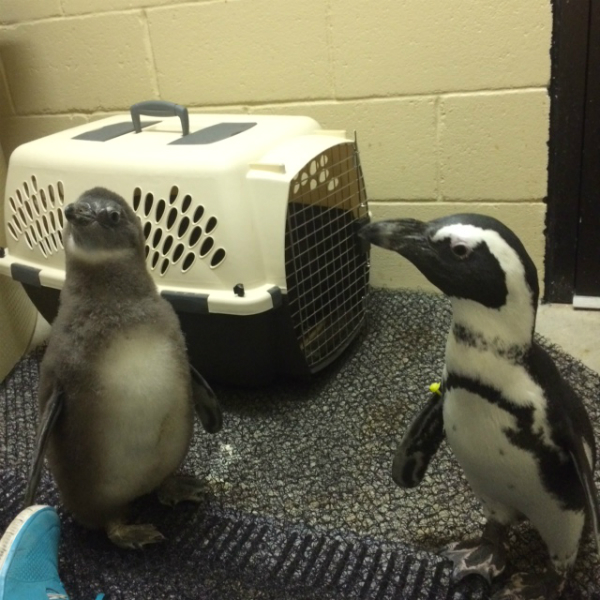


 Davis
Davis
 Casey
Casey
 McMurdo