Friday, April 17, 2009

Friday Videos!


Watch yellow eyed penguins in Educational  |  View More Free Videos Online at Veoh.com


Watch penguins pt 2 in Family  |  View More Free Videos Online at Veoh.com

Image of the Day


All fall down
Originally uploaded by Heaven`s Gate (John)
A chinstrap Penguin takes a fall on the pebble beach, Half Moon Island, Antarctica.
He then stood up and pretended nothing had happened !!

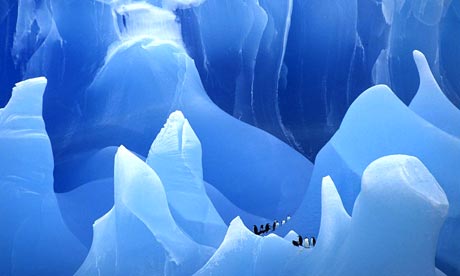
Plight of the penguins


Penguins on an iceberg in Antarctica. Photo: Corbis


Plight of the penguins


Already threatened by global warming, harvesting krill to supply omega-3 oil means danger for Antarctica's penguins

o Gerry Leape
o guardian.co.uk, Thursday 16 April 2009 19.30 BST

Fifty years ago, delegates from 12 nations - including the United States, Norway and Japan - gathered in Washington DC to discuss how to protect Antarctica, the only continent without a native human population. The result was a treaty system that ensures Antarctica will continue to be used exclusively for peaceful purposes and not become an object of international discord.

Yet as nations gather again to celebrate the Antarctic treaty system's 50th anniversary this spring, new scientific research indicates that many species of penguins, some of the Antarctic's most iconic residents, are in deep trouble.

While the plight of the polar bear may be better known, emperor penguins are also going to be hit hard by the effects of global warming. Made famous by the documentary March of the Penguins, these flightless birds use the Antarctic's sea ice as a breeding ground and base for feeding on krill, fish and squid. But projected changes in Antarctic sea ice due to global warming will dramatically change the environment for these penguins and countless other species.

Indeed, a 2008 study by a number of leading penguin experts warned that "50% of Emperor colonies ... and 75% of Adelie colonies ... that currently exist at latitudes north of 70 degrees S are in jeopardy of marked decline or disappearance, largely because of severe decreases in pack-ice coverage."

Making matters worse, these penguins increasingly must compete with man for their principal food: a small, yet invaluable shrimp-like animal known as Antarctic krill. Measuring only five to six centimetres in size, krill comprise the largest biomass in the Southern Ocean. These tiny creatures, rich in the omega-3 oils used in health supplements, are seen by some corporations as a potential source of big profits.

The Norwegian-based firm Aker Biomarine, one of the globe's leading krill fishing companies, recently applied to have its Antarctic krill fishery certified by the Marine Stewardship Council (MSC). The council attempts to provide market-based tools to promote sustainably caught fish. To accomplish this, the MSC works with fisheries, seafood companies, scientists, conservation groups and the public to promote the best "environmental choice" in seafood. Yet while the council's mission is important, certifying the krill fishery would stymie further efforts to more effectively conserve and manage Antarctic resources.

Certifying a fishery like Antarctic krill is far more complex than it may seem. Although overall catches appear relatively low as compared to total krill abundance, uncertainties exist about the local impact of fishing operations since they often overlap with the feeding areas of krill predators.

When it comes to krill and other forage species, MSC's standards fall far short of achieving its goal of sustainability. In certifying a fishery, the council considers the sustainability of fish stocks - seeking to minimize environmental impacts and maximize effective management. The problem is that it measures mortality rates as though the animals were in an aquarium without predators. In reality, krill are part of a living system where there are many pressures apart from fishing. Yet, the MSC's process to assess potential krill certification does not take adequate account of the role that krill serve in anchoring the Antarctic food chain.

Furthermore, according to a recently published study by the National Science Foundation's Long Term Ecological Research Programme, "Over the past 50 years, winter temperatures on the [Antarctic] Peninsula have risen five times faster than the global average." Krill are sensitive to warmer waters and thus less abundant there. Nonetheless, climate change and the complexity of ecosystem interactions are not adequately accounted for in the current management process.

Governments, acting jointly through administrative bodies of the Antarctic treaty system (such as the Commission for the Conservation of Antarctic Marine Living Resources) need to impose precautionary fishery management measures sufficient to ensure that enough krill are left to meet the needs of penguins and other predators. In the meantime, however, the MSC can do the right thing by agreeing not to certify the Antarctic krill fishery until the international community can enact proper protective measures.

As the world prepares to celebrate 50 years of cooperation on Antarctic research and resources management, we shouldn't stand idly by as the combination of careless fishing practices and unchecked global warming emissions speed the emperor penguins' march to extinction.

Story courtesy of The Guardian @
http://www.guardian.co.uk/commentisfree/cifamerica/2009/apr/16/antarctica-global-warming-penguins/print

Thursday, April 16, 2009

Time Photoessay on King Penguins

Ten very nice King Penguin pix and a much needed photoessay on the threat to these birds' existence: HERE

Image of the Day


Originally uploaded by pijus

Collective Nouns

Ever wondered what the correct nomenclature is for a group of penguins? Wonder no more... a few might even surprise you. :)

Ahay,
wiinterrr

Penguins, a colony of
Penguins, a creche of
Penguins, a formality of
Penguins, a huddle of
Penguins, an icing of
Penguins, a march of
Penguins, a muster of
Penguins, a parade of
Penguins, a parcel of
Penguins, a pride of
Penguins, a raft (in water) of
Penguins, a rookery of
Penguins, a shiver of
Penguins, a toboganning of
Penguins, a town of
Penguins, a waddle of
Penguins (King), a rookery of

Info via New Zealand Birds @
http://www.nzbirds.com/more/nounsp.html

Three new birds on the critical list


Three bird species have joined the likes of the kakapo, the black robin and the rowi kiwi on the list of critically endangered New Zealand birds.
NZbirds.com
CRITICALLY ENDANGERED: Top to bottom: the eastern rockhopper penguin, the grey duck, and the grey-headed mollymawk have been added to the list of critically endangered New Zealand birds.

Three new birds on the critical list

The conservation status of 428 birds was assessed by a panel of experts in a three-yearly review to identify those most in need of help.

Panel leader Dr Colin Miskelly of the Conservation Department said of the birds assessed 77 were considered "threatened" and 93 "at risk".

Dr Miskelly said all 21 birds assessed as nationally critical in 2005 remained in the most threatened category, along with three additional species that were quickly declining: the grey duck, the eastern rockhopper penguin and the grey-headed mollymawk.

However, he also said a number of birds had been put into a new 'recovering' category after responding well to conservation management.

"These included little spotted kiwi, Pycroft's petrel, brown teal, variable oystercatcher, and North and South Island saddlebacks," Dr Miskelly said.

"These birds all have populations greater than 1000 individuals and are increasing, and it is great to be able to recognise these success stories."

Dr Miskelly said, overall, 19 birds had improved their status, and 13 had declined.

Those that had declined were mainly seabirds, and birds that used riverbeds and rough farmland - generally killed by fisheries by-catch, changes in oceanic productivity near breeding islands, and changes in land-use.

- NZPA

Story and images via Stuff.CO.New Zealand@
http://www.stuff.co.nz/environment/2339615/Three-new-birds-on-the-critical-list/

The Secret Lives of Penguins

Here's a great pictorial on "The Secret Lives of Penguins" from Environmental Graffiti:

HERE

African Penguin Takes First Swim


(NECN: Brian Burnell, Mystic, Conn.) - A few months ago, Mystic Aquarium set up a penguin cam. Thousands of people went online to watch an African penguin chick get bigger, move off the nest and take its first steps. Today was a big day for those penguin watchers as the juvenile took its first swim.

Meet Blue-Blue, the youngest penguin in the African penguin exhibit at Mystic Aquarium in Mystic, Connecticut. At 78 days old, Blue-Blue is full grown and hard to tell apart from the older penguins.

"Only looks different by the color of its plumage. It has juvenile plumage which is all gray with a cream colored chest. And a little fuzzy I noticed. A little fuzzy. There's about maybe 30% of its chick down on its head and shoulders," says Laurie Macha of the Mystic Aquarium.

You may be asking why Blue-Blue is referred to as an "it" instead of a "him" or "her". That's because the only way to tell the gender of a young penguin is through a blood test which they haven't done here yet. Blue-Blue is one of the chicks featured in the aquarium's web cam set up right after he was hatched. For over 2 months thousands of people have been logging on to watch his progress. This was the biggest day of all for Blue-Blue. His first day testing the water. Surprisingly he was a little hesitant.

"Isn't that what penguins do? Go in the water? Yeah. We see that with all the chicks. They're very hesitant. They've never experienced a big body of water yet and usually afraid to get their feet wet for the first time but once they hit the water then its old hat to them. They just take to it."

And Blue-Blue certainly did to the delight of the crowd.

"He's learning how to maneuver. He's got to learn how to use his feet and wings to turn and spin and its accidental that he was doing barrel rolls and we tend to see that a lot. Some of them won't go under the water for a while but once he got under he was really trying to figure out how to use his wings and by tomorrow he'll probably have it mastered pretty well."

As much fun as it is to watch Blue-Blue take his or her first swim there's a serious future for this penguin. He or she is part of the breeding program here and the African penguin in the wild is in steep decline.

"Over the past 5 to 8 years there's been a fifty percent decrease in the population size. If it continues at this rate they can become extinct within our lifetime."

Experts think it might have something to do with climate change but research is underway now to pinpoint the cause.

Story and video courtesy of NECN@
http://www.necn.com/Boston/SciTech/2009/04/15/African-penguin-takes-his/1239829116.html

Wednesday, April 15, 2009

Image of the Day


December 1, 2006
Originally uploaded by superdisco
Yellow-eyed penguin

A census taker for Penguins in Argentina


A census taker for Penguins in Argentina
By Agency Reporter
Published: Tuesday, 14 Apr 2009

P. Dee Boersma, a University of Washington conservation biologist, is the Jane Goodall of penguins. As director of the Wildlife Conservation Society‘s Penguin Project, Boersma, 62, has spent the last quarter of a century studying the behaviors of some 40,000 Magellanic penguins, inhabitants of one stretch of beach in southern Argentina. We spoke at last month‘s American Association for the Advancement of Science meeting in Chicago and again later by telephone. An edited version of the interview follows.

How did the Penguin Project begin?

In the early 1980s, a Japanese company went to the Argentine government and said, ”We‘d like a concession to harvest your penguins and turn them into oil, protein and gloves.” There was a public outcry. This was during a military dictatorship when dissidents were being thrown into the ocean from airplanes. And yet people said, ”We object to having our penguins harvested.”

So the military regime did what any government facing a controversy might do -- they said, ”Let‘s have a study.” Not long after that, the Wildlife Conservation Society entered into an agreement with the Argentine Office of Tourism and the Province of Chubut to set up a research project at Punta Tombo where there was the world‘s largest colony of Magellanic penguins. Once that agreement was in place, it was the end of the concession idea.

I came to Punta Tombo in 1982 to determine how many penguins were actually there. I didn‘t think I‘d be doing a long-term study of them. But we didn‘t know how long wild penguins lived. With time, we discovered that penguins are quite long-lived, 30 years, more. So I‘ve ended up going to Argentina every year since 1982.

What does your research involve?

I‘m a kind of census taker of the 200,000 breeding pairs of penguins at Punta Tombo. I track who is at home, who gets to mate, where the penguins go for the meals, their health, their behaviors.

On a typical day, I‘ll get up before dawn. The penguins rise early, but they spend the morning calling to each other from their nests and socializing. Around 8 or 9, they head down to the beach. Once they‘re out, we check the nests, see who‘s stayed behind, weigh the babies, band them, and we put satellite tags on some birds so we can track them while they‘re swimming.

I‘m interested in where they go. Through the tagging we‘ve been able to show that in the last decade, the birds are swimming about 25 miles further in search of food. They‘re having trouble finding enough fish to eat. That costs a penguin energy and time while their mate is sitting on the egg, starving. So when they return to the nest to relieve their mate, they arrive in poorer body condition. And then, the mates also have to go farther to find food.

These penguins are now laying eggs on the average three days later in the season than they did a decade ago. That means that the chicks may leave for sea at more inopportune times, when fish may not be close to the colony. Many will not survive to come back and breed. The Punta Tombo colony has declined 22 per cent since 1987. That‘s a lot. This type of penguin is considered near-threatened. Of the 17 different penguin species, 12 are suffering rapid decreases in numbers.

Why is this decline occurring among the Magellanic penguins?

Changes in the availability and abundance of prey. And we think that‘s due to both climate change and exploitation of the penguins‘ food sources by commercial fisheries.

There‘s also oil pollution in the South Atlantic. There‘s dumping from ships. For a while in the 1980s, 80 per cent of the dead penguins found along the coast were covered in oil. In 1994, we were able to get the Chubut authorities to move the oil tanker lanes further from the coast. That‘s helped.

But as the birds take these longer migrations in search of food, they sometimes find themselves outside of Chubut‘s protected areas. Some of our tagged penguins have been located as far north as Brazil. When they‘re in the waters of northern Argentina, Uruguay and Brazil, where the laws against oil dumping are less enforced, they‘re encountering problems.

What are the policy implications of your research?

We‘re seeing that conservation areas that we‘ve set up to protect penguins are not going to work. If we‘re going to have penguins, I think we are going to have to do ocean zoning and try to manage people.

I also think that our information about the penguins‘ migratory patterns means we must try to anticipate the next place they might move to. Right now they are on public land in Punta Tombo, but as the birds look for new food sources, they might end up colonizing beaches that are privately owned. What then?

The big thing is that penguins are showing us that climate change has already happened. The birds are trying to adapt. But evolution is not fast enough to allow them to do that, over the long term.

The 2005 documentary film ”The March of the Penguins” was a remarkable international success. Do you understand why?

Because people can identify with penguins. These birds are curious. They walk upright. They dress well. They‘re highly social. They know their neighbors. They mate. And some of them even get divorced.

How can you know that?

When we do our census, we find individuals with mates other than those they had the year before -- and they are living within meters of the old mates. That‘s more likely to happen, by the way, if the couple has failed at raising a chick; they‘ll move to another mate.

And yet, we find other pairs with great fidelity. We have one pair that stayed together for 16 years. What‘s really interesting is that if the penguins keep the same mate, they raise more chicks. Fidelity gives them greater evolutionary success.


Story courtesy of The Punch @
http://www.punchng.com/Articl.aspx?theartic=Art20090414461523
Image via Flickr

Tuesday, April 14, 2009

Penguins in peril


Fading fast: This lovely scene of penguins preening on the beach at Simons Town, South Africa, may soon disappear as the penguin population plummets.


Blot on the landscape: A seagull walks past with a penguin egg in its mouth.


Tuesday April 14, 2009
Penguins in peril
By CLARE NULLIS

Threatened by over-fishing, sea pollution and theft of their eggs, South African penguins face an uncertain future.

NESTING in the sparkling sand, preening on the rocks and darting through the waters, the penguins on the southern tip of Africa are the ultimate crowd-pleaser. But crisis looms.

Short of food, exposed to predators and the African sun, their numbers are plummeting. But salvation may rest in a simple manmade solution – housing for penguins.

Dotting the shore Boulders Beach, a penguin colony near the Cape of Good Hope, are 200 nesting boxes, each big enough to house a happy family of parents, eggs and chicks. The experiment has already worked well on a more distant penguin island in South African waters, and wildlife rangers are eagerly watching to see whether the boxes recently installed on Boulders Beach, where tourists can watch the birds up close, will prove equally attractive.

“You look at the penguins and think they have a lovely time in sunny South Africa, but it’s a struggle,” says Monique Ruthenberg, a ranger with the Table Mountain National Park in Cape Town, where summer temperatures recently hit 40°C.

Park authorities installed the boxes – made of a fibreglass mix, shaped like a burrow and dug into the sand to mimic the real nests – at Boulders Beach as part of desperate efforts to protect the dwindling populations of African penguins.

It has been a losing struggle. Numbers of the cute, curious creatures have plummeted from around three million in the 1930s to just 120,000 because of over-fishing and pollution. Some experts fear the species will die out in as little as a decade, and are particularly alarmed at the prospect of global warming increasing the number of scorching days, raising water temperatures and altering fish migration patterns.

The Boulders Beach colony has fallen 30% from a peak of 3,900 birds in 2005 to 2,600 and some of the island colonies have suffered calamitous declines of 50%.

The African penguin, also called the jackass because of its bray, is the only one to inhabit the African continent. It has shorter feathers than the Antarctic birds because it doesn’t face such cold and is just 5cm tall.

The Boulders Colony began in 1985 when a couple of penguins moved from a nearby island onto the beach in the naval base of Simon’s Town, decided they liked it and stayed. So many followed that authorities had to build fences to prevent them invading people’s gardens. But the tourists poured in.

About 600,000 a year now visit Boulders Beach. The real life Happy Feet are unfazed by all the attention and, apart from a few who were killed while snoozing under visitors’ cars, don’t seem to have suffered from their contact with humans.

There is a constant risk from pollution. The last big oil spill was in 2000, when 20,000 penguins were trucked about 756km from Cape Town to Port Elizabeth to allow workers time to clean up oil from a wrecked tanker while the birds swam home.

But even in years with no big accidents, the South African Foundation for the Conservation of Coastal Birds has to rescue and rehabilitate hundreds of birds whose feathers are covered in oil illegally dumped at sea and washed ashore.

The population fall continues, especially on the more remote Dyer Island where numbers have plummeted from 23,000 breeding pairs in the early 1970s to just 1,500 pairs. Penguins normally mate for life.

“It’s horrible,” Wilfred Chivell, chairman of the Dyer Island Conservation Trust, who blames bad fishing management for a dwindling supply of sardines and pilchards, the penguins’ main food. Such is the competition for fish that Ruthenberg says young seals attack penguins to rip the fish from their bellies.

Gulls prey on the eggs and young chicks. Eggs lie abandoned in the sand because the parents have taken to the water to escape the heat.

So volunteers calling themselves the iKapa Honorary Rangers asked the public to sponsor nesting boxes for US$20 (RM72) each. They initially planned 100 boxes but this was doubled thanks to a US$2,000 (RM7,200) donation from the Species Survival Plan – a co-operation program linking members of the Association of Zoos and Aquariums in the United States.

The nesting boxes are meant to give the penguins an edge – shelter from the heat and a better defence against egg-stealing gulls – and the 1,000 boxes on the more remote Dyer Island have proven popular, with 80% occupancy.

Now, Ruthenberg hopes the Boulders Beach penguins that have lost eggs and chicks will learn the lesson and take to the newly installed boxes in time to lay a second batch before the laying season ends in April. – AP

Story and images courtesy of The Star @
http://thestar.com.my/lifestyle/story.asp?file=/2009/4/14/lifefocus/3590700&sec=lifefocus