Thursday, June 19, 2014

Dr. Boersma introduces Ryan the Penguin

Introducing Ryan the Penguin


Ryan carried a GPS logger just like the bird pictured above. 

Ryan is an adult male Magellanic penguin that breeds in the largest Magellanic penguin colony in the world at Punta Tombo, Argentina with about 200,000 other breeding pairs of penguin. To thank our supporters and donors at Experiment, we’ve named Ryan after a Dr. Pepper-loving, UK-hailing engineer at Experiment. We thank you and all those who supported our penguin conservation campaign in 2012 to purchase a tracking tag. With your funding, we were able to put a GPS satellite tag on Ryan during the 2012 and 2013 breeding seasons and track his whereabouts while foraging at sea. We got to see how far he swam, how deep he dove, and how long he was away from his hungry chicks. Below is a bit more info about our feisty, flippered friend.

Ryan was banded as an adult, and has lived in the same bush nest for at least the last two years. He has the same mate as last year and they have been a very successful pair, rearing two chicks in 2012-2013 and another two in 2013-2014. By tracking him at sea over the last two breeding seasons, we learned that like other successful parents, he foraged within about 100 km of his nest on most of his trips. His trips were shorter when his chicks were small; some as close as fifty or sixty kilometers offshore. They got progressively longer with his longest recorded trip reaching about 160 kilometers from the colony at the end of December.

This past season, we saw Ryan and his mate together when we first checked his nest on October 7th, 2013. Ryan’s mate laid two eggs by the 19th of October and took the first incubation stint. Ryan relieved her in early November and by late November, when their first egg started to hatch, they were trading off incubation duties regularly. The first chick hatched on the 24th of November. The second hatched on the 27th of November. Both chicks grew rapidly. The first chick was three days older and had a pretty big head start on growth. On December 10th, the #1 chick weighed 1.02 kilograms and the #2 chick weighed 0.515 kilograms, but they were both being fed consistently. We gave Ryan a GPS logger because the chicks both looked so healthy and he weighed 4.3kg. On December 24th, we saw Ryan at home feeding his chicks a big meal of hake. We checked his nest every ten days during the breeding season and saw Ryan, his mate, or just his two chicks each time. Ryan had his GPS logger removed on January 5th and weighed the same as when we put the tag on, 4.3 kg. He maintained his weight while swimming 100’s of kilometers and feeding two growing chicks. The #1 chick weighed 3.5 kg at its last measurement and fledged on the 12 of February. The #2 chick weighed 3 kg at its last measurement and fledged on the 19th of February. Ryan looked healthy when we saw him for the final time this season on the 22nd of February. We can’t wait to see what he does next year.

Your support and funding allow us to follow the details of these penguins’ lives, just like we do with our own good friends. Thank you so much for your support. To learn more about penguins and our work and see pictures and maps from other penguins that have carried tracking tags, visit www.penguinstudies.org and sign up for the penguin update. Our research and the penguins continue to benefit from your support and interest. 

Tiny penguins are predicting the results of World Cup matches

One of the breakout stars of the 2010 World Cup was Paul the octopus, an “animal oracle” that rose to fame by correctly predicting the results of all eight Germany matches as well as the winner of the final. Sadly, Paul passed away later in 2010. His shoes will obviously be tough to fill for this tournament (and not just because there are eight of them).

Enter: Penguins. This penguin is named Don Juan, and he is one of Germany’s “penguin World Cup oracles.”

(Patrick Pleul/EPA)
(Patrick Pleul/EPA)

At an event at the Spreewald Spa in Germany, Don Juan predicted a German win over Ghana this coming Saturday by nudging the Germany ball first with his beak.
Curiously, all of Don Juan’s penguin friends also appear to have picked Germany. Something seems fishy here…

(Patrick Pleul/AFP/Getty Images)

No, literally, maybe they stuffed the German ball with fish?
(Patrick Pleul/AFP/Getty Images)

Meanwhile, over in Tokyo, a 2-year-old penguin named Aochan made a prediction on the opening Japan vs. Ivory Coast match by spinning a wheel with her beak. The wheel predicted a Japan draw, but the Ivory Coast went on to win that match, 2-1.

(REUTERS/Issei Kato)

(AP Photo/Eugene Hoshiko) 


(AP Photo/Eugene Hoshiko)

And just for kicks, here are even more penguins (!) on parade in miniature Japanese national team uniforms:

(AFP PHOTO / Jiji Press)

The verdict is still out on the accuracy of penguins as World Cup oracles. Thankfully, any lack of psychic ability is made up tenfold by cuteness.

The Antarctica national team has no chance of making the World Cup. (via Giphy)
 

Llanbradach knitting group help save crook Aussie penguins

Thursday June 19th, 2014
By Gareth Hill
A CARING NATTER: Members of Llanbradach Knit and Natter
A CARING NATTER: Members of Llanbradach’s Knit and Natter group
Poorly Penguins in Australia have been given a cwtch the way only the Welsh can, thanks to a Llanbradach knitting group. The sick penguins are being kept warm by jumpers knitted by a Knit and Natter group, who meet in Llanbradach Library – and they are saving the birds’ lives. An emergency appeal by the Phillip Island Penguin Foundation, based in Victoria, Australia, called for special penguin pullovers to be knitted for birds affected by oil spills and leaks from fishing boats.

GOOD ON YA MATE: A crook Penguin in its Welsh jumper
GOOD ON YA MATE: A crook penguin in its Welsh jumper
Knit and Natter member Emma Boone saw the appeal and spoke to the group who went knitting crazy for the little creatures. The knitted jumpers are placed on oiled penguins to keep them warm and prevent them from preening and swallowing toxic oil. They are kept on the penguins until they are strong enough to be cleaned.

Emma Boone said: “I look forward to coming along each week, we love to chat to each other about what we’ve been making and show off our latest creations. “It was great to be able to use our hobby to help the Philip Island Penguin Foundation.” The Knit an Natter group have a collective knitting experience of over 500 years so they soon had enough warm, colourful jumpers to send Down Under.

No more jumpers are needed thanks to groups like the Llanbradach one, but the Phillips Island Penguin Foundation said people can help with their adopt a penguin scheme – more information at www.penguinfoundation.org.au

The Knit and Natter women also knit for causes such as Help the Aged and Velindre Hospital and meet weekly.

source

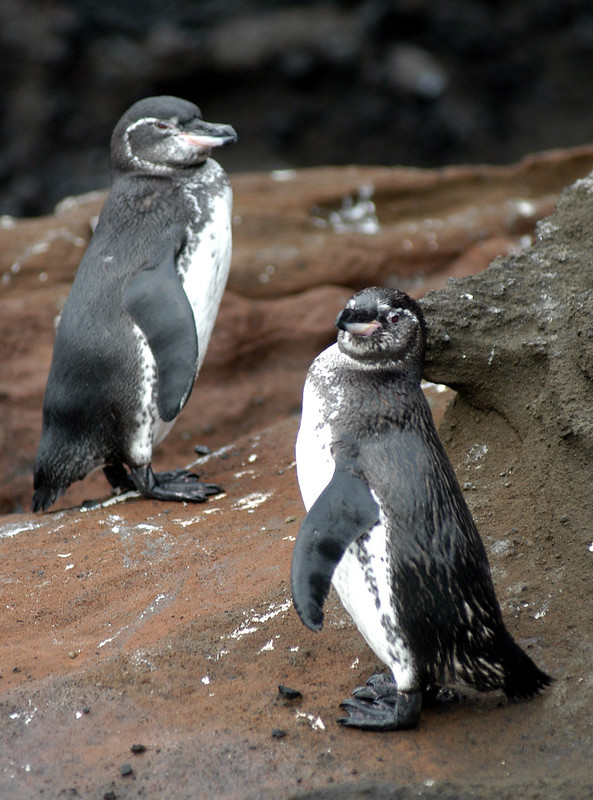
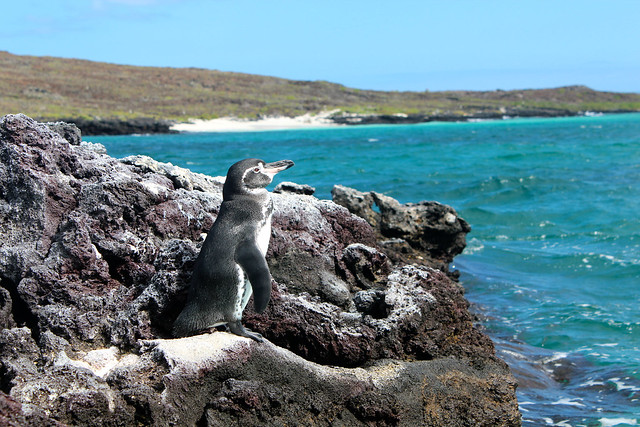
Penguin of the Day


The Galapagos penguin (Spheniscus mendiculus)

Santa Cruz - Dragon Hill

The Seneca Park Zoo answers your penguin questions


If you spend enough time at the Zoo this summer, you’re likely to get a chance to see our animal care staff feeding our colony of African black-footed penguins. If you stick around until the end of the feeding, you’ll have the opportunity to ask the keeper a few questions about our penguins. Click here to watch a cool time lapse of our penguin feeding.In the meantime, lets take a look at some of the more popular questions asked:

Photo by Kelli O'BrienQ: Do they all have names and can you really identify each penguin?

A: Yes, they do all have names and can easily be identified using a number of visual cues, the most obvious being a colored wing band. Each band not only identifies the bird by name but also its sex and genetic family. A band located on the bird’s right wing identifies it as a female while a band on the left wing tells you it is a male. When unbanned, which they are during their molt, keepers can identify penguins by their spot patterns, body size and unique behaviors learned from observing them day after day.

Q: What are you writing on the clipboard?

A: Believe it or not, we make every effort to track what each penguin eats, on a daily basis. As with most animals, a change in feeding habits is the first sign of a health issue. With penguins in particular, an increase in appetite can also be a sign that the bird is about to molt – an annual occurrence where the penguin will drop and replace all its feathers.

Q: How much do the penguins eat?

A: Since we’re talking about nearly 40 penguins, that’s a tricky question. Each bird will have slightly different feeding preferences. Some prefer lake smelt, a small freshwater fish while others may prefer capelin, a slightly larger saltwater smelt. These feeding habits also change during the year, especially when approaching a molt. In the days leading up to a molt, a penguin’s daily intake could easily triple as they prepare for time out of the water while they shed their old feather and replace them with new feathers.

While some of our penguins have been recorded eating over 70 fish in one day, statistical analysis of our feed records show that, on average, each bird consumes roughly 16 per day. That equates to roughly one pound of fish per bird per day. Last year, our penguin colony consumed over 230,000 fish, weighing over seven tons and were dispensed over 14,000 vitamins. Not bad for a bird that seldom weighs over 7 pounds!

- Kevin Blakely, zoo keeper

Little blue takes a bath

ANDREA O'NEIL
Last updated  18/06/2014


It had the whole sea to swim in, but one little blue penguin decided it rather fancied a bath. The penguin was found stuck in an outdoor bath in Eastbourne, Lower Hutt, yesterday morning.

Holiday cottage manager Lynne Plimmer got a call from her tenants saying the penguin needed rescuing after spending the night at her seaside property. "Honestly, I couldn't believe it. I thought, 'I'm hearing things'," Plimmer said. "Maybe it thought it was the sea or something and jumped in in the dark."

In her 12 years living in Eastbourne, Plimmer had seen only half a dozen of the shy penguins, the smallest of their species. "They tend to go under houses and rocks," she said. "To see one in a bath is quite extraordinary." It took five people to pick up the penguin with the aid of a towel, and it was then taken to the beach in a recycling bin, Plimmer said. The penguin happily swam away, looking back just once.

Holidaying couple Linda and Graham Cresswell, from Birmingham in England, rang a vet, the SPCA and a Department of Conservation ranger when they found the penguin at their cottage. They did not at first realise how special an encounter with a little blue penguin was, Linda Cresswell said. "Being from the UK, we just thought, 'Hello, who's that in the bath?' " she said.

Homeowners should generally leave little blue penguins alone if they visited a property, Eastbourne forest ranger Ray Smith said. "They come onshore because they want to rest a bit. They don't want to be interfered with," he said.  If it was necessary to move a penguin that was stuck or in the line of traffic, Smith advised wearing gloves because the penguins' beaks were sharp and strong.

The breeding season, when penguins most commonly came to shore, began in October, he said.

source

Despite the heat, penguins at the KC Zoo are staying cool


June 17, 2014, by Judy Le and Kasey Babbitt

KANSAS CITY, Mo. — Heat and humidity are not fun for us mere mortals, but if you’re a penguin at the Kansas City Zoo, it’s not so hard keeping cool.

45 degrees is the temperature penguins like. And to keep it that way, it has to snow. Their place at the Kansas City Zoo is their Antarctica and it comes equipped with snow. For the penguins, it’s their home away from home. “Sometimes they’ll play a game; it’s like king of the hill basically. There’s a big mound of snow so they’ll climb to the top and try to knock their buddies off the top as they get to the top. It’s really fun to watch,” said Tim Steinmetz, an animal curator at the Kansas City Zoo.

The penguin exhibit is one of the most popular at the zoo and is barely a year old. It’s something everyone can appreciate. “I’m here to see the penguins most of all,” said zoo visitor Marge Kalousek.
“We spent an hour and a half here last time, and then we went outside for five minutes and came back in and then she’s ready to go,” said Sarah Levy, another visitor.

Two-year-old Haley Levy pulled her mom away from FOX 4’s interview to get a better look at her favorite birds. There are more than 60 to watch. “We love watching them swim and play. They interact and go up to the glass with us. They come up and try to chase your finger like you’re trying to eat them,” said the Levy’s.

There are three different types of penguins and to keep them all happy, the water and air is kept at 45 degrees. Two machines constantly spit out snow into mounds. “Right now we can probably produce a couple of tons of snow if we ran full capacity all the time,” said Steinmetz.

15 new penguins were recently introduced to the Kansas City version of Antarctica. They can often be seen enjoying each other’s company and the company they bring.

This exhibit has gotten so big five additional zoo keepers were hired to take care of all the penguins.

source

Aquarium of the Pacific welcomes new penguin chicks to Long Beach

New penguin chick born at the Aquarium of the Pacific, Long Beach. (Photo credit: Robin Riggs)
LONG BEACH >> The Aquarium of the Pacific welcomed two new residents over the last few weeks — a pair of penguin chicks being cared for by their parents in nest burrows inside the Keyes Penguin Habitat.

Parents Patsy and Noodles gave birth to a chick a week ago, and penguin parents Kate and Avery birthed a chick 2½ half weeks ago. The new chicks can be seen by the public when they leave their nests and join the other birds, likely at the end of the summer, officials said Tuesday.

Magellanic Penguins are a temperate species native to the coasts of Argentina and Chile in South America, according to the aquarium. It takes between 38 and 43 days of incubation before a Magellanic Penguin egg will hatch.

The chicks hatch with their eyes closed, and they are able to open their eyes about a week later. Magellanic Penguin parents take turns incubating the eggs on the nest and feeding and raising the chicks after they hatch. The chicks fledge, or replace their downy newborn feathers with water-tight sub-adult feathers, after about 90 days.

The aquarium’s penguin chicks are expected to fledge in late August or early September and join the other penguins in the viewable parts of the exhibit. It is also around that time that caretakers will know if they are male or female.

In the meantime, the public can help support the penguins at the nonprofit Aquarium of the Pacific through the Adopt an Animal program. Adoptions start at $25 and include various benefits such as a photo of your adopted animal, adoption certificate and invitations to special events, and more.

— Staff report
source

Excited Sydney penguin on morning walk (video)

 
7
Mr Munro, a happy little resident at Sydney's Taronga Zoo has become an online sensation after footage of his 'Happy Feet' routine went viral.

Tuesday, June 17, 2014

Syracuse zoo's baby penguin named 'Filomena'

By Michelle Breidenbach
June 17, 2014


A primary penguin keeper holds the newest Humboldt chick during a press conference at the Rosamond Gifford Zoo in Syracuse on Tuesday, June 3, 2014. The conference was held to introduce the chick, which is the 39th hatched at the zoo. (Kate Collins | syracuse.com)


The newest Humboldt penguin chick checks out the surroundings as primary penguin keeper Deb Tobin, left, and Onondaga County Executive Joanie Mahoney look on during a press conference to introduce the female chick at the Rosamond Gifford Zoo on Tuesday, June 3, 2014, in Syracuse. The chick, which hatched April 16th, is the 39th to hatch at the zoo. (Kate Collins | syracuse.com)


SYRACUSE, N.Y. - The new penguin chick at the Rosamond Gifford Zoo will be called Filomena, the zoo announced Tuesday.

The zoo held a contest to name the chick and narrowed the list down to five for online voting. The other names were Dahlia, Francesca, Graciela and Solana.

Filomena rose to the top with 27 percent of the 1,107 total, said Onondaga County Executive Joanie Mahoney.

Sue Engel, of Dryden, submitted the name. It means "greatly loved" in Spanish.

The zoo staff likes to choose Latin-American names to reflect the heritage of Humboldt penguins, which are named for a cold nutrient-rich current that flows along the western coast of South America.
The penguin hatched April 16.

source

 (Kate Collins | syracuse.com)

(Kate Collins | syracuse.com)

 (Kate Collins | syracuse.com)

(Kate Collins | syracuse.com)

 (Kate Collins | syracuse.com)
(Kate Collins | syracuse.com)

TN Aquarium Cute Penguin News of the Day

Tuesday, June 17, 2014

Security Camera Catches Penguin Thief

Nipper, a male Gentoo penguin, is noted by Aquarium experts as Penguins' Rock's most enthusiastic nest builder. Sometimes, even before the nesting rocks are placed on exhibit each nesting season, he will begin "building" with ice cubes from feeding buckets.

Nipper with this year's nest
So Nipper wasted no time getting to work when this year's rocks were delivered by our penguin caretakers. While his neighbor Hercules (a male Gentoo) was distracted by interactions with Shamrock (a female Gentoo), Nipper was nabbing nesting rocks as his mate Flower watched his back.
Egg update: Since this was filmed, Nipper and Flower have laid an egg. The current total egg count stands at 6.* With more potential penguin parents still pairing up and building nests, the season is still off to great start!


*Keep in mind, each penguin egg has a long journey ahead of it. Lots of factors can impact the chances of hatching and newborn chicks face even more challenges. Again, keep your flippers crossed for a new group of healthy chicks later this summer!
 

Detroit Zoo to 'break the ice' on new penguin center

Published On: Jun 16 2014
Polk Family penguin center
ROYAL OAK, Mich. - 
  The Detroit Zoo will ceremoniously “break the ice” Tuesday on its $29.5 million, 33,000-square-foot Polk Penguin Conservation Center.

The groundbreaking event, which is scheduled for 6 p.m., will mark the beginning of an 18-month construction period for the largest project the Zoo has ever undertaken. The PPCC will be built on a 2-acre site just inside the Zoo's entrance and is scheduled to open in late 2015. The facility will feature 4-D effects such as arctic blasts, rough waves and snow, and include other elements like ice crevasses.
Penguin underwater gallery

It was designed by Jones & Jones, architects of Disney’s Animal Kingdom as well as the Detroit Zoo’s Arctic Ring of Life and National Amphibian Conservation Center, and by Albert Kahn Associates, architects of the Zoo’s Ruth Roby Glancy Animal Health Complex.

 source