Tuesday, August 18, 2015

Humboldt penguins’ arrival at Byculla zoo delayed


Laxman Singh, Hindustan Times, Mumbai
Updated: Aug 18, 2015 

Six South American Humboldt penguins, expected to be brought to Byculla zoo in September, will arrive next year.


If you had been waiting to see the Humboldt penguins at Byculla zoo, you will have to wait till next year. The Brihanmumbai Municipal Corporation (BMC) has not been able to appoint an agency for their upkeep.

Dr Sanjay Tripathi, Byculla zoo director (in charge), said the tenders had not got a single response. “This has delayed getting the penguins here.”

The BMC is in the process of floating fresh tenders to appoint an agency.

Last year, Byculla zoo authority planned to bring six penguins under the ongoing Rs150-crore renovation project.

The penguins were to be brought in March but as the enclosure work was not completed, September was set as the new deadline. The BMC has purchased six penguins (three males and three females) worth Rs2.57 crore from a Thailand firm. An addition of Rs.6.50 crore will be spent on the maintenance of penguins for five years. The BMC has already paid the token amount to the penguin supplier.

Initially, the zoo authorities had clubbed the purchase and maintenance contract. “As we didn’t get any response, we have separated the tenders for maintenance and purchase,” said Tripathi.
The plan is to have an aquarium on premises of the penguins’ enclosure.

A senior civic official said: “The penguins’ diet and maintenance will be a tedious job. Moreover, the aquarium’s maintenance too will need expert hands. This was another reason no contractor had come forward to bid.”

The revamp work is expected to be completed before December 2016.

The Humboldt penguin is a South American species found in cold climate of coastal Peru and Chile. The medium-size penguins grow 50 cms to 70 cms long. The enclosure in the zoo has been designed as per the climatic conditions where they are found.

ZOO MAKEOVER

* Six South American Humboldt penguins, expected to be brought to Byculla zoo in September, will arrive next year.
* The appointment of an agency for maintenance and supply of special diet of penguins has been delayed as there has been no bidders.
* The BMC will float a fresh tender for the penguins’ maintenance as well as upkeep of an aquarium.
* Byculla zoo is undergoing a Rs 150-crore revamp which is expected to be complete next year.
* The revamp plan has included more animals such as tiger, Asiatic lion, exotic fish and zebra in the zoo. The BMC will build 24 enclosures and the animals will be bought in a year’s time.

source

Baby Penguin Dives Into Life at the Aquarium

The chick, born on June 5, is native to the coasts of Argentina and Chile.


By Sophia Kunthara

A new baby penguin chick makes its debut at the Aquarium of the Pacific in Long Beach Tuesday 
Published Tuesday, Aug. 18, 2015
Southern California's newest feathered friend made its debut Tuesday morning at the Aquarium of the Pacific in Long Beach.

Lily, a Magellanic Penguin chick, was born at the aquarium on June 5 and joined the other penguins in the June Keyes Penguin Habitat after spending about two months in a nursery.

"She was a little reluctant to go swimming, but in the end she did and she seems to be enjoying herself," said Adrian Samora, a media relations coordinator at the aquarium.

Magellanic Penguins, which are native to the coasts of Argentina and Chile, are not born with plumage suitable for water, so they are removed from their nests after 25 days and taken to a nursery until their watertight feathers come in. While they are in the nursery, they learn to swim and eat hand-fed fish, aquarium representatives said.

Lily, who represents the third generation of Aquarium-born penguins, is the seventh penguin to be born at the aquarium since 2013 and the 20th penguin to join the exhibit. Samora said she is slightly large for a baby and is eating whole fish.

Community members can support the new chick through the Adopt an Animal program.

#Penguin of the Day

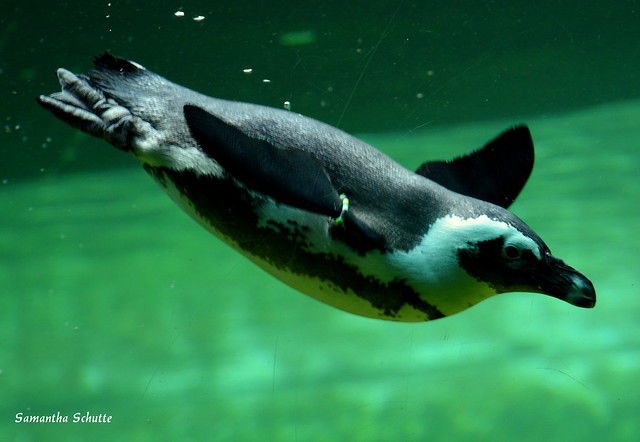
African penguin, Artis 

African penguin, Artis by samantha schutte

Monday, August 17, 2015

#Penguin chick to make debut at Aquarium of the Pacific


This yet to be named penguin hatched at the Aquarium of the Pacific on June 5. It will make its public debut Aug. 18. Photo courtesy Aquarium of the Pacific.
The baby penguin has been in a nursery for weeks. On Aug. 18 it will join its family and colony in the public exhibit. Photo courtesy Aquarium of the Pacific.

Penguin Chick Debut

When: 9 a.m. Aug. 18.
Where: Aquarium of the Pacific, 100 Aquarium Way, Long Beach.
Tickets: $14.95-$28.95.
Information: 562-590-3100, www.aquariumofpacific.org.

This is going to be a big week for one rambunctious little penguin at the Aquarium of the Pacific in Long Beach. The recently hatched chick has spent weeks in a nursery where it has been growing its watertight juvenile feathers, learned to swim, eat fish and is beginning to give its stuffed “momma” penguin trouble.

Now it will waddle out into the public eye for the first time and join its real parents, siblings and other members of the colony in the penguin habitat Aug. 18. “She’s a real personable bird, so I don’t think she’ll have a problem,” said Sara Mandel, one of the penguin keepers at the Aquarium.

The penguin will enter its permanent home in the June Keyes Penguin Habitat at 8 a.m. and the public will be able to see it explore its new environment and get to know the 19 other birds when the Aquarium opens at 9 a.m. It’s sure to be a big day for the entire colony since the other penguins will likely be curious about the new kid.

The chick will meet longtime residents like Henry, known as “the wise elder,” the oldest in the group who leads the pack during feeding time. The chick could get a lesson in the pecking order too when it meets others like Shim, the biggest penguin in the group; Patsy, the shy one, and Ludwig, who may be trouble since he’s known as the rowdiest penguin around.  “Usually when we add a new chick they think they’re really cool and the adults that are out there are like ‘no, no, no, this is my exhibit,’” Mandel said. “She’s going to have to figure out a certain path going in and out of the pool. The adults might be a little aggressive to her and that’s where I have to let them work it out, but I still have to be there.”

The Magellanic penguin chick hatched June 5 with a down layer of plumage that isn’t watertight. For its safety, the chick was removed from the nest after 25 days and taken to a nursery and fed by Aquarium personnel. The sex of the chick has yet to be determined and it’ll be named once handlers figure out if it’s a boy or girl, however, Mandel thinks the chick is a girl since it reminds her so much of the penguin’s older sister.

The chick represents the third generation of penguins born at the Aquarium. Four other penguins — Paddles, Jayde, Mattson and Skipper — hatched in 2014 and two others — Heidi and Anderson — hatched in 2013. The chick’s parents, Roxy and Floyd, will be there, too.

By all indications, the little penguin is ready to leave the nursery since it’s already rebelling against its surrogate mom. Mandel said the chick used to snuggle with the stuffed penguin in the nursery, but now she likes to slap it and beat it around all over the pen. “She’s becoming more and more independent,” said Mandel, who admits that right now she feels like an anxious mom as the bird she’s helped raise prepares to waddle out on her own.

 source

#Penguin of the Day

IMG_9385 

King Penguin on the beach by Anne Dirkse

Friday, August 14, 2015

#Penguins of the Day

Gentoo Penguins 

Gentoo Penguins by Sandro Menzel

The Amazing Work Being Done to Protect Galapagos Penguins

August 14, 2015  
Commentary and photos by Dr. Godfrey Merlen

The Galapagos Marine Reserve, which protects all species within its boundaries, contains a variety of wildlife the nature of which is unparalleled worldwide. Among these species is the Galapagos penguin, a curiosity, as it lives in tropical waters and is the most northerly of all penguin species.
I have been involved in a study that began five years ago as a project to create additional Galapagos penguin nest sites in order to help boost breeding success in years of food shortage. This project has been extended to include a study of the ecological setting of this unique, endangered, and charming creature.

Lending a Hand to Endangered Penguins

Helping to Protect the Only Population of Warm Weather Penguins on the Planet

The species population has been declared endangered for it’s extremely limited range and data that indicates a weak reproductive response following strong Niño seasons, which appear to cause a high mortality rate in adults.

Have the new nests attracted tenants? During the last few years, the answer is yes!

In July 2015, nest holes dug in the volcanic scoria of the largest of the Mariela Islets in the headwaters of Elizabeth Bay, have been inhabited with penguins producing eggs and young. These nest sites have even been used in preference to natural ones.

Helping to Protect the Only Population of Warm Weather Penguins on the Planet

Ecologically we have found that this location receives “pulses” of cold water from mineral-rich upwellings. Within a day of the arrival of cold water the bay can be alive with Sierra mackerel, shearwaters, brown pelicans, blue-footed boobies, Bryde’s whales, and this year, the presence of a humpback whale and calf, and a male orca.

Helping to Protect the Only Population of Warm Weather Penguins on the Planet

Penguins may survive due to these cold-water pulses, especially if they occur in times of food shortage. 2015 is considered to be a strong Niño season but so far the penguins are molting or have molted and are courting, selecting nest sites, and raising young.

Yet the weather in the Enchanted Islands is becoming difficult to predict.

Every Little Bit Counts

Locally, mankind cannot control global warming that may bring added threats to the Galapagos penguin, but we must ensure that the Marine Reserve remains as a protected area. It is imperative that all species that live in or pass through this zone, and which may have large or small influences on this unique ecological region, receive the refuge status they deserve – for they are all vitally needed for the survival of the oceanic and coastal fauna and flora of the Galapagos Islands.

source

Thursday, August 13, 2015

Four orphaned penguin chicks released

2015-08-13
SANCCOB released the four orphaned African penguin chicks admitted to its centre in Cape St. Francis after a mystery oil spill hit Algoa Bay.

THE Southern African Foundation for the Conservation of Coastal Birds (SANCCOB) released the four orphaned African penguin chicks admitted to its centre in Cape St. Francis after a mystery oil spill hit Algoa Bay, Port Elizabeth during the third week of May.

After undergoing 13 weeks of rehabilitation at SANCCOB, these chicks have now reached fledging age, are in good health and have gained the natural waterproofing of their brand new, blue-grey feathers, which is needed for them to survive in the wild. “It is a bittersweet celebration, releasing these penguins back into the wild after seeing them grow into healthy juvenile penguins. But we are proud of all the staff and volunteers involved in the rescue operation and helping us to achieve a 100% release rate for all the birds admitted to SANCCOB during the spill,” says Juanita Raath, rehabilitation coordinator.

The Marine Rangers at SANParks, the penguins’ original rescuers, transported and released these chicks back into their St. Croix- and Bird Island colonies over the weekend.

Thirty oiled African penguins and the four penguin chicks were admitted from Bird and St. Croix islands, after being rescued by rangers from the Marine Section of the Addo Elephant National Park (SANParks). The adult oiled penguins were all released back into the wild by July 11, after being successfully rehabilitated and approved for release by SANCCOB’s veterinary team.

While all of the penguins affected by the oil spill have been released back into the wild, the source of the oil spill still remains uncertain.

To assist SANCCOB financially, visit their website at www.sanccob.co.za or make an electronic funds transfer to SANCCOB, First National Bank, account number 59 23 713 5859, branch number 203809, swift code FIRNZAJJ461, reference initials, surname and oil.

For more information, contact SANCCOB Eastern Cape at 042 298 0160/ 082 890 0207 or send an e-mail to louanne@sanccob.co.za

source 

#Penguins of the Day

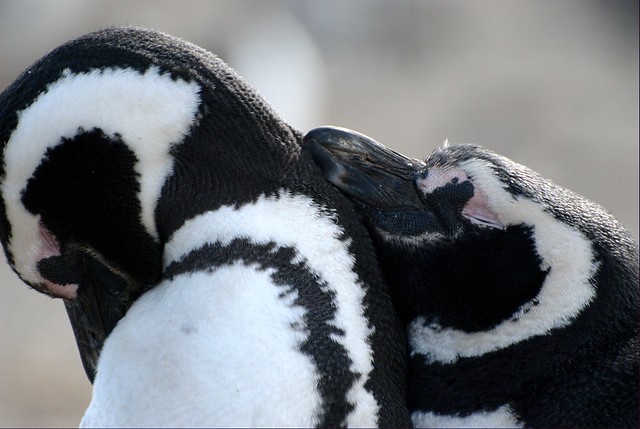
Penguins loving I / Pinguinos cariñosos I 

Penguins loving by Luis Alejandro Bernal Romero