Sunday, October 11, 2015

“Puddles” and “Splash” finally make the Albuquerque Balloon Fiesta


“Puddles” and “Splash” finally made it to the Albuquerque Balloon Fiesta, with not a minute to spare. The two penguin special shape balloons and “Pirate Ship,” one of the largest hot-air balloons in the world, disappeared more than a week ago.

As the fiesta got underway, the balloons’ pilots frantically searched for them, but nary a penguin squawk nor pirate’s “Arrrr” could be heard. British pilot and owner Andrew Holly said Friday night that the balloons were shipped from Bristol, England, in August.“We checked on their progress, and the shipping company gave us confirmation that they were delivered Sept. 24 to Balloon Fiesta Park,” he said.

Holly and the other pilots, Andy Collett and Lee Hooper, arrived on the Friday before the fiesta started, only to discover that the balloons were nowhere to be found. To make matters worse, they were not getting much response from the shipping company, which Holly declined to name. “We were pretty angry. It was the perfect weekend, and we lost a lot of publicity and good flying,” he said of the first weekend. “We were hoping maybe they were in a warehouse in Albuquerque.”

On Monday, Holly and his crew spent the day trying to trace the location of the balloons. “Finally, the shipping company responded and said they had been in New York and were in transit to Albuquerque and would be here Tuesday.” Meanwhile, Holly and crew had a little lighthearted fun by recording and posting a video modeled after a missing child appeal. “This is a direct appeal to the good people of Albuquerque to help us find our missing penguins … . We are particularly concerned for their safety as the Exclusive Ballooning Pirate Ship was also seen in the vicinity making its way to Albuquerque. … Puddles, Splash, if you can hear us, we are not angry with you and you are not in trouble; we just miss you and want you to come to Balloon Fiesta Park here in Albuquerque.”

Finally, on Wednesday, the shipping company told Holly that the balloons were in Los Angeles.
“At that point, I got British lawyers involved, and suddenly the shipping company was helpful and they had the balloons overnighted to Albuquerque.”
Not quite the happy ending. “A lot of things were damaged,” particularly the envelope of the Pirate Ship, “which looks like a forklift went through the travel bag,” said Holly. Still Puddles, Splash and Pirate Ship were able to inflate for the Friday morning Special Shapes Rodeo and the Friday night Special Shapes Glowdeo after temporary repairs were made.

Which just goes to show, you can’t keep a good penguin down, even in the face of pirates.


source

#Penguins of the Day

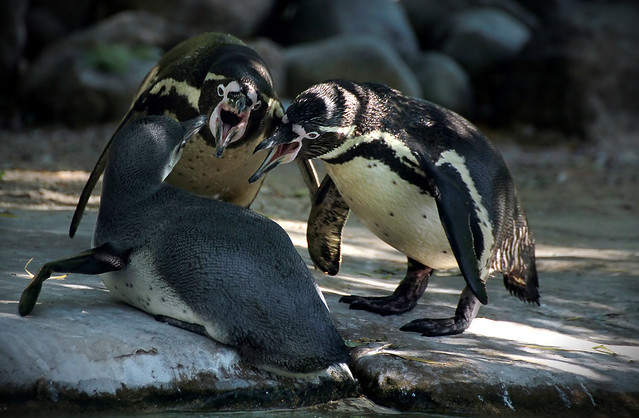
Banishment 

Banishment by Sonja V.

This Week's Pencognito!


Please be sure to visit Jen and all the Pengies by clicking this link!

Saturday, October 10, 2015

Sydney Aquarium welcomes first Little Penguin chick for 2015

Say Hello To Our Penguin Chick!


SEA LIFE Sydney Aquarium is today celebrating an extra pair of happy feet in its South Coast Shipwreck exhibit, with the highly anticipated arrival of the first Little Penguin chick for the 2015 breeding season.

Yet to be named, the adorable Little Penguin chick was welcomed into the world on 27 August to proud parents Pinksta (Mum)and Mr Black (Dad). Currently weighing just over one kilogram, the fluffy youngster is rapidly growing up from the palm-sized hatchling it was merely six weeks ago.

Kristen Witcomb, Marine Biologist at SEA LIFE Sydney Aquarium, said it's an exciting time in the attraction's South Coast Shipwreck exhibit, and remarked: "We're absolutely thrilled to welcome our newest Little Penguin chick to the underwater family here at SEA LIFE Sydney Aquarium! The youngster is progressing very well, quickly gaining weight and reaching all its developmental milestones."

"The safe arrival this Little Penguin chick marks another successful breeding season here at SEA LIFE Sydney Aquarium, which is a true testament to the excellent husbandry skills of our Marine Biologists and the capabilities of our breeding program," Witcomb continued.

Currently residing in SEA LIFE Sydney Aquarium's back-of-house penguin nursery, the attraction's newest arrival will continue to thrive and grow and gradually shed its juvenile fluffy feathers. During this time, Marine Biologists will also teach the chick to be hand-fed.
penguin chick header
"Training our Little Penguin chicks at a young age is extremely important as we need to conduct daily roll calls and regular health checks. Luckily, our newest chick is feeding really well and even loves a good chest scratch," said Witcomb.

"Over the coming weeks, the chick will learn how to swim in our back-of-house nursery and study the ways of the colony from Mum and Dad. Once big and strong enough, the youngster will join the rest of the adult penguin population in our South Coast Shipwreck exhibit," continued Witcomb.

While relatively common in the southern waters of Australia, an endangered population of Little Penguins reside in Manly, which is the only mainland breeding colony of penguins left anywhere in NSW.

SEA LIFE Sydney Aquarium's Little Penguin breeding program plays a crucial role in ensuring the future of this iconic Australian species. The attraction's newest arrival not only provides a unique insight into the social structure and interworking of a penguin colony, but also provides valuable knowledge about their natural history.

Visitors to SEA LIFE Sydney Aquarium can join the 'Adopt an Animal' program to help save Little Penguins from extinction. An initiative led by the SEA LIFE Trust, donations will be used to fund projects which help protect and restore the population of Australia's threatened species and their habitats.

Pioneering the strong ethical and environmental values BREED, RESCUE and PROTECT in all areas of operation, SEA LIFE attractions are a globally recognised, respected and influential voice in marine conversation.

Currently home to an incredible 13,000 animals, SEA LIFE Sydney Aquarium has the world's largest variety of sharks and rays. From the freshwater rivers of the south to the tropical waters of the north, a trip to SEA LIFE Sydney Aquarium takes you around Australia's coastline, out into its oceans and up into its waterways - all without leaving the city!


source

Minnesota's penguins included in an "ultimate guide"

By Jim Williams

Minnesota has one species of penguin, the Black-footed Penguin. They’re in our zoos (Minnesota, Como), of course, but this species perhaps could survive in wild Minnesota. 

Except for our winter. That might sound strange, but of the world’s 18 penguin species only seven live along the Antarctic shoreline (none are found in the northern hemisphere). The others live no closer than 750 miles from that icy coast. Some enjoy locations almost tropical.

The Black-footed or African penguin lives in south Africa. It has one of the smallest populations of all penguins, about 25,000 pairs

The Minnesota Zoo on its web page says, “African Penguins, like most other penguin species, are endangered in the wild. Oil spills, historical hunting, and destruction of their habitat have killed 80 percent of the population in the last 50 years. 

“Right now, the greatest source of their troubles comes from a catastrophic drop in the number of sardines as a result of overfishing and changing ocean climate.”

The situation for the Yellow-eyed Penguin is worse, with fewer than 2,000 breeding pairs, in decline. The Galapagos Penguin also is in trouble. In 2009, when the most recent census for this species was taken, only 1,042 individuals were found. 

Penguins, as is the case for so many bird species, often find themselves incompatible with the world as humans have remade it.

Five species are listed as endangered, including those mentioned above. Six are listed as vulnerable, four as near-threatened, and three as species of least concern. The latter includes two of the penguin icons — King, Chin-strap. Both live in the cold places.

Six penguin species number over one million individuals.

This all is contained in a beautiful book — “Penguins: the Ultimate Guide,” by Tui De Roy, Mark Jones, and Julie Cornthwaite, published in the U.S. by Princeton University Press.

The book, large enough and with the requisite excellent photos (more than 400), could be considered a coffee-table book. It also is authoritative. Page through to tour the photos and you will be stopping to read about what you see. These are fascinating birds.

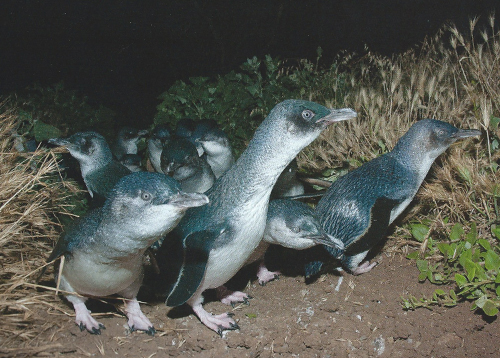
Consider the Little Blue Penguin, resident of Australia and New Zealand. No larger than a crow, it’s nocturnal, nesting in burrows. Hardly your movie penguin. Troubled by non-native predators, Little Blues in New Zealand have human friends who restore native vegetation, kill predators, and even provide nest boxes.

The book presents status, distribution, habitats, and habits of the 18 species, all mapped to location. The penguins nesting on icy Antarctica are well-known for their survival ability. The stories the other species could tell are as interesting, if not as cold.

This is a bird family well-known in one regard — ice and snow — and pretty much unknown in another — the variety of species. This book covers very well the entire family. It would make an excellent holiday gift.

Penguins: The Ultimate Guide, 240 pages, profusely illustrated with photos by the authors, detailed information on each species, index, and a guide to penguin locations, $35.

(Photo, Little Blue Penguins, by the authors, scanned from the book)


source

#Penguins of thr Day

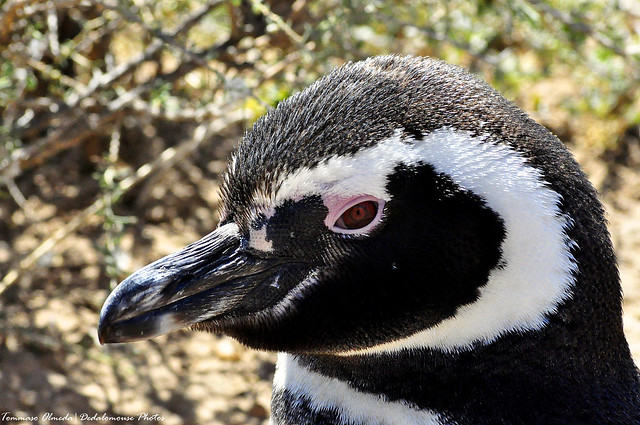
Pupilla - Pupil - Pupila 

Magellanic Penguin by T

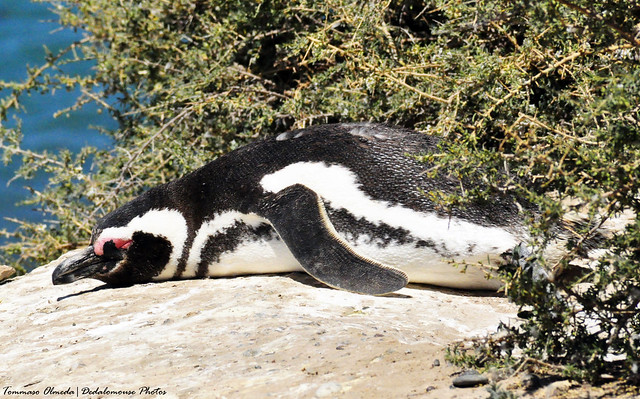
Siesta 

Siesta by T

Friday, October 9, 2015

Celebrating the 'year of the penguin' in Japan

Humboldt penguins walk in the Omoriyama Zoo in Akita, Akita Prefecture, in June. (Asahi Shimbun file photo)
October 09, 2015

There are all sorts of landmark years. This year marks the 100th anniversary of the arrival of the first penguin to be kept in Japan.

“Penguin Arrives” was the headline of an Asahi Shimbun article in June 1915 about the arrival of a Humboldt penguin at the Ueno Zoological Gardens in Tokyo. But the subhead stated bluntly, “It is expected to die soon.”

Sure enough, the paper’s headline proclaimed nine days later, “Penguin Dead.” According to the article, the keepers had done everything in vain to care for the bird, giving it plenty of ice and lots of fresh fish. Native to Chile, Humboldt penguins normally tolerate heat well. But this particular bird had been transported over a long distance, which probably stressed it out. Also, the keepers were not experienced in handling a penguin.

A century has since passed, and Japan today is said to be the world’s No. 1 penguin keeper. As of 2012, there were about 3,600 penguins of 11 species at zoos around the nation, where they are noted crowd-pleasers.

In the wild, however, some species are declining in population. Among them is the Humboldt, which accounts for the largest number among species kept in Japan.

Another species that has undergone drastic depopulation is the African penguin, which inhabits the southwestern coast of Africa. And should global warming increase, the population of the statuesque Emperor penguin in Antarctica, standing more than 1 meter tall, is expected to shrink.

These exotic birds in “tail coats” were made known to the Japanese people by the Japanese antarctic expedition of 1910-1912, led by army Lt. Nobu Shirase. Photographs of penguins taken on the expedition survive today, and one team member was said to have penned this haiku: “It is so frigid, penguins dance on ice floes.”

Shirase referred to penguins as “extremely comical creatures” in his log. He probably did not know about their aquatic prowess. Emperor penguins have been recorded diving more than 600 meters--a feat no human could ever emulate.

This weekend, it may be a good idea to go and see these lovable creatures and show them our respect.

--The Asahi Shimbun, Oct. 9

source

Cape Town increases penguin protection measures


Johan van der Merwe |
Dogs are to blame for attacks on endangered birds, city says

City increases penguin protection measures in Simon’s Town

Following the recent discovery of another 22 African penguins killed just north of Seaforth Beach near Simon’s Town, the City of Cape Town will be increasing its penguin protection measures in the area between Seaforth Beach and Franks Bay.

Since the beginning of the year, 42 endangered African penguins have been killed as a result of 10 dog-related incidents.

Based on the observed incident patterns, field observations and the necropsy reports from the Southern African Foundation for the Conservation of Coastal Birds (SANCCOB)veterinarian, it has been deduced that the most likely predator is one or more dogs.

‘This is a substantial loss to the penguin breeding population in Simon’s Town. The situation cannot be allowed to continue.

‘The City is continually trying to find an appropriate balance between protecting the African penguin, while at the same time not over-regulating human recreation in the area. We therefore again urge members of the public to work with us. We need active participation and responsibility from every person who uses the area.

‘The African penguin is our shared heritage and its survival in an urban environment requires a joint effort.

‘To curb further penguin incidents, two additional full-time penguin monitors will be employed to boost the capacity of the four monitors who are already working in the area. The funding for these additional monitors has been generously provided by Shark Explorers and the Simon’s Town Boat Company. We thank them and laud them for their commitment and support of marine wildlife. They are leading by example in showing that the survival of the African penguin is a shared responsibility,’ said the City’s Mayoral Committee Member for Energy, Environmental and Spatial Planning,

Councillor Johan van der Merwe.

The penguin monitors will patrol the area from sunrise to sunset on a full-time basis from 1 November 2015  to 31 January 2016.

As of 10 October 2015:
- Burghers’ Walk will be reopened to dogs but leashes are mandatory. The City placed a temporary ban on dogs along this walkway on 21 August 2015. Ongoing non-compliance with this requirement will result in the permanent closure of Burghers’ Walk to all dogs. It is therefore imperative that members of the public take responsibility to ensure compliance with these regulations at all times. Recent nest counts of breeding penguins indicate that of the 982 nests counted, 109 nests are located just along Burghers’ Walk and the areas immediately south of Burghers’ Walk
- Windmill Beach (the sand area only) remains a free-running beach for dogs. However, the onus is on dog owners to ensure that their dogs are under control at all times and that they do not approach or harass penguins. Repeated non-compliance in this regard will result in a recommendation to the Subcouncil to remove Windmill Beach as a free-running dog area. Dog-walkers are to keep their dogs on a leash when arriving to and departing from Windmill Beach. Dog-walkers who are unable to maintain control of their dogs with voice/whistle commands are advised to keep their dogs on a leash at all times
- Camera traps will be installed in the entire area to monitor attacks on penguins (this would include all natural predations and domestic animal attacks)

Penguin monitors deployed to the area have been mandated to ensure that penguins are not harassed, interfered with, or impacted on by recreational users. They will be supported by City Law Enforcement in this regard and members of the public and visitors are advised to heed their requests and instructions.

The African penguin is currently listed as endangered by the International Union for Conservation of Nature and Natural Resources, with a steady decline in numbers over the past decade. The overall population of this species is estimated to be a mere 2,5% of its population level some eight decades ago.

The Department of Environmental Affairs published the Biodiversity Management Plan for the African penguin in October 2013 (Government Gazette No. 36966), in terms of Section 43 (Species Management Plans) of the National Environmental Management Biodiversity Act (Act 10 of 2004).
The City therefore has an obligation to put measures in place to protect penguins on City property, especially during the breeding and nesting seasons.

City Law Enforcement will be enforcing the Animal By-law. Members of the public who observe unaccompanied dogs in the Burghers’ Walk area are urged to report this to City Law Enforcement on 021 596 1999.

Issued by Councillor Johan van der Merwe, Mayoral Committee Member for Energy, Environmental and Spatial Planning, City of Cape Town, 9 October 2015

source

Wednesday, October 7, 2015

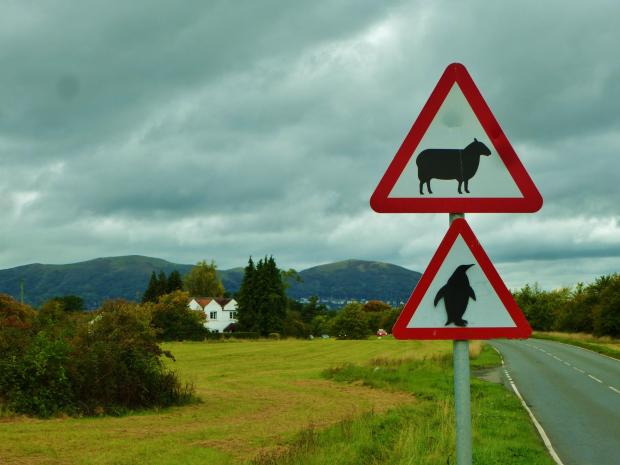
Beware of the #penguins? Probably not.

The mysteriously-altered sign on the Guarlford Road.
The penguin is indigenous to the southern hemisphere and are unlikely to be roaming wild in the Malvern area; the nearest penguins are likely to be found at the National Sea Life Centre in Birmingham and the West Midlands Safari Park in Bewdley.
A spokesman for Worcestershire County Council, which is in charge of highways, says that the sign will be restored to its former condition.

source

#Penguin of the Day

Penguin Portrait 

Penguin Portrait by Sonja V.

Waddle this way at SA festival

2015-10-06 


Celebrate the African penguin at the annual Penguin Festival on Saturday 17 October.


PHOTO: 
Wilna Wilkinson/ SANCCOB
Celebrate the African penguin at the annual Penguin Festival on Saturday 17 October. PHOTO: Wilna Wilkinson/ SANCCOB

Join the Southern African Foundation for the Conservation of Coastal Birds (Sanccob) and Sanparks for the annual Penguin Festival at Boulder’s Beach on Saturday 17 October.

The date marks African Penguin Awareness Day, dedicated to raising worldwide awareness about the plight of the endangered African penguin – the only penguin endemic to the African continent. Less than 2% of the African penguin population remains in the wild today.

Sanccob, Sanparks and their partners in conservation are at the forefront of saving this charismatic penguin species. All proceeds from the festival are donated to Sanccob in support of its African penguin conservation work.

As is customary every year, the Penguin festival is officially opened with a beach release of African penguins, as they waddle their way back into the wild at Seaforth Beach at 10:00.
Parking may be found at the Seaforth Beach parking area. Be sure to arrive early to find the perfect viewpoint on the beach.

After the release, you can stroll along the Boulders Beach boardwalk to the parking area in front of the Boulders Beach Lodge and Restaurant for the festival activities.

Fun attractions on the day include an interactive Lego build display, children’s games, face-painting, a treasure hunt, jumping castle, live animal talks and food stalls.

Entry to the festival is free and it runs until 14:00.

source